

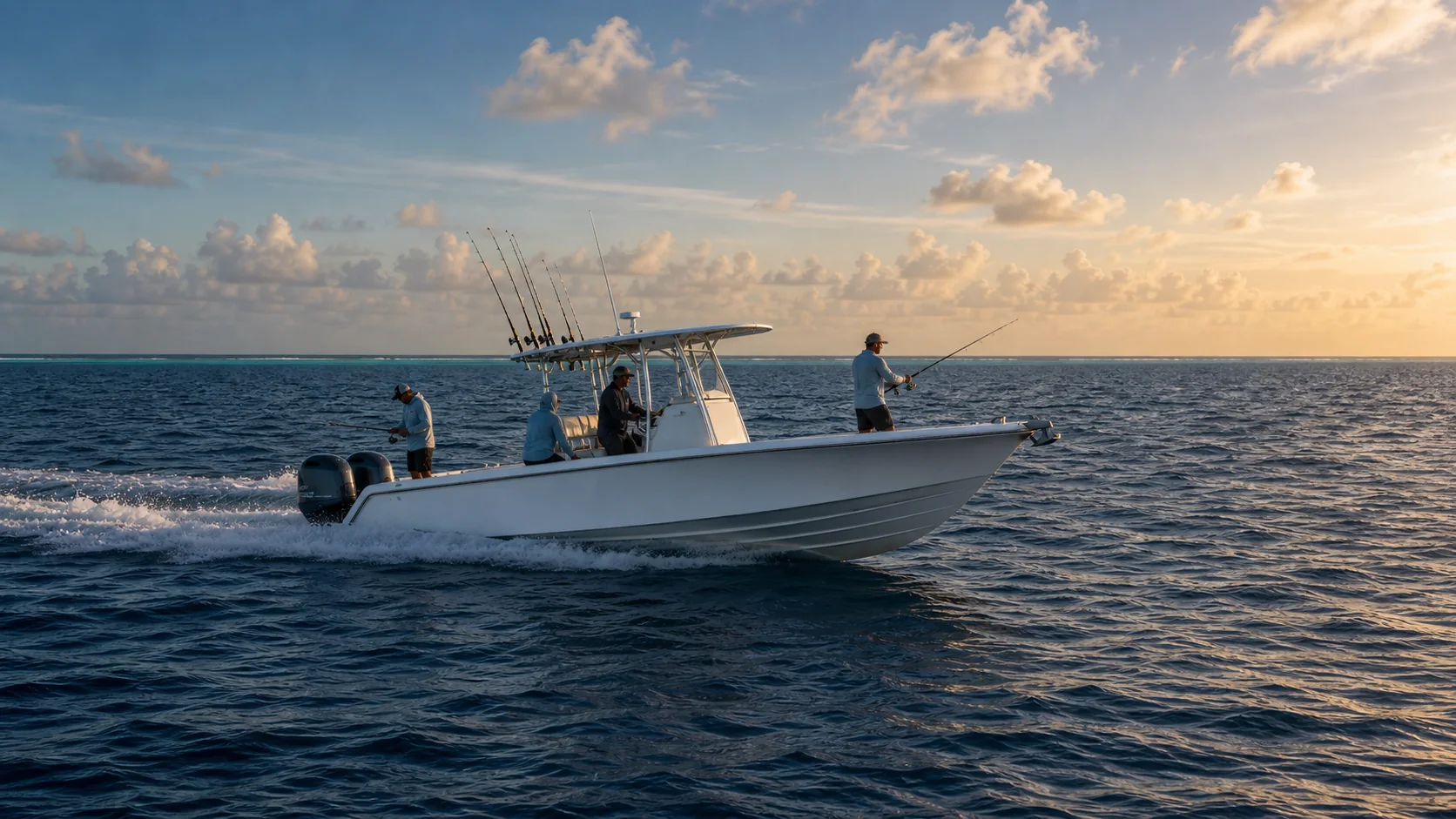
Huvadhoo Atoll is the deep-south fishing zone of the Maldives. Split across Gaafu Alifu and Gaafu Dhaalu, this is the second-largest atoll in the country, covering close to 3,000 square kilometres with wide channels, remote reef edges, strong currents, and the serious Giant Trevally, dogtooth tuna and yellowfin grounds that make it worth flying south for. It is not the easiest atoll to reach. For anglers planning a dedicated Maldives fishing trip, it is often the atoll worth building the whole itinerary around.
Tell us your target species, group size, accommodation preference and travel dates. We will design the trip from domestic flight to fishing day, vessel selection to island base.
Build My Huvadhoo Fishing Trip WhatsApp +960 992 7007The simple answer is structure. Huvadhoo is the second-largest atoll in the Maldives, covering close to 3,000 square kilometres of lagoon and containing more than 230 islands, which is more than any other atoll in the country. The central lagoon is around 65 kilometres wide at its broadest point. That scale alone changes the fishing.
The atoll sits in the deep south of the archipelago, roughly 340 to 400 kilometres south of Male’, between the One and a Half Degree Channel (Huvadhu Kandu) to the north and the Equatorial Channel (Adoo Kandu) to the south. Both are broad, deep channels where pelagic species move past in numbers that smaller channels simply do not see. Huvadhu Kandu alone is roughly 97 kilometres wide and contains the Medutila bank, a submerged seamount in the middle of the channel that rises to within 11 metres of the surface. That is the kind of structure that holds dogtooth tuna.

Inside the atoll, the inner lagoon reaches depths of around 80 metres. The outer reef has long unbroken edges with sharp drop-offs into deep blue water. Named channels including Villingili Kandu, Nilandhoo Kandu and Meradhoo Kandu cut through the reef ring and act as ambush points for reef predators. The Kondey Kandu channel on the eastern side is a protected reserve where fishing is not permitted, which is part of why the surrounding waters remain productive.
The other thing that matters is pressure. Huvadhoo gets a fraction of the day-boat traffic that Male’ Atoll or Ari Atoll sees. The fish are not naive, but they have not been hammered. For serious anglers, that is the difference between a typical Maldives fishing day and a Huvadhoo day. For broader context on how Huvadhoo compares to the other Maldives atolls, see our Maldives sport fishing guide.
Huvadhoo produces almost every species that makes Maldives fishing famous. Here are the catches that drive the trip planning.
| Species | Best method | Peak months | Catch & release |
|---|---|---|---|
| Giant Trevally | Popping, stickbaiting, fly | May to Oct strongest, year-round possible | Always released |
| Dogtooth tuna | Vertical jigging, live bait | Nov to Apr | Always released |
| Yellowfin tuna | Trolling, live bait, popping | Nov to Apr, year-round possible | Usually kept |
| Sailfish | Trolling | Nov to Apr | Always released |
| Marlin (blue, black) | Trolling skirted lures | Nov to Apr | Always released |
| Wahoo | High-speed trolling | Nov to Apr, year-round | Usually kept |
| Mahi-mahi | Trolling, casting around debris | Year-round | Usually kept |
| Coral trout, grouper, jobfish | Jigging, bottom fishing | Year-round | Crew guidance |
| Bonefish, triggerfish, milkfish | Fly fishing on flats | Nov to Apr | Always released |
Catches vary by season, conditions, and angler experience. Photos and statistics reference past trips; no specific catch is guaranteed.
Huvadhoo is one of the most consistent Giant Trevally grounds in the Maldives. The atoll’s long reef edges, channel mouths, bommies and sandbank drop-offs all hold fish, and the broad lagoon means there is always somewhere to fish on the protected side regardless of wind direction. The southwest monsoon from May to October is the strongest popping window, when current and wind shifts push baitfish onto reef edges and trigger aggressive surface feeding. Heavy PE6 to PE8 spinning gear with 80 to 100 lb fluorocarbon leader is standard. Every Huvadhoo GT is released. For the species in detail, see our Giant Trevally fishing in the Maldives guide.

If one fish gets serious anglers on a domestic flight to Kooddoo or Kaadedhdhoo, it is the dogtooth tuna. Huvadhoo’s combination of deep channels, submerged seamounts and pinnacle structure is what dogtooth need, and the atoll holds consistent fish through the northeast monsoon from November to April. Vertical jigging with 250 to 300 gram knife jigs on heavy slow-pitch or speed-jigging gear is the standard method. Fishing depth runs anywhere from 80 metres on reef-edge marks to over 150 metres on deep channel slopes. Dogtooth hit jigs with a savagery that destroys tackle, so use the heaviest setup the conditions allow. Releases only. See our future guide to dogtooth tuna fishing in the Maldives and the broader Maldives jigging guide.

The deep blue water outside Huvadhoo’s reef line and across the broad channels above and below the atoll is genuine pelagic trolling country. Yellowfin tuna are the workhorse target year-round, with the largest fish concentrated during the northeast monsoon. Wahoo are an almost everyday catch on high-speed trolling spreads. Sailfish move through the southern channels during the dry season, and blue and black marlin are part of the November to April pelagic spread without being the everyday catch. Huvadhoo is not a marlin-guarantee destination. It is a strong mixed pelagic atoll where billfish are part of the dry-season package. Because the atoll is large and the productive marks are spread out, full-day charters work better here than half-day trips.

The shallow sand flats and lagoon zones inside the atoll hold a credible saltwater fly fishery, particularly during the dry season from November to April when wind and visibility cooperate. Targets include bonefish, triggerfish, milkfish, indo-pacific permit and bluefin trevally, with occasional shots at flats-tailing GT. The fly water around Maamendhoo and other northern islands of Gaafu Alifu is the most developed, and Huvadhoo is one of the few places in the Maldives with dedicated fly-focused lodging. Standard kit runs 8 to 10-weight for the smaller species and 12-weight for trevally. This is technical sight fishing, best suited to experienced fly anglers. For more on the technique, see our Maldives fly fishing guide.
Huvadhoo is large enough that the choice of which part of the atoll to fish matters. The administrative split between Gaafu Alifu in the north and Gaafu Dhaalu in the south corresponds roughly to two different fishing experiences.
The northern half of the atoll, accessed through Kooddoo airport. Strong fly fishing flats around Maamendhoo and the other northern islands, productive channel marks on the eastern reef including Villingili Kandu and Nilandhoo Kandu, and Meradhoo Kandu on the western side for pelagic cruising. Gaafu Alifu also holds the bulk of the fly-focused fishing lodges and several higher-tier resorts that handle big-game fishing as an add-on. See our guide to Huvadhoo Atoll fishing resorts for the full list of properties, which airport serves each one, and what to ask before booking.
Key marks: Villingili Kandu, Nilandhoo Kandu, Meradhoo Kandu, Maamendhoo flats.
The southern half of the atoll, accessed through Kaadedhdhoo, Maavarulu or Faresmaathoda airports. Deeper proximity to Adoo Kandu (the channel separating Huvadhoo from Fuvahmulah), strong dogtooth marks on the southern reef edges, and the more remote feel that comes from being closer to the equator. Fewer resorts, more guesthouse-based fishing options on islands like Thinadhoo, Gadhdhoo, Fiyoari and Madaveli.
Key marks: Fiyoaree Kandu, southern reef edges, Adoo Kandu approaches.
The 97-kilometre-wide Huvadhu Kandu running between Huvadhoo and Laamu to the north is genuine pelagic ground, best fished on longer-range full-day or multi-day trips. In the middle of the channel, the Medutila submerged bank rises to within 11 metres of the surface and is the kind of seamount structure that holds dogtooth, yellowfin and amberjack. Reaching Medutila requires a vessel with the range and the captain’s local knowledge to time the run with conditions.
Key marks: Huvadhu Kandu central channel, Medutila Seamount, deep edge approaches.
Not sure whether Gaafu Alifu, Gaafu Dhaalu or a full-atoll liveaboard fits your trip best? Match me to the right Huvadhoo setup.
Huvadhoo sits close to the equator, between roughly 0.3° and 0.7° North. That position smooths out the seasonal swings that affect the central Maldives. Both monsoons are milder here, and productive fishing is genuinely possible year-round, though the species mix and conditions shift across the calendar.
| Window | Best for | Conditions |
|---|---|---|
| January to March | Dogtooth, yellowfin, sailfish, marlin, fly flats | Peak dry-season conditions, calmest seas, best visibility |
| April | Mixed pelagic, transition | Shoulder month, conditions vary, fewer boats |
| May to October | Giant Trevally popping, reef-edge action | Southwest monsoon, weather windows shift, GT season |
| November to December | Yellowfin, dogtooth, wahoo, returning trolling | Dry season returns, conditions firming up |
One practical note: Huvadhoo’s distance from Male’ makes weather planning more important than in the central atolls. A 5-night trip gives meaningful flexibility if a single day blows out. A 2-night trip leaves no margin. For a full month-by-month breakdown of the whole country, see our future Maldives fishing season guide.
Getting to Huvadhoo is the part of the trip that needs the most planning. The atoll is too far from Male’ to reach by speedboat, and four different domestic airports serve different parts of the system. Which one you fly into determines which part of the atoll you can practically fish from.
Gaafu Alifu, northern Huvadhoo. Main entry for fly fishing lodges, Maamendhoo, and the higher-tier Gaafu Alifu resorts. About 1 hour from Male’.
Gaafu Dhaalu, southern Huvadhoo. Serves Thinadhoo and the southern inhabited islands. The older of the two main airports. About 1 hour 10 minutes from Male’.
Gaafu Dhaalu, central southern Huvadhoo. Opened July 2020. Useful for trips based on the central southern islands. Limited schedule.
Gaafu Dhaalu. The smallest of the four with the most limited schedule. Use only when itinerary specifically routes through it.
All four airports are operated by Maldivian, the national domestic carrier. Round-trip domestic flights typically run USD 200 to 300 per person and can be timed to connect with international arrivals at Velana International Airport in Male’.
From the domestic airport, transfers to your island base run by speedboat. Times range from a 10-minute hop (Kooddoo to Maamendhoo, for example) to longer rides of 45 to 60 minutes for the more remote islands. Speedboat transfer costs typically sit between USD 30 and USD 100 each way per person, often included in package rates.
The booking sequence that works: arrive Male’ on the morning international flight, connect to the same-day domestic flight south, arrive your island base by early afternoon. Arriving Male’ on a late evening flight usually means an overnight in Hulhumale’ before the morning domestic. This is the kind of logistics the Trip Builder handles automatically.

Three accommodation formats work for Huvadhoo, and the choice matters more than at central atolls because everything is harder to reach from a wrong base.
For the angler-first trip, the guesthouse plus private day-charter combination delivers the best value and the most fishing time. For a couples or family trip where one person fishes seriously and others want comfort, a resort base in Gaafu Alifu works well. Liveaboards make sense for week-long expeditions covering both Gaafu Alifu and Gaafu Dhaalu marks, particularly when timed with the November to April dry season.
Costs vary widely with trip format, vessel choice and accommodation tier. These are realistic indicative ranges for 2026.
4 hours, private boat, big-game gear, from a guesthouse or resort base
8 to 10 hours, private vessel, full crew, lunch on board, fuel included
4 fishing days, accommodation, meals, domestic transfers, gear
All-inclusive, dedicated angler-focused lodging
5 fishing days, multi-zone coverage, all-inclusive
On top of resort accommodation rate
Male’ to Kooddoo or Kaadedhdhoo, sometimes included in packages
Domestic airport to island base, varies with distance
Two government charges apply to almost every line item. TGST has been 17% from 1 July 2025, applied to accommodation, charter services, and food and beverages at tourist establishments. Green Tax is a per-night environmental fee: USD 12 per person per night at resorts and tourist vessels including liveaboards, and USD 6 per person per night at smaller guesthouses on inhabited islands with 50 rooms or fewer.
For a deeper cost breakdown including how vessel range, crew tier and group size shift these numbers, see our future Maldives fishing trip cost guide.
Three real-world itineraries built around the trip-length and target-species choices that drive most Huvadhoo planning.
Best for: anglers extending an existing Maldives stay. Light on weather buffer.
The recommended minimum for a Huvadhoo trip. Strong weather buffer, balanced species mix.
The full experience. Covers both halves of the atoll and the deep channel grounds in between.
Huvadhoo works best when flights, island base and fishing days are planned together. Send your dates through the Trip Builder and we will check which southern-atoll setup makes sense.
Design My Huvadhoo Trip WhatsApp UsA quick comparison of where Huvadhoo sits against the other commonly-fished Maldives atolls. This is the decision most serious anglers face: is the southern flight worth it?
| Atoll | Best for | Trade-off |
|---|---|---|
| Huvadhoo | Serious GT, dogtooth, remote southern trip, fly flats | Domestic flight, higher logistics cost, 5-night minimum |
| Laamu | GT popping, southern feel, less pressured grounds | Domestic flight required, fewer accommodation options |
| Ari Atoll | Mixed fishing, resort add-ons, shorter trips | More tourism pressure, less remote feel |
| North & South Male’ | Short day charters, first-timers | Most boats and pressure, no domestic flight needed |
| Addu | Fly fishing flats, equatorial expedition | Furthest south, requires Gan domestic flight |
For a quick weekend extension, central Maldives works. For a dedicated fishing trip of 5 or more nights, Huvadhoo and Laamu deliver materially better fishing per day. For the country-wide breakdown, see our Maldives sport fishing guide.
Huvadhoo fishing follows the same rules as the rest of the country, with one geographic caveat worth knowing.
Giant Trevally, dogtooth tuna, sailfish and marlin are released regardless of size. This is the accepted practice across Maldives sport fishing captains and the basis of the fishery’s long-term health. Yellowfin tuna, wahoo, mahi-mahi and reef species are typically kept within sensible limits.
Sharks are not a sport fishing target. Spearfishing is currently restricted for visiting anglers and we do not include it in any HolidayVibe trip design. The Kondey Kandu channel reserve on the eastern side of the atoll is protected and off-limits to fishing; your captain knows where these zones sit.
The geographic caveat: Huvadhoo’s distance from Male’ and its position near the equator mean weather windows are real but milder. Your captain’s call on conditions matters more here than in the central atolls, where weather alternatives sit closer at hand. Listen to the crew.
Catches vary by season, conditions, and angler experience. Photos and statistics reference past trips; no specific catch is guaranteed.

Huvadhoo is the most logistics-heavy fishing destination in the country. Domestic flights, speedboat transfers, vessel range, island bases, weather windows and accommodation tier all need to line up. We do that work in-house.

Yes. Huvadhoo is widely considered the premier atoll for serious sport fishing in the Maldives. Its wide channels, deep drop-offs and remote reef edges produce consistent Giant Trevally, dogtooth tuna and yellowfin grounds, with less day-boat pressure than the central atolls. Anglers willing to fly south from Male’ are rewarded with cleaner water and a more remote feel.
Headline species are Giant Trevally, dogtooth tuna, yellowfin tuna, sailfish, blue and black marlin, wahoo and mahi-mahi. Reef fishing produces coral trout, grouper, jobfish, red bass and bohar snapper. Fly anglers target bonefish, triggerfish, milkfish, indo-pacific permit and bluefin trevally on the flats around the inhabited islands.
Yes. Huvadhoo holds some of the best Giant Trevally grounds in the Maldives. Reef-edge popping is strongest during the southwest monsoon from May to October, when current and wind shifts drive aggressive surface feeding. Catch-and-release is the universal practice for GT in Huvadhoo and throughout the country.
Yes. Huvadhoo is considered the premier dogtooth tuna ground in the Maldives. The atoll’s deep channels and submerged seamounts including the Medutila bank in the middle of Huvadhu Kandu hold consistent fish through the northeast monsoon from November to April. Vertical jigging with 250 to 300 gram knife jigs on heavy gear is the standard technique.
November to April (northeast monsoon) is best for big-game trolling, dogtooth jigging and fly fishing on the flats. May to October (southwest monsoon) produces the strongest GT popping. Because Huvadhoo sits close to the equator, both monsoons are milder than in the central Maldives, and productive fishing is possible year-round.
Fly into Velana International Airport in Male’, then take a domestic flight south. Four airports serve Huvadhoo: Kooddoo (GKK) for Gaafu Alifu, Kaadedhdhoo (KDM) and Maavarulu (RUL) for Gaafu Dhaalu, and Faresmaathoda (FMT) for smaller routings. Flight time from Male’ is approximately one hour. A speedboat transfer from the domestic airport to your island base typically takes 10 to 60 minutes.
Five nights is the practical minimum for a Huvadhoo fishing trip given the domestic flight commitment. A 5-night stay delivers 4 full fishing days with buffer for weather. Three-night quick missions work for anglers already in the Maldives. Week-long trips of 7 nights give the most flexibility for chasing different species across the atoll’s channels.
Huvadhoo is better for serious anglers chasing dogtooth tuna, Giant Trevally and remote southern-channel fishing. Ari is easier to reach from Male’, suits shorter trips and resort add-ons, and offers a broader species mix close to easier accommodation. The choice depends on trip length, target species and travel budget.
Yes, with the right vessel and a good captain. Huvadhoo is more remote than the central atolls and a poor choice for casual sunset trips, but private day charters with experienced crews are well suited to beginners who want serious gear and proper guidance. Most beginners do better starting with reef and trolling techniques before progressing to heavy popping or jigging.
Full-day private big-game charters in Huvadhoo typically run USD 700 to 1,500. A 5-night guesthouse-based fishing package starts around USD 1,800 per person. Liveaboard or dedicated island fishing camps run USD 3,000 to 6,000 per person depending on tier. Domestic flights add USD 200 to 300 per person return. All Maldives services attract 17% TGST and a Green Tax of USD 6 to 12 per person per night depending on accommodation type.
Tell us your target fish, dates, number of anglers and accommodation style. We will build a Huvadhoo plan with fishing days, domestic transfers, stay options and a clear quote.
Open the Trip Builder WhatsApp UsOr email sales@holiday.com.mv