

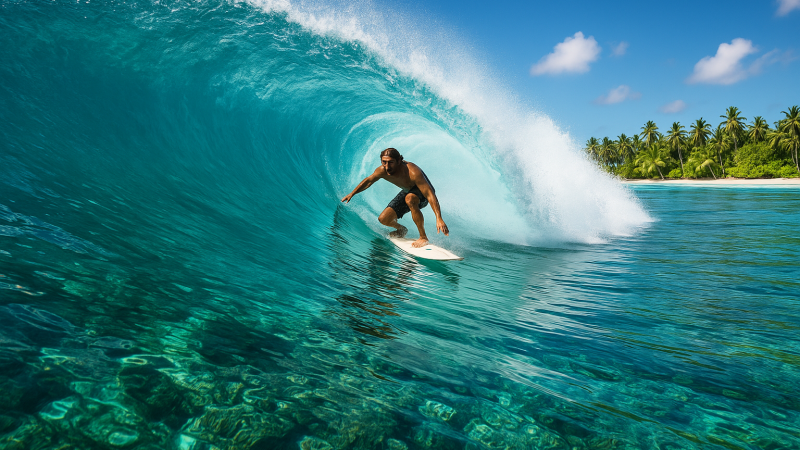
A Maldives surf holiday can be the easiest "serious surf plus real holiday" trip you'll ever do — but only if you choose the right base. The Maldives is reef breaks spread across atolls, and the difference between a perfect week and a frustrating one usually comes down to logistics: where you stay, how you access breaks, and how your plan matches your surf level.
This guide is written for real trip planning. You'll learn the best time to surf, how each region works, which trip style fits you, what it costs at different budgets, and how to build a trip without stress — whether you're a solo surfer, a couple, or a family.
The Maldives has a rare mix: warm water, excellent visibility, and consistent Indian Ocean swell during the main season. Most waves are reef breaks, which means clean take-offs and predictable lines when the tide, wind, and swell angle align. It's also one of the few surf destinations where your non-surfing travel partner can have an amazing time while you chase sessions.
You enjoy warm-water reef breaks, boardshorts surfing, short boat rides to multiple breaks, and a holiday that mixes waves with lagoon time, snorkeling, and spa recovery.
You expect beach breaks and "walk out anywhere" surfing. Most quality waves are over reef, access is often by boat, and absolute beginners need careful conditions and coaching.
The Maldives isn't hard if you plan smart, but it's not a "wing it" surf destination. Choose the right base first, then choose the accommodation. If you're combining surf with a full Maldives holiday, keep these guides handy: Ultimate Guide to the Maldives, How to Choose the Right Resort, and the Weather and Season Checker.
Most "Maldives surf packages" look similar at first glance. This planner helps you decide your trip style quickly so you spend money on the right thing.
| Your top priority | Best trip style | Why it works |
|---|---|---|
| Lowest cost, surf-first routine | Local island surf stay | Guesthouse prices plus targeted boat trips — best value if you base near key breaks |
| Comfort, easy logistics | Surf resort | Private island facilities plus structured surf transfers keep the week smooth |
| Maximum wave variety | Surf charter / liveaboard | You move with conditions, surf multiple breaks, and reduce wasted days |
| Family holiday + surfing | Family-friendly resort near surf | Kids clubs, lagoons, and flexible schedules make it realistic for parents to surf |
The main surf season runs March to October. Peak swell energy usually hits June to August. But good surf isn't only about swell height — wind, crowd patterns, and your flexibility matter too.
| Month window | What it feels like | Best for |
|---|---|---|
| Feb – early Mar | Transition, mixed days, sometimes smaller | Budget travellers, mellow expectations |
| Mar – Apr | Clean, friendly conditions, comfortable vibe | Families, mixed-skill groups, first-timers |
| May | More swell energy starts showing up | Intermediates who want more surf without peak crowds |
| Jun – Aug | Peak swell, more powerful sessions | Intermediate to advanced surf trips, charters |
| Sep – Oct | Still strong surf, good value, crowd relief | Smart-value trips, family surf balance |
| Nov – Jan | Smaller, less consistent, stunning weather | Holiday-first travel, beginners (right setup) |
If you can choose only one thing to improve your surf week, choose travel dates that match your level. Then pick a base that reduces transfer friction. For region-by-region season detail, see our full Best Time to Surf guide. For weather beyond surfing, use the Weather and Season Checker.
This is the part most surf travel pages avoid, because it forces them to be specific. In the Maldives, wave quality is high, but reef breaks demand good decisions. The goal isn't to "prove yourself" — it's to surf more days, safely, and actually enjoy your holiday.
The Maldives is possible but choose calm periods and a setup with coaching. You want mellow conditions, lagoon time, and a plan that doesn't push you onto shallow reef. Best months: March–April, September–November.
This is a great Maldives level if you pick the right breaks. You'll progress fast in warm water, but you still need clean conditions and forgiving wave choices. Best style: resort or local island base with guidance.
You'll love the Maldives in the main season. Chase specific breaks, surf longer walls, and build the week around conditions and tides. Best style: charter for variety, or a surf resort near multiple quality breaks.
If you're not comfortable with reef entries and shallow water awareness, don't force "iconic" breaks because you saw them on Instagram. Choose a setup that gives you safer options and coaching. The best session is the one you walk away from smiling, not injured.

Most surf visitors start in the Malé Atolls because they're the easiest region from the airport with the highest concentration of breaks. Central and Southern Atolls can be incredible, but they're more "trip" than "quick week."
| Region | Why it's popular | Best trip style |
|---|---|---|
| North Malé Atoll | Closest to airport, many famous breaks, reliable | Resort, local island, or short charter |
| South Malé Atoll | Less crowded feel, excellent quality | Resort base or mixed week |
| Central Atolls | Remote feel, variety, fewer crowds | Charter or specific surf resort |
| Southern Atolls | More exposure, more power, adventurous | Charter, longer trip, committed surfers |
If this is your first Maldives surf holiday: start with the Malé Atolls unless you have a strong reason not to. You'll get more waves with less transfer stress — which is the real luxury.
The Maldives has iconic names — Sultans, Cokes, Chickens, Pasta Point, Jailbreaks, Kandooma Right — but don't treat them like a checklist. Your best sessions will come from matching a break to the day's wind, tide, and your ability.
Here's the simplified way to understand what you'll find:
Great for rhythm surfing, turns, and building confidence in reef environments. Intermediate-friendly days, good for progression.
The "postcard" waves. Also the ones that punish mistakes. Advanced, tide sensitive. Choose carefully and listen to your guide.
Not every day is heavy. Some peaks offer friendlier sections and better learning opportunities. Good for mixed groups and coaching days.
For individual spot descriptions — wave type, difficulty, ideal conditions, how to access each break, and which resort or island puts you closest — see our dedicated Maldives Surf Spots and Wave Guide.
What to ask your guide (or your resort surf desk): "Which break is safest and most fun for my level today, given the tide?" That single question saves more trips than any board upgrade.
The Maldives can be budget-friendly, mid-range, or ultra-luxury — but the best value is always the trip style that matches your reality.
Stay on Thulusdhoo or Himmafushi, surf walk-out breaks, pay guesthouse prices. From about $625/week excluding flights. You trade some polish for big savings and daily surf access.
Best for: solo surfers, groups, budget travellers
Trade-off: limited non-surf activities, no alcohol on local islands
Private island facilities plus structured surf transfers. Non-surfers stay happy with spa, pool, and excursions. Surf program costs vary — some include guided trips, others charge extra.
Best for: couples, families, mixed groups
Trade-off: higher cost, sometimes limited break access vs charters
You move with the swell across atolls. Highest wave variety, often uncrowded lineups. 10-day trips from around $2,500–$5,000+ per person depending on boat and itinerary.
Best for: dedicated surfers, groups, advanced progression
Trade-off: limited non-surf activities, boat living isn't for everyone
For a deeper look at charters specifically, see our Maldives Surf Charter and Liveaboard Guide. To compare all package types with pricing, see Best Surf Packages in the Maldives.
All international flights land at Velana International Airport (MLE) in Malé. From there, how you reach your surf base depends on where you're staying.
| Transfer type | Time | Cost (one way) | When to use |
|---|---|---|---|
| Public ferry | 1–2 hours | $2 | Budget trips to Thulusdhoo / Himmafushi (check schedule, not Fridays) |
| Public speedboat | 20–30 min | $20–30 | Most local island surf trips |
| Private speedboat | 20–45 min | $100–250+ | Resort transfers, late arrivals |
| Domestic flight + boat | 45 min + 20 min | $200–400 | Central or Southern Atolls (Six Senses Laamu, COMO Maalifushi) |
| Seaplane | 30–60 min | $300–600 | Remote resort atolls (daylight hours only) |
If you land after 4 PM: ferries may have stopped and seaplanes don't fly at night. Book a Malé airport hotel or choose a resort with a speedboat transfer. This catches more travellers out than anything else. Use the Transfer Cost Calculator to plan your route and costs.
Most nationalities get a free 30-day tourist visa on arrival. You'll need a valid passport (6+ months), a confirmed hotel or boat booking, and a return flight. No advance visa application needed for most travellers. Check Maldives Immigration for the latest entry requirements.
Most airlines flying to Malé accept surfboard bags, but fees and size limits vary. Emirates, Singapore Airlines, and Sri Lankan Airlines all allow boards as oversized luggage (usually $50–$150 each way). Check your airline's sports equipment policy before booking and confirm at check-in. If you're renting boards on arrival, Thulusdhoo and Himmafushi have rental shops — expect $15–25 per day.
The Maldives is warm and tropical, so your gear list is short. But a few items make a real difference to your comfort and safety on reef breaks.
Reef booties — non-negotiable for reef entries. Even if you usually go barefoot, bring them.
Rashie or surf shirt — sun protection for multi-session days.
Board bag — airlines require it; bring padding for reef dings.
Repair kit — Solarez or ding repair for minor fixes between sessions.
Fins + leash — bring spares; island shops are limited.
Reef-safe sunscreen — SPF 50+, zinc-based. The Maldives sun is intense.
Hat and sunglasses — for boat transfers and between sessions.
Dry bag — for phone, wallet, and camera on boat trips.
Basic first aid — reef cuts are common; bring antiseptic and waterproof plasters.
Modest clothing — for local islands (cover shoulders and knees in the village).
What you don't need: wetsuit (water is 27–30°C year-round), boots thicker than 1mm, cold-water gear of any kind.
Each guide below covers one specific angle in depth — costs, resorts, itineraries, and practical planning. Pick the one that matches your situation.
Also useful: Surf Spots and Wave Guide · Best Time to Surf · Itinerary Generator · Resort Price Calculator
We're a registered Maldives travel agency — not a blog with affiliate links. When you message us, here's exactly what happens:
Tell us your dates, surf level, and who's travelling. We'll shortlist 2–4 options that actually fit — with costs, transfers, and logistics sorted.


