

Giant trevally on the fly, plus bluefin, triggerfish and bonefish across the Indian Ocean’s specialist saltwater fly fishery.
The Maldives is a specialist saltwater fly fishery built around giant trevally, with bluefin trevally, triggerfish and bonefish as supporting species. Across the country’s 26 atolls, the dedicated fly fishing water sits mainly in the south and central regions, fished from mid-December to mid-April during the northeast monsoon dry season. The fishery rewards intermediate to advanced anglers, runs at a fraction of Seychelles outer-island prices, and works as a dedicated trip, a local island package, or a fly fishing day inside a wider Maldives stay.
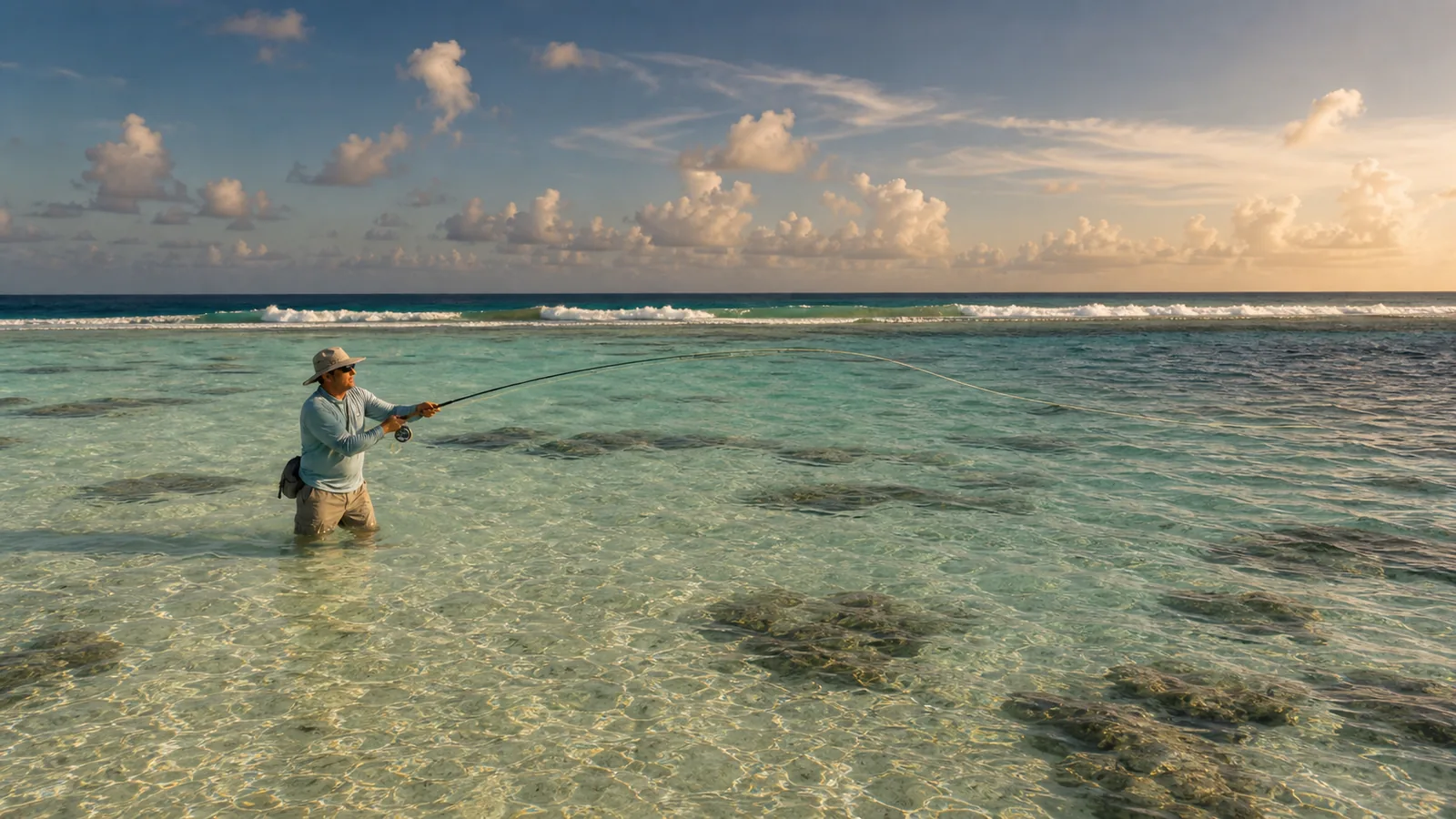
Fly fishing in the Maldives sits across a wider price and format spectrum than most anglers realise. The headline target species is giant trevally, but the shape of the trip changes how the cost, the water and the daily experience all play out. The table below sets the realistic from-pricing for each of the main formats we plan. Final quotes depend on dates, group size, atoll, vessel and stay type.
| Option | Best for | Duration | Indicative from |
|---|---|---|---|
| Resort-based fly fishing session | Couples, mixed holidays, half-day fishing | 3 to 5 hours | From USD 600 per trip |
| Full-day fly fishing charter | Dedicated fishing day on a guided skiff | 8 hours | From USD 900 per vessel |
| Local island fly fishing week | Best value dedicated guided programme | 6 to 7 nights | From USD 2,800 per angler |
| GT-focused fly fishing trip | Trophy giant trevally, serious anglers, harder water | 5 to 7 nights | From USD 3,500 per angler |
| Fly fishing liveaboard | Remote atolls, tide-chasing, dedicated anglers | 7 nights | From USD 4,000 per angler |
| Luxury resort fly fishing package | High-end stay with skiff-and-wading flats | Flexible | Custom quote |
Indicative from-pricing only. Final quote depends on vessel, atoll, domestic flights, stay type, group size, season and whether the trip is private or shared.
Prices are subject to 17% TGST and applicable Green Tax (USD 12 per person per night at resorts and tourist vessels, USD 6 at small inhabited-island guesthouses with up to 50 rooms). Final quotes confirm all taxes and fees upfront.
Yes, but with honest framing. The Maldives is not Seychelles, and it is not the Caribbean. It is a demanding, fast-developing saltwater fishery built around reef edges, surf zones, sandbanks and the occasional sand flat. The angler who arrives expecting ankle-deep wading and constant action will be disappointed. The angler who arrives prepared to wade deep, fish surf zones, walk on reef and read the water alongside a Maldivian captain will find a fishery that delivers shots most other Indian Ocean destinations cannot match at the price.
The headline target is giant trevally on the fly. Bluefin trevally, triggerfish and bonefish are real species on the daily card, but they rank as supporting acts to the GT focus. Permit and milkfish exist in Maldivian water but should not drive trip selection. Bohar snapper, golden trevally, barracuda and needlefish fill out the variety on a good day.
Expect a few quality shots per day rather than constant action. A landed GT on the fly is an achievement, not an expectation. The water is bigger and the fish warier than the country’s general fishing reputation suggests. Anyone promising daily GT catches on the fly is not being honest with you. The realistic standard is two to five quality shots per day on a serious week, with most days producing fewer landed fish than missed eats. That is normal saltwater fly fishing, and it is part of why the trip is worth taking.

The Maldivian species list is broader than the headline GT focus suggests, but each species sits at a different difficulty level and demands a different setup. The realistic breakdown looks like this.
| Species | How to target | Setup | Difficulty | Notes |
|---|---|---|---|---|
| Giant Trevally | Reef edges, surf zones, occasional flats, baitfish flies | 12wt, GT line, 80 lb braid backing | Very hard | Headline species. Catch and release mandatory by law. |
| Bluefin Trevally | Reef edges, flats, baitfish patterns | 9 or 10wt | Medium to hard | Aggressive, visual, the best volume target. |
| Yellow Margin Triggerfish | Sandbanks, flats, crab and shrimp patterns | 8 or 9wt | Technical | Tailing fish, precise casts, protected reef species. |
| Bonefish | Outer atoll flats, shrimp patterns | 8wt | Technical | Present but in smaller numbers than Seychelles. |
| Indo-Pacific Permit | Flats, crab patterns | 9 or 10wt | Very hard | Possible bonus, not a primary target. |
| Bohar Snapper | Reef edges, baitfish flies | 10wt | Medium | Strong reef predator, common bonus. |
| Golden Trevally | Reef and flats, mixed patterns | 9 or 10wt | Medium | Common alongside bluefin. |
| Barracuda and Needlefish | Surface flies, baitfish | 9 or 10wt | Easy to medium | Common bonus action. |
Protected species note. Triggerfish and parrotfish are protected reef species under Maldivian law and must be released. Giant trevally and billfish are catch-and-release only by national regulation. All shark fishing has been banned in the Maldives since 2010; if a shark is accidentally hooked, it is released immediately. Sharks are never a fly target.

The Maldives has 26 atolls but only a handful work as serious fly fishing water. The atoll choice shapes everything that follows: stay format, captain selection, target species mix, and how the daily logistics run. Listed in priority order for fly anglers.
The most established luxury resort-based fly fishing programme in the country. Skiff-and-wading access across roughly 150 square kilometres of flats targeting triggerfish, bonefish, trevally and giant trevally shots. Single resort in the atoll means virgin water and very low fishing pressure.
Best for couples, mixed holidays where one half of the couple does not fish, and anglers who want soft-luxury comfort alongside their fishing days. The luxury Thaa Atoll programme runs January through April on a Hewes 18 Redfisher flats skiff with our captain and crew.
Remote southern water with sandbanks, inside lagoons and a dedicated local-island fly programme. The lowest fishing pressure of any commercially viable Maldives fly fishing atoll. Best for serious anglers who want dedicated fly water at a sensible price point.
Read the full Huvadhoo Atoll sport fishing guide for the broader fishing picture across the atoll, including jigging and popping if you want to combine techniques.
Strong southern Maldives sport fishing infrastructure, with the popper-and-jig fleet established and fly fishing days available alongside. Good for mixed-technique trips where you want a day or two of fly inside a wider sport fishing week.
See the Laamu Atoll sport fishing guide for the full atoll-side detail.
Eastern atoll edge with direct ocean access at Keyodhoo and similar inhabited islands. Mixed-technique water that suits flexible itineraries and DIY-leaning anglers who want to wade local sandbars between guided days.
Less established than Thaa or Huvadhoo as a dedicated fly destination, but a useful add-on for trips routed through the central atolls.
Resort add-on fly fishing rather than dedicated programmes. Some outer Ari flats hold schools of bonefish, and a handful of resorts can arrange skiff and guide on request, but expect to set expectations clearly with the resort team in advance.
Best suited to one or two fly fishing days inside a wider Maldives stay, not a dedicated fly trip.
Home water for a smaller dedicated fly fishing programme. Long domestic flight from Velana International, but quieter water and a different feel from the central atolls. Useful for anglers who want a less-fished alternative and do not mind the extra travel time.
Where not to fly fish. Male’, North Male’ and Kaafu Atoll are not recommended for serious fly fishing despite being closest to the international airport. Boat traffic, fishing pressure and limited suitable flats and sandbanks make the area a poor return on the time and cost of fishing there. Plan the trip around the southern and central atolls instead.
Mid-December to mid-April is the established Maldives fly fishing season. December through March is the most stable window inside that range, with the calmest seas, clearest water and most reliable wind. Sight-casting on flats and sandbanks needs visibility above twenty metres and low wind, which the northeast monsoon dry season reliably delivers on the eastern side of the atolls.
April runs as a shoulder month. Conditions remain fishable but weather starts shifting into the transition. May through October falls inside the southwest monsoon, with visibility dropping to ten to fifteen metres on the western side of the atolls and stronger swell across the country. Giant trevally can still be targeted opportunistically in those months on the eastern side, weather-dependent, but flats sight-fishing becomes much harder. Most dedicated Maldives fly fishing programmes pause from May through November.
| Month | Conditions | Verdict for fly fishing |
|---|---|---|
| December | Northeast monsoon settling in, water clearing | Good, especially late month |
| January | Calm seas, clear water, peak conditions | Prime |
| February | Strongest currents, calm surface, excellent visibility | Prime |
| March | Stable, warm, prime sight-fishing | Prime |
| April | Transitional, still fishable, weather starts shifting | Good |
| May to October | Southwest monsoon, lower visibility, rougher seas | Limited, opportunistic GT only |
| November | Transition month, conditions starting to settle | Possible, especially late month |

The format you choose shapes the whole trip. The same atoll can deliver very different experiences depending on whether you fish from a resort, a local island guesthouse or a liveaboard. Here is the honest comparison.
| Format | Best for | Pros | Trade-offs |
|---|---|---|---|
| Luxury resort with fly fishing | Couples, soft-luxury, companion does not fish | Comfort, spa, dining, diving for the companion, professional flats skiff | Higher daily cost, limited water unless using a specialist captain and dedicated skiff |
| Local island package | Serious anglers, value, longer programmes | Lower cost, flexible programme, dedicated guided water, local logistics handled | Simpler accommodation, local-island alcohol and dress rules on shared beaches |
| Liveaboard | Dedicated anglers, remote water, tide-chasing | Best mobility across atolls, access to unfished sandbanks and reef edges | Higher cost, less suitable for non-anglers, more time on the boat |
| Mixed Maldives holiday | Couples or families, light fishing | One or two fly fishing days inside a wider stay, flexible | Not ideal for trophy giant trevally focus or guaranteed daily action |
The luxury resort programme runs on a small flats skiff with our captain and the resort’s watersports team handling on-island logistics. The fishing is mostly a 30 minute boat ride from the resort, with full-day options for further-flung sandbanks. A non-fishing companion has the full resort to themselves while you fish, which is the single biggest reason this format wins for couples.
The local island package is the angler’s value play. A guesthouse base on an inhabited local island, a dedicated captain and crew, and access to atoll water that a resort skiff would never reach in a half day. Plan for simpler accommodation and the local-island cultural norms on dress and alcohol. The trade-off is real, but the fishing access is better and the cost is roughly a third of the equivalent luxury resort week.
The liveaboard is the dedicated-angler format. A working week of tide-chasing across multiple atolls, with the boat as the home base and the fishing built around water conditions rather than fixed location. It works for serious anglers travelling solo or in small groups. It does not work for non-fishing companions, who will get bored on a working fishing vessel.
Seychelles outer-island atolls (Cosmoledo, Astove, Farquhar, Alphonse) remain the benchmark for dedicated outer-island flats fishing. They have deeper bonefish populations, more reliable permit shots, and the highest concentration of trophy giant trevally on shallow water flats anywhere in the Indian Ocean. Weekly packages from these lodges typically start above USD 16,000 per angler, before flights, gratuities and conservation fees. For the angler who wants pure dedicated flats fishing with maximum bonefish and permit volume, the Seychelles outer atolls are the right answer.
Compared with those ultra-premium outer-island lodges, the Maldives offers a more flexible entry point, especially through local island packages and liveaboard-style trips. Seychelles remains the benchmark for dedicated outer-island flats fishing, while the Maldives is better positioned as a value-flexible giant trevally, bluefin trevally, triggerfish and reef-flat destination, with the option to combine fishing with a luxury or honeymoon-compatible stay that the Seychelles lodge model does not support.
The honest framing: not a Seychelles replacement, but a more flexible Indian Ocean alternative. Different fishery, different price spectrum, different trip shape. If you have done the Seychelles outer atolls already, the Maldives is a genuinely different experience worth taking. If you are choosing between the two for a first dedicated saltwater fly trip and the budget supports it, Seychelles is the purer flats fishing destination. If the budget is tighter or the trip needs to work for a non-angling companion, the Maldives is the better answer.

Maldives fly fishing gear must be saltwater-rated end to end. Reefs are coral and rock, the sun is direct year-round, and giant trevally are unforgiving on equipment. The current gear consensus across specialist saltwater fly anglers looks like this.
| Setup | Rod | Line | Backing | Leader | Use |
|---|---|---|---|---|---|
| Light | 8 or 9wt | Floating tropical WF | 150 yds | 16 to 25 lb fluoro | Bonefish, triggerfish, smaller trevally |
| Medium | 10wt | Floating or intermediate | 200 yds | 25 to 40 lb fluoro | Larger bluefin, mixed reef-edge work |
| Heavy | 12wt | GT-specific line, strong core | 300 yds 80 lb braid | 60 to 100 lb shock tippet | Giant trevally |
Bring a spare 12 weight rod if you are on a dedicated GT trip. The rods take a serious pounding on big fish in shallow water, and replacement sections in Male’ are not something you can rely on. Sealed-drag saltwater reels with corrosion-resistant components are essential, as are quality polarised sunglasses, a sun hood or buff, sun gloves, and wading boots with hard soles. Reef walking is not optional on most days, and trail-running shoes will not last the week. A floating intermediate line can be useful for surf-zone work where the GT push close to the wash on a rising tide.
The Maldives fly box is closer to a Seychelles box than a Caribbean one, with the GT patterns doing the heavy lifting. Our captains carry working boxes for guests who travel light, but most anglers bring their own and supplement on arrival.
For giant trevally, large baitfish patterns on heavy hooks in dark colours work best. GT brush flies, NYAP-style baitfish, and Semper-style baitfish in black, blue and purple are the standard set. Six to eight inches is typical. The fly needs to push water and stay visible in low light, and the hook needs to hold under sustained pressure against reef structure.
For bluefin trevally and reef-edge species, scaled-down baitfish patterns: Clouser Minnow, Surf Candy, smaller deceiver patterns in chartreuse, white and tan. The bluefin are aggressive and visual, so movement and silhouette matter more than exact size.
For triggerfish and bonefish on flats and sandbanks, weighted crab patterns including Alphlexo-style crabs, shrimp patterns such as the Crazy Charlie, and small olive or tan baitfish. Barbless or crushed-barb hooks are best practice on the flats, both for the fish and for the reef. A small selection of cuttlefish patterns is useful for the deeper-water bluefin and snapper bonus shots.
Maldives fly fishing rewards intermediate to advanced saltwater fly anglers. Giant trevally work demands accurate double-haul casting under wind, fast reaction to feeding fish, and the conditioning to wade reef and surf zones for full days. Triggerfish and bonefish demand precise short casts and stealth. None of this is impossible to learn, but a fly fishing trip is the wrong place to learn it.
Beginners can do a guided introductory session from a luxury resort, focused on light-tackle flats fishing for bluefin trevally, triggerfish and the chance of a bonefish. A beginner targeting giant trevally on a dedicated week will almost certainly come home empty-handed. We say this clearly when planning your trip rather than after you arrive, because the cost of a dedicated GT week is significant and the disappointment is worse.
A realistic giant trevally expectation on a serious week is two to five quality shots per day, with most days producing fewer landed fish than missed eats. That is normal. The water is bigger and the fish warier than the country’s general fishing reputation suggests. The anglers who return year after year are the ones who came in with realistic expectations the first time.
Catches vary by season, conditions, and angler experience. Photos and statistics on this page reference past trips; no specific catch is guaranteed.
All fly fishing in the Maldives runs from government-licensed vessels. There is no individual angler licence to apply for. Our captain and crew handle compliance with the national fisheries framework, including the current Maldives Reef Fishery Management Regulation that governs reef-area fishing.
Shark fishing has been banned nationally since 2010. Spearfishing is banned. Net fishing over reefs is prohibited. Marine protected areas are off-limits entirely. Giant trevally and billfish are catch-and-release by national law. Triggerfish and parrotfish are protected reef species and must be released. Walking on or otherwise damaging live coral is a criminal offence.
Resort house reefs typically hold reserve status and require explicit resort permission to fish. On inhabited local islands, where the beach-to-reef-edge distance exceeds one thousand metres, fishing is allowed beyond the seven hundred metre boundary of the reef. Our captain knows the specific rules for the atoll and island you fish from. The standard practice across our fleet is full catch and release, with billfish handled as tag-and-release where applicable.
The Maldives is the right answer for many fly fishing trips, but not all of them. The honest list of cases where another destination is a better fit.
If your only target is bonefish, choose Seychelles or the Bahamas. The Maldives has bonefish but in smaller, more dispersed populations than purpose-built bonefish destinations.
If you are travelling May to October and cannot shift dates, the fly fishing window is closed or seriously compromised for sight-fishing. Big game offshore fishing remains good in those months but that is a different trip. The Maldives sport fishing guide covers the offshore options in detail.
If you cannot wade hard reef and surf for full days, plan a resort-based programme with shorter half-day sessions rather than a dedicated fly fishing week. The dedicated programmes are physical.
If you want guaranteed daily landed fish, fly fishing is the wrong format anywhere in the world, and the Maldives is no exception. Try popping and jigging from a charter or liveaboard instead: the Maldives giant trevally fishing guide covers the popper-and-jig approach in detail, and the catch rates are substantially higher than fly.

Most Maldives fly fishing trips include a non-fishing companion. The country is built for it in a way that Seychelles outer-island lodges and Belize fly camps are not. The combinations that work best pair a luxury resort programme or central-atoll resort with daily flats fishing for one half of the couple and spa, diving, snorkelling and beach time for the other.
The luxury Thaa Atoll programme is the strongest single match for this pattern. The angler gets dedicated flats fishing in water that very few foreign anglers have touched. The companion gets a high-end resort with the full range of soft-luxury amenities, an excellent house reef, and access to surfing, diving and spa programmes. Daily schedules are flexible: half-day fishing leaves the rest of the day for shared time, full-day fishing is balanced by a rest day on the resort.
For travel companions who prioritise underwater time, see the luxury dive resorts in the Maldives for properties with strong house reefs and dedicated dive programmes that pair well with a fly fishing trip. For couples building this around a honeymoon, see Maldives honeymoon planning for companion-friendly resort combinations. For wider Maldives stay planning, the Maldives holiday guide covers two-week itineraries that split fishing days and rest days across the trip rather than back-loading the fishing.
Fly fishing trips work best when the planning runs on a realistic timeline. The peak season window is narrow and the best captains and skiffs book out months in advance. Here is how the planning process runs from first message to first cast.
Target species, casting experience, dates, companion setup and budget on WhatsApp. We match you to the right atoll and format.
Full itinerary with vessel, captain, stay format and total cost. Deposit secures the dates.
Final gear list confirmed. Domestic flight bookings, accommodation and transfers locked.
Weather and tide outlook, daily schedule outline, and contact details for the Maldivian crew you’ll be fishing with.
Meet at Velana International, domestic transfer handled, on the water the day after arrival.
Topic-depth questions that come up most often during planning.
Most anglers bring their own rods, reels, lines and fly boxes. Our captain stocks a small selection of loan gear for guests who prefer to travel light, and the luxury Thaa Atoll programme has higher-end loan equipment available on request. The boat carries backup leaders, tippet, pliers and a basic fly selection, but relying on loan gear for a dedicated GT week is not a great strategy. The rod tube is your most important piece of luggage. Pack it as carry-on if your airline allows.
Departure between 6:30 and 7:30 am from the resort or local island, depending on tide and run distance. Most water is reached within thirty to ninety minutes by skiff. Lunch is usually on board or on a sandbank, with cold water and snacks throughout the day. Return between 4 and 5:30 pm, with the daily schedule built around tide windows rather than fixed hours. A typical day delivers several quality shots, a mix of wading and skiff fishing, and one or two hours of transit between water types.
Fly fishing is more weather-sensitive than popping and jigging. Sight-casting needs flat light, low wind and good visibility. On a fully-closed weather day, options are: switch to deeper-water reef-edge work where visibility matters less, fish a sheltered atoll side if the wind direction allows, or take a rest day. Most dedicated programmes plan a buffer day into a seven-night trip. We cover specific weather-closure terms in your itinerary before deposit.
Tourism Goods and Services Tax (TGST) is 17 percent from 1 July 2025, applied to accommodation, food and beverage, and most tourism services. Green Tax is USD 12 per person per night at resorts and tourist vessels, and USD 6 per person per night at small inhabited-island guesthouses with up to 50 rooms. Both taxes are typically included in the quoted package price for fly fishing programmes, and we confirm inclusion in your itinerary so there are no surprises on departure.
Passport requirements: machine-readable zone, at least one month of validity beyond your departure date from the Maldives. Visa: a 30-day tourist visa is issued on arrival at Velana International to most nationalities, no advance application required. Travel insurance is strongly recommended, particularly cover for trip cancellation, baggage loss (including fishing gear), and medical evacuation. We can suggest insurers that handle fishing gear and remote-atoll medical evacuation if needed.
Yes. The Maldives has a specialist saltwater fly fishery on flats, sandbanks, lagoons, reef edges and surf zones. The main targets are giant trevally, bluefin trevally, triggerfish, bonefish and a range of reef species, with the established water concentrated in the southern and central atolls.
Yes, for the right angler. It is a demanding saltwater destination, best for intermediate to advanced fly anglers targeting giant trevally, bluefin trevally, triggerfish and mixed reef-flat species. It is not a dedicated bonefish destination in the way Seychelles or the Bahamas are.
Yes. Bonefish are present in some outer-atoll flats systems but in smaller numbers than the outer atolls of Seychelles. Most serious Maldives fly fishing trips combine occasional bonefish shots with giant trevally, bluefin trevally and triggerfish work.
Thaa Atoll for luxury resort-based skiff-and-wading. Huvadhoo Atoll for remote, low-pressure water and dedicated local-island programmes. Laamu Atoll for southern logistics and mixed programmes that pair fly with popping and jigging days.
Mid-December to mid-April is the established Maldives fly fishing season, during the northeast monsoon dry season. December through March gives the most stable visibility, calm seas and reliable sight-fishing conditions. May through October falls inside the southwest monsoon, with lower visibility and limited fly fishing potential.
An 8 or 9 weight for bonefish, triggerfish and smaller trevally, a 10 weight for larger bluefin and reef-edge work, and a 12 weight for giant trevally. A spare 12 weight is strongly recommended on dedicated GT trips.
Beginners can do a guided introductory session, focused on light-tackle flats fishing for bluefin trevally, triggerfish and the chance of a bonefish. Serious giant trevally work is better suited to intermediate or advanced saltwater fly anglers.
For dedicated anglers, yes. A liveaboard offers better mobility across tides and remote atolls, plus access to unfished sandbanks and reef edges. For couples where a non-angling companion is part of the trip, a resort-based or local-island package usually works better.
Seychelles outer-island atolls remain the benchmark for dedicated flats fishing with deeper bonefish and permit populations. The Maldives is not a Seychelles replacement but a more flexible Indian Ocean alternative, with a wider price spectrum across resort, local-island and liveaboard formats and a stronger fit for trips that include a non-angling companion.
No individual licence is required for visiting anglers. All fly fishing in the Maldives runs from government-licensed vessels and locally-guided programmes. Our captain and crew handle compliance with national fisheries regulations, marine protected areas and catch-and-release rules.
Tell us your target species, dates, casting experience and whether your travel companion is fishing or relaxing. We will match the right atoll, stay format and captain for the trip.
Plan my Maldives fly fishing trip