

GT popping, jigging and bluewater trolling in the southern Maldives.
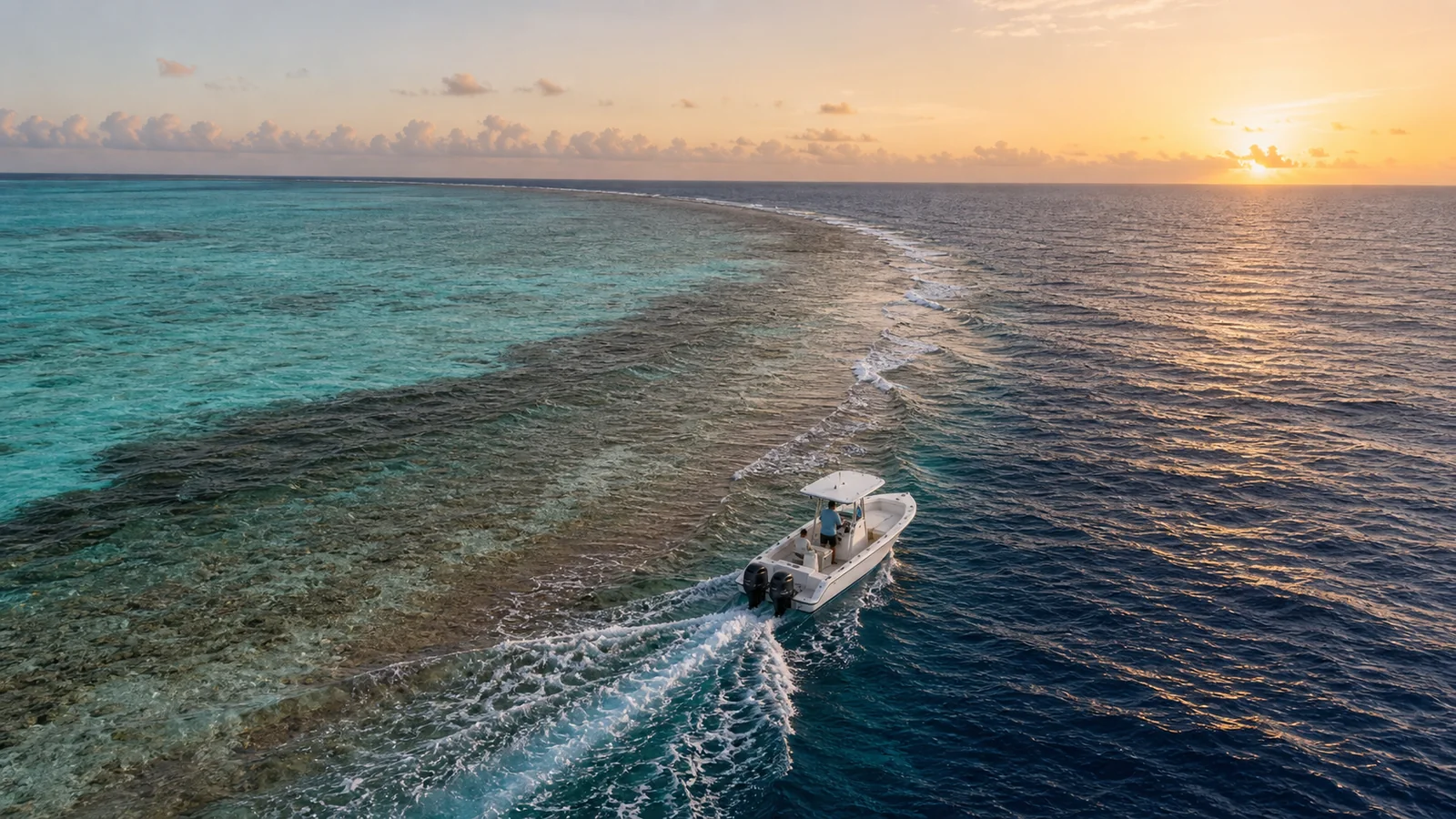
Laamu Atoll is one of the strongest southern Maldives options for sport fishing, with GT popping, reef-edge jigging, yellowfin trolling and mixed bluewater days inside a single atoll. The country covers 26 atolls with over 1,100 fish species, and Laamu sits 263 kilometres south of Male’. Reached by a 45 to 75 minute domestic flight to Kadhdhoo Airport, then matched with a guesthouse, resort or liveaboard base. Less remote than Huvadhoo, less pressured than the central atolls.
The bookable shapes of a Laamu trip. Send your dates and angler count for a confirmed quote.
| Option | Best for | Duration | Indicative from |
|---|---|---|---|
| Laamu GT Popping Day | Serious anglers, southwest monsoon | Full day | From USD 700 per vessel |
| Laamu Mixed Jigging & Trolling Day | Dogtooth, yellowfin, wahoo, mixed bag | Full day | From USD 700 per vessel |
| 3-night Laamu Fishing Starter | Maldives extension, first taste of the south | 3 nights, 2 fishing days | From USD 1,500 per angler |
| 5-night Laamu Sport Fishing Package | The standard well-rounded Laamu plan | 5 nights, 4 fishing days | From USD 1,500 per angler |
| 7-night Liveaboard or Southern Combination | Multi-zone, serious angler groups | 7 nights minimum | From USD 3,000 per angler |
From-pricing reflects the lower bound of typical trips. Final quote depends on vessel choice, fuel range, room type, domestic flights, group size and season. Quotes are typically before TGST 17% and Green Tax; final figures confirm all taxes and fees upfront.
Laamu is the local name for Haddhunmathi Atoll, a single natural atoll in the southern Maldives with barrier reefs and inhabited islands strung along its eastern and southern boundaries. Fonadhoo is the administrative capital. Gan, Maandhoo, Hithadhoo, Maavah and Kadhdhoo are the names you will hear most often when planning a trip.
The fishing logic is straightforward. A long, mostly continuous barrier reef on the eastern side gives sport anglers a productive reef-edge to fish along for GT, jacks and reef predators. Channel mouths break the reef at regular intervals, concentrating baitfish and pulling pelagic species in close. Outside those channels the seabed falls away to ocean depth within a short run, which is where dogtooth tuna and the trolling spread come into the picture.
Two practical points matter more than the geography itself. First, Laamu sits roughly 263 kilometres south of Male’ but flies in well under an hour and a half, which makes it noticeably easier to package than Huvadhoo. Second, Laamu carries less rod pressure than the central atolls around Male’ and Ari, but more than the deep-south atolls. The result is honest southern fishing without the full Huvadhoo travel commitment.
For the country-wide picture, see our Maldives sport fishing guide. If you are weighing Laamu against the deeper south, the Huvadhoo Atoll guide is the natural comparison.
Laamu is a mixed-species atoll. Most serious anglers come for the GT and the reef-edge action, but the bluewater outside the channels carries a real pelagic spread through the dry season, and the deeper structure holds dogtooth tuna for jigging days. The casual day-tripper at a Laamu resort fishes a different programme on a different vessel, and we cover that briefly later on.
| Species | Best method | Best months | Notes |
|---|---|---|---|
| Giant Trevally (Caranx ignobilis) | Popping, stickbaiting | May to October strongest | Catch and release |
| Dogtooth tuna (Gymnosarda unicolor) | Slow-pitch jigging, live bait | November to April stronger | Catch and release |
| Yellowfin tuna (Thunnus albacares) | Trolling, live bait, drift | November to April, possible year-round | Kept (food fish) |
| Wahoo | High-speed trolling | November to April | Kept |
| Sailfish | Trolling, teaser-bait switch | December to April | Catch and release |
| Blue marlin | Trolling | December to April possible | Catch and release |
| Dorado, jobfish, grouper, snapper | Trolling, jigging, bottom | Year-round | Captain’s guidance |
| Bluefin trevally, reef predators | Casting, light jigging | Year-round | Mostly release |
One honest note on billfish. Laamu is not a marlin-guarantee atoll. Sailfish and blue marlin sit inside the dry-season trolling spread as a real possibility, not the daily promise. Yellowfin and wahoo are the more reliable pelagics. If billfish are the only reason for the trip, the conversation needs a different shape and probably a different route.
Catch expectations. Catches vary by season, conditions, and angler experience. Photos and statistics reference past trips; no specific catch is guaranteed.
GT are the headline draw. The eastern reef rim of Laamu is a long, mostly continuous wall facing the open Indian Ocean, broken by channel mouths and outer corners where current meets structure. These are the spots where GT ambush baitfish on a moving tide.

The strongest window is the southwest monsoon, roughly May through October. Wind direction pushes bait onto the eastern reef edges, currents are more reliable, and the fish are more aggressive on the surface. Standard popping setups are PE6 to PE8 braid, 130 to 200 pound fluorocarbon leader, 130 to 180 gram poppers and stickbaits, drag set heavy to stop the fish before it reaches the reef. Upgraded trebles and split rings are standard.
Every GT is released. The fish recover and grow on the reef; the photograph at the boatside takes ten seconds, the fish goes back in the water alive. For the full species deep-dive, see our GT fishing guide. The Laamu page focuses on the where, when and how within this atoll.
Dogtooth are the second species serious anglers come to Laamu for. They sit on the channel slopes and reef-wall drops where the seabed falls from the reef edge into deep water within a short run. Productive depths typically sit between 80 and 180 metres, with 200 to 300 gram slow-pitch jigs depending on current and drift speed.
Laamu produces dogtooth, but to be honest about it, fishing Huvadhoo Atoll remains the stronger choice for a dedicated dogtooth trip. Laamu’s strength on the same gear is mixed jigging: dogtooth as the headline, with amberjack, jobfish, grouper and snapper through the same drop. Plan for a mixed-jig day and the bag fills out predictably. Plan for dogtooth-only and the trip lives or dies on conditions.

Trolling outside the eastern and southern reef edges produces yellowfin tuna and wahoo through most of the year, with the calmest conditions running from November through April under the northeast monsoon. Full-day trips give the trolling spread more time to find fish than half-days; an early start and a long run before turning back is the standard productive shape. Schools of small yellowfin can produce 5 to 15 kilogram fish in numbers; the larger 40 to 60 kilogram-plus yellowfin are an occasional event rather than a daily expectation.
Not every day on a Laamu trip needs to be a full big-game push. A variety day on light spinning gear or light jigging produces bluefin trevally, jacks, jobfish, snapper, grouper and the occasional barracuda inside the lagoon and along the inner reefs. These days work well when conditions on the outside are difficult, when a non-angling companion is on board, or when an angling group wants a slower pace for half a trip. The same vessel and crew handle both formats.
The Laamu GT fishery has its own character. The eastern barrier reef is the spine of the atoll’s GT fishing, with channel mouths breaking the reef at regular intervals. Each channel mouth, each outer corner of a reef section, and each promontory facing the open ocean is a potential spot. Our captains who work the atoll regularly know which channels are producing week to week, which depends on bait movements, current direction and recent fishing activity.
The southwest monsoon from May to October is the strongest GT window. The wind pushes bait onto the eastern reef edges, the fish are more aggressive on the surface, and the surface chop helps disguise the angler’s silhouette in the boat. The northeast monsoon from November to April produces GT but with longer waits between fish; many trips through this window split the days between trolling outside and short popping sessions on selected reef edges.
Tackle is heavy. PE6 to PE8 popping rods, 10000 to 18000 size spinning reels, locked drags above 12 kilograms, upgraded terminals on every lure. The fish run hard into the reef when hooked, and any weakness in the tackle chain shows up in the first thirty seconds.
Every Laamu GT is released. The crew handles unhooking in the water where possible; boatside photographs are taken quickly with the fish kept partly submerged; the fish swims off under its own power. For a deeper dive on technique, gear and timing across the whole country, see Giant Trevally in the Maldives.
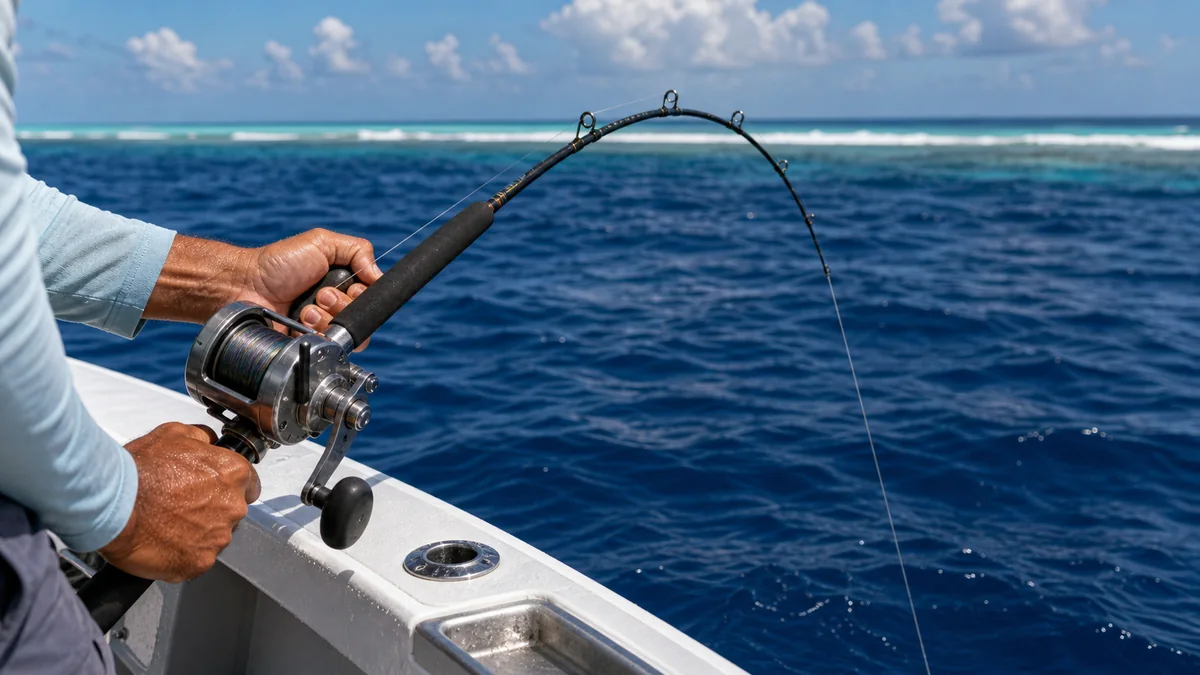
Jigging is the second technique Laamu does well. The channel slopes and reef-wall drops give the productive 80 to 180 metre range that slow-pitch jigging is built for, and the mixed species composition through that depth band means the rod loads up more reliably than on a dogtooth-only programme.
Slow-pitch jigging produces dogtooth tuna, amberjack, jobfish, large groupers and snapper through the same drop, depending on which structure the captain works. Mechanical jigging on heavier gear is the alternative for anglers who prefer the faster rhythm; the species mix is similar but biased toward dogtooth and the larger reef predators.
Typical gear specifications: PE3 to PE5 slow-pitch setups, 200 to 300 gram jigs for the deeper drops, longer rods (around 6’3″ to 6’6″) for the slow-pitch motion, shorter heavier rods for the mechanical approach. The crew on board carries spare jigs and assist hooks; bring your own preferred patterns if you have favourites, but standard tackle is available.
For the technique deep-dive across the country, see our Maldives jigging guide once it goes live; this page covers the Laamu-specific context.
Trolling days run outside the eastern and southern reef edges, on the open Indian Ocean side. The vessel sets a four to six rod spread of skirted lures, occasionally with a teaser or a daisy chain, and works the colour change where deeper water meets the upwellings near the reef edge.
The northeast monsoon from December to April is the calmer trolling window. The southwest monsoon still produces yellowfin and wahoo, but sea state is less predictable and full-day offshore trips can get cut short on weather. A productive trolling day is usually 8 to 10 hours on the water, with an early start to cover the morning bite.
Yellowfin tuna and wahoo are the realistic targets. Sailfish appear in the spread through the dry season as an opportunistic catch rather than a guaranteed one. Blue marlin are possible, mainly December through April, but the marlin numbers in any single Maldives atoll are not at the level of dedicated marlin destinations elsewhere in the Indian Ocean. If billfish are the headline goal, the conversation should be about a longer trip with route flexibility, not a single-atoll booking.
Laamu is large enough that vessel positioning matters. Our captain chooses the day’s zone based on wind, swell, current direction and what produced on recent trips. These are the broad areas; specific marks stay with the crew.
The long barrier reef facing the open Indian Ocean. Channel mouths and outer corners are the GT and reef-edge popping water. The most consistent zone through the southwest monsoon.
Mixed fishing zone with strong jigging and trolling water. Slightly more remote feel, longer runs from the standard island bases, often quieter on the rod.
The practical base zone for guesthouse trips and short-stay anglers. Daily fishing runs out from here to the eastern rim or the channel mouths within reach.
Good for stay logistics and mixed-interest groups where one angler fishes and the rest of the party uses the islands. Reef access for variety days is close at hand.
Where reef sections turn and current concentrates. The moving-water GT spots and the trolling start points on yellowfin and wahoo days. Captain’s call on conditions.
Laamu fishes year-round, but the two monsoon seasons give the atoll two different characters. The dry northeast monsoon brings calmer water and longer trolling days; the wet southwest monsoon brings the strongest reef-edge GT window.
| Season | Months | Best for | Sea state |
|---|---|---|---|
| Northeast monsoon (iruvai) | December to April | Trolling, yellowfin, wahoo, jigging, sailfish window | Calmer, more reliable |
| Southwest monsoon (hulhangu) | May to October | GT popping, reef-edge action, surface bite | Wetter, less predictable |
| Shoulder months | April to May, October to November | Mixed programmes, depends on the year | Conditions-dependent |
One correction on a piece of advice that circulates online: May to October is the stronger GT and reef-edge window, but the claim that “colder water” through this period drives heavy feeding frenzies across all pelagic species is overstated. November can be excellent as a transition month when wind and current line up, but it is better treated as a shoulder month than a guaranteed pelagic peak. Our captains plan around the patterns of the specific year, not a fixed calendar.
Laamu works best when the domestic flight, island base and fishing days are planned together. Send your dates through the Trip Builder and we’ll match the right Laamu setup.

The route to Laamu starts at Velana International Airport in Male’. After clearing immigration and customs, the connection is a domestic flight to Kadhdhoo Airport (KDO), the airport serving Laamu Atoll. Flight time is roughly 45 to 75 minutes depending on the routing; some flights are direct, others stop briefly at another southern atoll airport. Domestic carriers operate the route on regional turboprops.
Morning international arrivals into Male’ connect best to same-day domestic flights to Kadhdhoo. Afternoon and evening international arrivals usually mean an overnight in Male’ before the domestic connection the next morning. The Trip Builder factors flight timing into the booking so the connection works.
Kadhdhoo Airport sits at the central-eastern side of the atoll. From the airport, onward transfers to the chosen island base or vessel are usually by speedboat, with run times from 10 minutes to around 45 minutes depending on the destination island. Guesthouse stays often include the airport transfer; resort and liveaboard bases coordinate their own pickup. For broader Maldives planning, see planning a Maldives trip more broadly.
Most Laamu sport fishing trips are arranged from Kadhdhoo, Fonadhoo, Gan, Maandhoo or nearby guesthouse islands, depending on the vessel position and chosen stay. Kadhdhoo is the airport island and a practical pickup point for short-stay anglers. Fonadhoo is the atoll’s administrative capital with a small range of guesthouse options. Gan and Maandhoo sit further along the eastern reef edges and suit groups wanting closer access to the reef-rim fishing without the central-island feel. The Trip Builder confirms the pickup point as part of the daily run plan, alongside the vessel and fishing days.

The best value option and the most practical base for serious anglers travelling alone or in small groups. Guesthouses on Laamu’s inhabited islands offer clean rooms, simple board, short transfer times to fishing departure points, and lower nightly costs than the resorts. Most anglers building a 5-night Laamu trip use a guesthouse base. Bikini beach access on inhabited-island guesthouses varies by island; this is a question to raise at planning stage if non-angling companions are on the trip.
Resorts on Laamu suit couples and families where one person fishes and the rest of the party wants a full resort experience. The atoll’s main luxury resort runs its own programme of resort-organised fishing activities including reef and dhoni-based fishing for guests, which is a different format from dedicated sport fishing. For serious sport fishing with a dedicated charter, an external vessel is the better fit even when staying at a resort. Resort-base trips also pair naturally with dive and fishing resort ideas if the group includes divers.
For dedicated angler groups wanting maximum time on the water and access to multiple zones, the liveaboard format is the strongest choice. A liveaboard vessel covers the eastern rim, the southern edge, channel mouths and outer corners over consecutive days without returning to a fixed base. Some liveaboard routes extend south into Thaa or Huvadhoo across a longer trip, which gives the group exposure to more than one atoll’s water. Liveaboard fishing trips are typically 5 to 10 nights. For a deeper look at the format across the country, our dedicated Maldives fishing liveaboards guide will be online soon.
How the practical booking shapes work, depending on where you are staying and how you want to fish.
Yes. Resort guests can book an external charter that picks up from the resort jetty for the day, separately from any resort-organised fishing programme. For serious sport fishing, a dedicated charter is the better fit than the resort’s own activity desk vessel.
Yes, and this is the most common shape. Guesthouse-based anglers fish from a chartered vessel that picks up from the inhabited island, runs the day’s programme, and returns at sunset. Guesthouse stays usually cost less than resort stays for the same number of fishing days.
Solo anglers fish on private charter, on a shared charter with other guests on matching dates, or on a liveaboard format. Shared charters reduce the cost per angler but depend on other anglers booking the same dates. Send dates early to widen the shared-charter window.
Private by default. Full-day private charter runs from USD 700 per vessel and accommodates up to four to six anglers depending on the boat. Shared charters are arranged when two or more booking groups have matching dates and compatible target species.
Standard rods, reels and terminal tackle are included on every charter. Anglers with preferred personal setups (specific popping rods, jigging reels, favourite lures) are welcome to bring them. The full inclusions and exclusions are in the cost section above.
Best for: a Maldives extension, first taste of southern Maldives fishing.
Best for: the standard well-rounded Laamu plan for serious anglers.
Best for: serious groups wanting multi-zone access and the longest fishing window.
Indicative ranges in USD. Final quotes confirm all taxes and fees upfront.
| Format | Indicative range | Notes |
|---|---|---|
| Half-day resort fishing | USD 200 to 500 | Per trip, vessel basis, resort programmes |
| Full-day private charter | USD 700 to 1,500 | Per vessel per day, gear and crew included |
| Guesthouse-based 5-night package | USD 1,500 to 3,000 pp | Per angler, fishing days plus stay and transfers |
| Liveaboard or southern multi-day trip | USD 3,000 to 6,000+ pp | Per angler, 5 to 10 nights, vessel-dependent |
| Domestic return flight to Kadhdhoo | USD 200 to 300 pp | Per traveller, return Male’ to Kadhdhoo |
Tax note: Quoted prices are typically before TGST 17% (effective 1 July 2025) and the Green Tax of USD 12 per person per night at resorts and tourist vessels, USD 6 at small inhabited-island guesthouses with 50 rooms or fewer. Final quotes from our Male’ team confirm all taxes and fees upfront. Prices vary by season, vessel, fuel range, group size and dates.
The southern atolls and the central atolls fish differently. Picking between them depends on what you want to catch, how much travel you accept, and whether the trip is angler-only or mixed.
| Atoll | Best for | Trade-off |
|---|---|---|
| Laamu | GT, jigging, southern character, easier than Huvadhoo | Domestic flight needed; less fishing pressure than central atolls but more than the deep south |
| Huvadhoo | Dogtooth tuna, serious GT, deep-south remoteness | More remote, longer travel commitment, fewer accommodation options |
| Ari | Resort add-ons, mixed trips, easier access | More tourism pressure on the reefs, less remote feel |
| Male’ Atolls (North and South) | Short day charters, weekend Maldives extensions | Most boat traffic, least remote, central-atoll pressure |
The cleanest decision shape: choose Laamu if you want southern Maldives water for GT and mixed fishing without the deep-south commitment. Choose Huvadhoo if the trip is built around dogtooth tuna and serious GT and you accept the longer travel. Choose Ari or Male’ if the trip is mixed with non-anglers and access is the priority. For the country-wide view, see the full Maldives sport fishing picture.

The Maldives is strict on marine conservation, and Laamu’s reefs and channels are no exception. A short summary of what matters in practice for a sport fishing trip:
The crew carries standard tackle. Anglers with preferred personal setups should bring their own; the rest can travel light.
Yes. Laamu is one of the strongest southern Maldives atolls for sport fishing, with productive eastern reef edges for GT popping, deep channel slopes for jigging, and bluewater outside the reef for yellowfin and wahoo trolling. It carries less fishing pressure than the central atolls around Male’ and Ari, and is more accessible than Huvadhoo further south.
Giant Trevally, dogtooth tuna, yellowfin tuna, wahoo, sailfish, occasional blue marlin, jobfish, snapper, grouper, bluefin trevally and a range of reef predators. GT and dogtooth are catch and release. Yellowfin, wahoo, dorado and food reef fish are kept. Sailfish and marlin are released.
Yes. Laamu’s eastern reef rim and channel mouths are productive GT water, with the strongest window running from May to October during the southwest monsoon. Fish hold along the reef edges and at channel breaks; popping and stickbait techniques produce the most consistent results. All GT are released.
Laamu produces dogtooth on the channel slopes and reef-wall drops, typically at depths of 80 to 180 metres. For a dedicated dogtooth-only trip, Huvadhoo further south is the stronger choice. Laamu’s strength on the same gear is mixed jigging: dogtooth as the headline, with amberjack, jobfish and reef predators through the same drop.
Two windows. May to October (southwest monsoon) is the strongest GT and reef-edge window. December to April (northeast monsoon) is the calmer trolling window for yellowfin, wahoo and the sailfish or marlin chance. Shoulder months can be excellent when wind and current line up, but are conditions-dependent.
Fly into Velana International Airport in Male’, then connect to a domestic flight to Kadhdhoo Airport (KDO), the airport serving Laamu Atoll. Flight time is 45 to 75 minutes. From Kadhdhoo, an onward speedboat transfer of 10 to 45 minutes reaches the island base or vessel.
Three nights gives a short fishing taste with two fishing days. Five nights is the standard well-rounded Laamu plan with four fishing days covering popping, jigging and trolling. Seven nights or more suits the liveaboard format or southern combinations with Thaa or Huvadhoo.
Different rather than better. Huvadhoo is the deeper-south choice for serious dogtooth tuna and the most remote fishing pressure, with a longer travel commitment. Laamu offers similar southern character with easier domestic flight logistics, slightly more pressure on the reefs, and stronger packaging for mixed groups. For a dogtooth-led trip, choose Huvadhoo. For a GT-led or mixed-fishing trip with easier logistics, choose Laamu.
Beginners can fish in Laamu, but the typical sport fishing programme is built around techniques (popping and slow-pitch jigging on heavy gear) that suit anglers with some prior experience. Pure beginners often do better with a casual reef and trolling day or with the broader range of casual options covered on the casual Maldives fishing experiences page.
Indicative ranges: half-day resort fishing USD 200 to 500 per trip; full-day private charter USD 700 to 1,500 per vessel; guesthouse-based 5-night packages USD 1,500 to 3,000 per angler; liveaboard or southern multi-day trips USD 3,000 to 6,000+ per angler; domestic return flights to Kadhdhoo USD 200 to 300 per traveller. Prices are typically before TGST 17% and Green Tax. Final quotes confirm all taxes and fees upfront.
Tell us your target fish, dates, number of anglers and accommodation style. We’ll build a Laamu plan with fishing days, domestic transfers, stay options and a clear quote.