

Planned around the right reef edge, season and vessel by a Malé-based team that fishes these atolls.
Reviewed May 2026
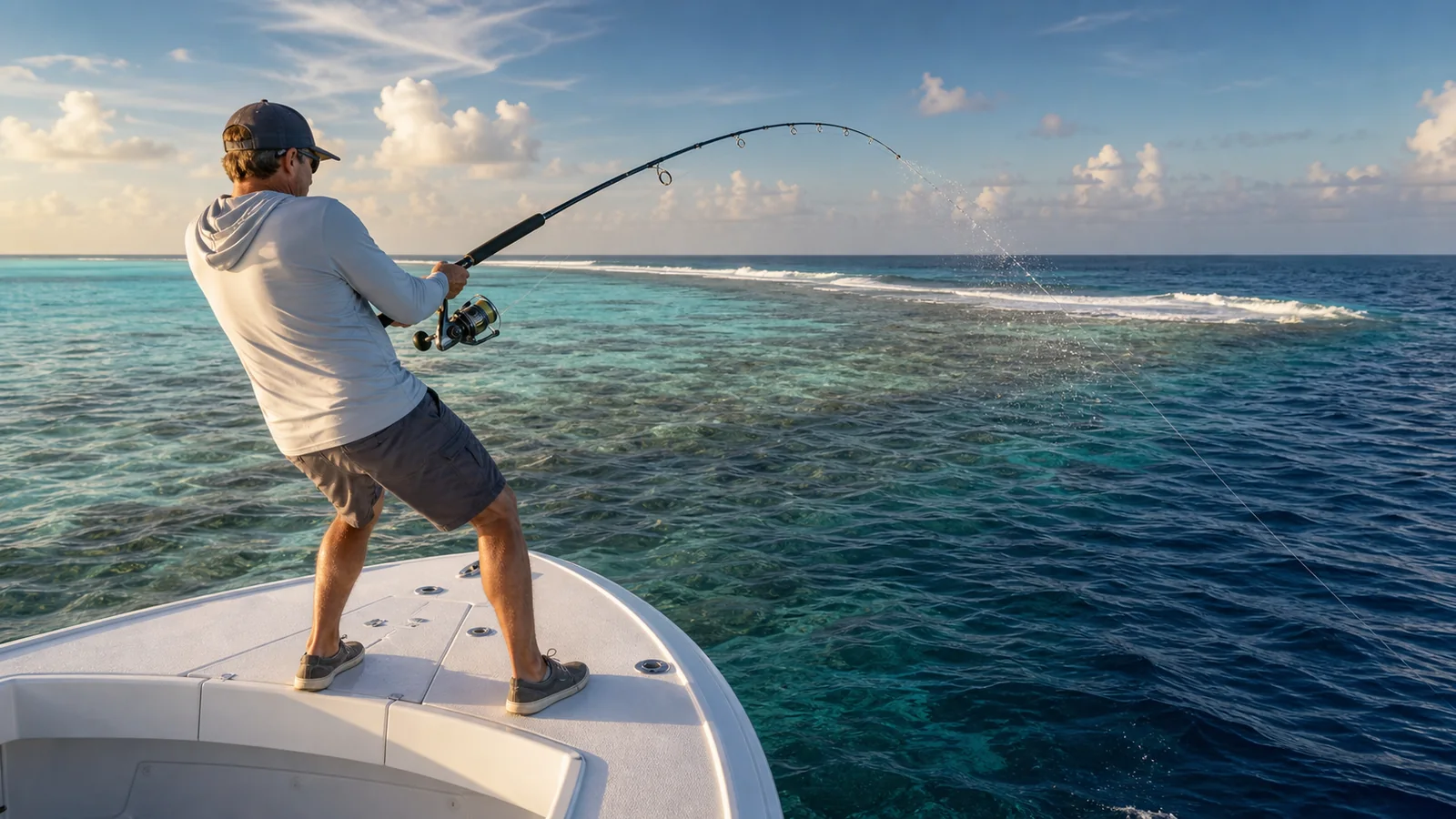
GT fishing in the Maldives runs year-round, with the conditions splitting cleanly. May to October, during the southwest monsoon, owns the strongest surface popping as bait pushes onto the reef edges. November to April, the northeast monsoon, brings calmer water, better visibility and easier sight-casting and jigging. Huvadhoo, Laamu, South Ari and North Malé hold the strongest grounds in the country. The right atoll depends on your dates, casting ability and trip length. The country holds more than 1,100 fish species across its 26 atolls, and Giant Trevally are the headline reef predator.
For the wider context across other species, see our Maldives sport fishing guide. This page is written for anglers who already know what GT are and who want to put a serious trip together. If you want a casual sunset or handline fishing experience instead, the right page is our casual Maldives fishing experiences guide. Everything below is release-only.
Giant Trevally, Caranx ignobilis, is the apex reef predator of the Indo-Pacific. The fish is built for ambush: a deep oval body, a blunt forehead that pushes water like a brick on the strike, and a shoulder mass that turns into solid mass under the rod. GT hunt by pinning baitfish against structure and accelerating into them, which is why current, depth changes and edges define where you find them.
Across the 26 atolls of the Maldives, GT are resident year-round. They hold along reef edges, in the mouths of channels between atolls, around isolated bommies on the inner reef, and along sandbank drop-offs where flats fall away into deeper water. The country's geography of narrow reef rims with deep blue water on the outside and calm lagoons on the inside gives GT exactly the kind of structure they hunt.
Most fish you catch will run 10 to 25 kg. Fish over 30 kg count as a serious trophy. Fish of 40 to 50 kg do come out of the southern atolls each season, and the species has been recorded to around 170 cm and 80 kg at the global extreme, but those numbers are highlights, not the daily average. Anyone telling you otherwise is selling something.
| Reef structure | Why GT hold there |
|---|---|
| Reef edge | Bait pushed against the coral wall has nowhere to go; ambush from below. |
| Channel mouth | Tidal current concentrates prey into a moving column. |
| Bommie | Isolated coral structure on the inner reef holds resident fish year-round. |
| Sandbank drop-off | Flats GT and bluefin trevally patrol the edge between shallow and deep. |
| Outer reef corner | Two currents meet; bait stacks; the predators wait. |
Catches vary by season, conditions, and angler experience. Photos and statistics reference past trips; no specific catch is guaranteed.

The single most common question we get on GT trips is when to come. The honest answer is that GT can be caught every month of the year, and the conditions, not the fish, are what change. The country runs two monsoons, and each one fishes differently.

The southwest monsoon pushes warmer surface water, more wind, and more bait movement onto the reef edges. This is when popping comes alive. Mornings can be glassy, afternoons can blow up. The wind brings swell against the outside of the atolls, which concentrates feeding behaviour against the reef. Rougher days happen and we plan around them, but the GT action in this window is the strongest in the calendar. If you have ever seen the videos of explosive surface strikes that pulled you into GT fishing, this is the season they were filmed in.
The dry season runs from December through to April, with November and May acting as transition months. Water is calmer, visibility is better, and conditions are friendlier for stickbaiting, sight-casting and jigging the channel walls. This is also the season we usually recommend for mixed groups, fly anglers, and anyone targeting GT alongside other species like dogtooth tuna and bluefin trevally. Trophy GT come out in this window too, just less frequently as surface strikes.
In either season, the first and last hours of daylight do most of the work. GT hunt the shallow reef edges hardest at low light, when bait is reduced to visible silhouettes against the sky. Moving tide is the second factor, especially around the channel mouths, where slack water turns the fishing off and the change of tide turns it back on. A good day rarely means fishing midday in flat sun; a good day means being on the right edge at first light and again before sundown.
GT exist across every atoll in the country, but the headline grounds for serious anglers are grouped in the south. The geography matters: depth, channel size, fishing pressure, and how easy the atoll is to reach all shape what a trip there looks like.

The most accessible base. Resident reef GT around channel mouths, well-known marks within an hour or two of Malé. The right choice for short stays, first GT attempts, and trips that need to start fishing the day of arrival. See our sport fishing in North Malé Atoll guide for the full plan.
Deeper outer-reef channels and the stretch from Dhigurah to Maamigili. Trophy water by reputation, with a working schedule of channel mouths and outer reef corners. Direct domestic flight to Maamigili shortens the travel day. More in our Ari Atoll sport fishing guide.
The southern showpiece for serious anglers. Wide channels, deep outer reefs, and less fishing pressure than the central atolls. Read the deeper plan in our sport fishing in Huvadhoo Atoll guide. Domestic flight to Kooddoo.
Eastern reef walls, remote channel mouths, classic southern GT grounds with limited boat traffic. The natural pair to Huvadhoo for multi-day southern trips. Domestic flight to Kadhdhoo. See our sport fishing in Laamu Atoll guide for the full plan.
Resort-based GT for mixed-interest groups, where the rest of the family wants the resort and the angler wants the reef. Less specialist than the southern atolls; entirely workable on the right tides. More in our Baa Atoll sport fishing guide.
Central-atoll channels accessible by liveaboard or speedboat from Malé. A common waypoint for multi-day trips that combine GT with reef-edge jigging. See our sport fishing in Vaavu Atoll guide for the working plan.
A single-island atoll in the far south, with seamount edges that draw deep-water predators within casting range of the reef. A specialist destination for anglers willing to travel for less-fished water. Domestic flight to Fuvahmulah. More in our Fuvahmulah sport fishing guide.
The southernmost ring atoll in the country, with natural channels and reliable GT grounds around the outer reef. Domestic flight to Gan. Often paired with Huvadhoo or Fuvahmulah for extended southern programmes. See our sport fishing in Addu Atoll guide.
Four techniques cover the working majority of Maldives GT fishing: popping, stickbaiting, jigging, and fly. Trolling will catch GT incidentally on the way to or from a mark, but no one comes to the Maldives specifically to troll for them. Shore casting is possible from a small number of resort islands and sandbanks but stays a sideline rather than a main programme.

Casting a cup-faced popper at a reef edge, working it back hard with the rod tip low, and watching the strike materialise out of clear water is what most anglers picture when they think GT. The romance is real and the reality is heavier work than it looks. A full popping day is hundreds of casts with a long rod and a 14000 to 20000 size reel, and the strike usually arrives just as your forearms start to question the decision. For the deeper plan on popping mechanics, casting fundamentals and lure choice, read our GT popping in the Maldives guide.
When fish are following but will not commit on the surface, stickbaits earn their place. A sinking stickbait worked along the reef edge holds the strike zone longer than a popper, and a floating stickbait twitched on the surface gives a different sound profile. Many of our most productive afternoons happen because the angler has switched off the popper.
The channel walls between atolls drop into deep blue water with structure all the way down. Speed jigging and slow-pitch jigging both work, and the bycatch on a jigging session can include dogtooth tuna, yellowfin trevally, snapper and grouper. Our dedicated technique guide to jigging on the channel slopes covers gear, retrieve patterns and where the bycatch comes from.
GT on fly is the hardest of the working methods and the most visual. The setup is a 12-weight saltwater fly rod, large brush flies or baitfish patterns, and the patience to wade flats or walk reef edges looking for cruising fish. Hook-up numbers are low. The reward is that each shot is a sight cast at a known fish, and a hooked GT on a fly rod is its own category of memory. Wider Maldives fly content sits on our Maldives fly fishing guide.

You can fish with the kit our vessels carry, and most anglers do. Serious anglers usually bring their own trusted rods, reels and lures because a popping rod is a personal piece of equipment and the relationship between angler and rod matters when a 25 kg fish is changing direction under the bow.
| Item | Working setup for Maldives GT |
|---|---|
| Rod | PE8 popping rod, 7 ft 6 in to 8 ft 3 in. PE6 for lighter days; PE10 for heavy southern reef work. |
| Reel | 14000 to 20000 size spinning reel with a sealed drag. |
| Braid | PE6 to PE10. PE8 is the working default. |
| Leader | 80 to 130 lb fluorocarbon or hard mono; usually 100 lb. |
| Lures | 160 to 220 mm cup-faced poppers and sinking and floating stickbaits. |
| Hooks | Single inline hooks, 8/0 to 10/0; heavy split rings. |
| Extras | Casting gloves, split-ring pliers, leader gloves, polarised sunglasses. |

If you fly in with your own rods, tube them properly. Domestic flights to atoll-level airports have hold-baggage limits that catch out anglers travelling with multiple long rod tubes. We will tell you exactly what your domestic carrier allows when we put your itinerary together.
The format of the trip matters as much as the atoll. Four options cover almost everything we plan.
One fishing day inside a wider Maldives trip. Best for first GT attempts, short stays, and anglers whose main reason for visiting is something else. Lower logistics, lower cost, lower probability of catching the trip's standout fish.
For couples and families where the angler wants real fishing and the rest of the group wants the resort. We arrange daily transfers to the right reef edges from a base that keeps everyone happy. Pair with our luxury dive and fishing resort options for groups who want both.
The best value format for 3 to 5 fishing days. You stay on a local island close to the fishing grounds, head out at first light with a Maldivian crew, and come back to a small guesthouse rather than a resort. Lower cost, higher fishing efficiency.
For serious anglers focused on Huvadhoo, Laamu, Vaavu or Fuvahmulah, with multiple days on the water and the freedom to move with conditions. The longest format, the highest cost, the strongest fishing.
A quick decision aid for anyone unsure which format fits. Use this as a starting point and the Trip Builder will refine it against your actual dates.
| If you are | Best setup |
|---|---|
| Staying in Malé or Hulhumalé | North Malé day charter |
| Staying at a South Ari resort | Resort-pickup GT popping charter |
| A serious GT angler chasing trophy fish | Huvadhoo or Laamu multi-day trip |
| A fly-focused angler | Huvadhoo, Addu or a flats-based programme |
| A couple or family with one fishing companion | Resort-based fishing add-on |
| A budget-focused angler | Guesthouse-based 3 to 5 day trip |
| Travelling in a group of 4 to 6 anglers | Southern-atoll liveaboard or two-vessel coordinated programme |
Send your travel month, group size and casting level. We will match the atoll, vessel and stay format and come back with one bundled quote.
HolidayVibe is a Ministry of Tourism licensed Maldivian agency based in Malé. We are not a charter listing platform. The job is to match the right reef edge, season, current, vessel and accommodation base to the way you want to fish, and to send back one quote with the boat days, transfers, domestic flights and stay all coordinated. Our fleet covers walkaround sport fishers, centre consoles and liveaboards across the atoll system. Each vessel is surveyed and certified annually under Maldivian regulation.
The Trip Builder is the working tool for this. Tell it what you want to catch, the month you can travel, group size, casting level and stay preference, and it returns a draft itinerary that our team finalises with a real quote.
Every Giant Trevally caught on a HolidayVibe-planned trip goes back into the water. This is not a footnote or a regulation we are reluctantly observing; it is how Maldives sport fishing operates. GT are slow-growing, territorial reef fish. A 30 kg trophy is a 15 to 20 year old animal. Killing one is killing the ground.

Working release looks like this: the fish stays in the water through every part of the handling, supported horizontally under the belly and at the wrist of the tail, never hung vertically by the lower jaw. Hooks come out at the boatside with long-nose pliers; if a hook is deep, the leader is cut and the hook left in. Photographs happen quickly, with the fish still wet and just below the surface. The fish is then held facing into the current until it turns under its own power and swims down. Wet gloves, calm hands, no rush.
The honest version: you are up before first light, eating something fast, on the boat by sunrise. The first hour of light fishes the highest-percentage reef edges. The middle of the day is slower, and you might run to a channel mouth on the change of tide or rest the casting arm and switch to jigging. Late afternoon brings the second window. You are back at the base by sundown, salt-burned, forearm-tired, and probably hungry.
Some days the strikes line up and the photographs come quickly. Other days the wind comes up or the bait disappears, and you cast for hours for one fish. Most weeks land somewhere in between. We do not guarantee catches and no one credible does. On the trips we plan, you may also hook dogtooth tuna, yellowfin tuna, bluefin trevally, wahoo and the occasional sailfish, depending on where and how you fish.
If a non-angler is travelling with you, that is no problem. The flexibility to add reef snorkels, spa days, dive trips or simply a quiet beach stay is built into the way we put trips together. The wider Maldives vacation does not pause because one person is fishing.
The mistakes below are the ones that turn good trips into mediocre ones. Most come from foreign anglers using off-the-shelf assumptions instead of local conditions.
The southwest monsoon fishes differently from the dry season, and the southern atolls fish differently from the central ones. Picking the atoll first and then trying to make the season work is the most common opening error.
One day inside a beach holiday will probably catch you a GT. It probably will not catch you the standout fish. Trophy GT come from putting in repeat dawn windows.
Light split rings, undersized assist hooks, abrasive leader knots. A serious GT will find every weakness in the connection chain in the first three seconds. The leader, knots and hooks are not where to save money.
Anglers used to lighter species often bring 130 mm lures expecting a downsize advantage. For reef GT in the Maldives, 160 to 220 mm is the working range. Smaller lures move less water and trigger fewer commits.
It is easy to rationalise lying in. The high-percentage hours sit either side of those rationalisations. If you want a serious fish, the alarm goes off before sunrise.
Slack water turns the channel mouths off. The change of tide turns them back on. Sound boat planning is built around moving water, not the clock.
It damages the fish and lengthens recovery time, sometimes fatally. Horizontal support, fish in the water, quick photographs. Always.
Indicative ranges for the formats we plan, with what each one typically covers. Every quote we send is built individually to your dates, group and atoll, so treat the numbers below as starting reference points.
| Trip format | Best for | What's included | Indicative price |
|---|---|---|---|
| Malé or North Malé GT day charter | Short-stay anglers, first GT attempt | Private vessel, captain and crew, popping and stickbait gear on board, drinks and snacks, fuel | USD 900 to 1,500 per boat |
| South Ari resort GT add-on | Resort guests adding fishing to a wider stay | Resort pickup, 4 to 8 hour vessel, working gear on board, reef-edge popping or jigging programme | USD 800 to 2,500 per boat |
| 5-night Huvadhoo GT package | Serious anglers wanting full days in less-fished water | Guesthouse stay, 4 fishing days, domestic flights, transfers, meals, gear on board | USD 1,800 to 3,500 per person |
| 6 to 7 night southern liveaboard | Hardcore GT, mixed popping and jigging across multiple atolls | Liveaboard berth, crew, meals, multi-atoll fishing programme, gear on board | USD 3,000 to 6,000+ per person |
Vessel, captain and Maldivian crew. Popping and stickbait gear on board (most vessels). Drinks and snacks aboard. Fuel allowance for the planned programme. Resort or guesthouse pickup where applicable. In package formats: domestic flights, transfers, accommodation and meals.
International flights to and from Malé. Premium lures lost or damaged on the reef, where the vessel charges for replacements. Alcohol. Crew gratuities. Personal fishing gear, if you bring your own. Travel insurance. TGST and Green Tax, which are applied on top of listed rates.
Most anglers arrive into Velana International Airport in Malé and connect to a domestic flight to the right atoll. Kooddoo serves Huvadhoo, Kadhdhoo serves Laamu, Maamigili serves South Ari, and Gan serves Addu in the far south. Domestic flights typically run 45 to 75 minutes. Speedboat transfers from Malé serve North Malé, South Malé and Vaavu directly.
For multi-day southern atoll trips, we recommend a minimum lead time of six to eight weeks during peak season. Liveaboard berths book ahead. For shorter charters from Malé, two to four weeks is usually workable. Groups of two to four anglers fit cleanly onto most sport fishers; larger groups split across two vessels with a coordinated programme.
The order matters. Get the first two right and the rest falls into place.
We are a Ministry of Tourism licensed Maldivian agency based in Malé, with years of experience planning sport fishing across the atolls. Our team speaks English and the captains and crews in our fleet do too. Vessels are surveyed and certified annually. You have direct WhatsApp access to our team before, during and after the trip, on a Malé number that someone in Malé actually answers.
GT can be caught year-round, but the seasons fish differently. May to October, during the southwest monsoon, owns the strongest surface popping as bait pushes onto the reef edges. November to April, the northeast monsoon, brings calmer water, better visibility and easier sight-casting and jigging. The first and last hours of daylight are the high-percentage windows in either season.
Huvadhoo and Laamu in the south hold the strongest and least-fished GT grounds. South Ari offers deeper outer-reef channels for trophy fish. North Malé is the most accessible base for short trips. Baa, Vaavu and the equatorial atolls of Fuvahmulah and Addu each have a place in trip design, depending on your dates and travel style.
Caranx ignobilis reaches around 170 cm and 80 kg at the global extreme. Realistic Maldives sport-fishing catches run 10 to 25 kg most days, with fish over 30 kg counting as a serious trophy. Fish of 40 to 50 kg do come from the southern atolls each season, but they are highlights, not the daily average.
Yes. Release-only is the working ethic for Giant Trevally across Maldivian sport fishing. Fish are kept in the water through every part of the handling, supported horizontally under the belly, never hung vertically by the lower jaw, and given time in the current to revive before swimming away. Crews handle this as standard practice.
Yes. GT on fly is the hardest way to target the species and the most visual. A 12-weight saltwater fly rod, large brush flies, and the patience to wade flats and walk reef edges. Hook-up numbers are low compared with popping, but each shot is a sight cast at a known fish. A small share of our trip designs are built specifically around fly.
A PE8 popping rod, a 14000 to 20000 size spinning reel, PE6 to PE10 braid, 80 to 130 lb fluorocarbon leader, 160 to 220 mm poppers and stickbaits, heavy split rings, single inline hooks, casting gloves and split-ring pliers. Most vessels in our fleet carry working kit on board. Serious anglers usually prefer their own trusted rods, reels and lures.
Short GT charters run roughly USD 700 to 1,500. A full-day GT popping charter sits in the USD 900 to 2,000 band. A 4 to 5 night guesthouse-based GT package usually falls between USD 1,500 and 3,000 per person. A 6 to 7 night liveaboard or southern-atoll package runs USD 3,000 to 6,000+ per person. TGST of 17% and Green Tax apply on top; we confirm both upfront in every quote.
A day charter works if you have one fishing day in a wider Maldives trip. A 3 to 5 day guesthouse base lets you fish the right tides and dawn and dusk windows. A multi-day southern-atoll trip or liveaboard format is the answer for serious anglers chasing trophy fish in less-fished water. The Trip Builder is built to match the format to your dates and goals.
Tell us your dates, casting level, preferred trip length and accommodation style. We will come back with a bundled GT-focused itinerary, fishing days, transfers, stays and a clear quote.
Ministry of Tourism licensed Maldivian agency · Malé-based team · Direct WhatsApp throughout your trip
Read our wider Maldives sport fishing guide and explore more Maldives experiences.