

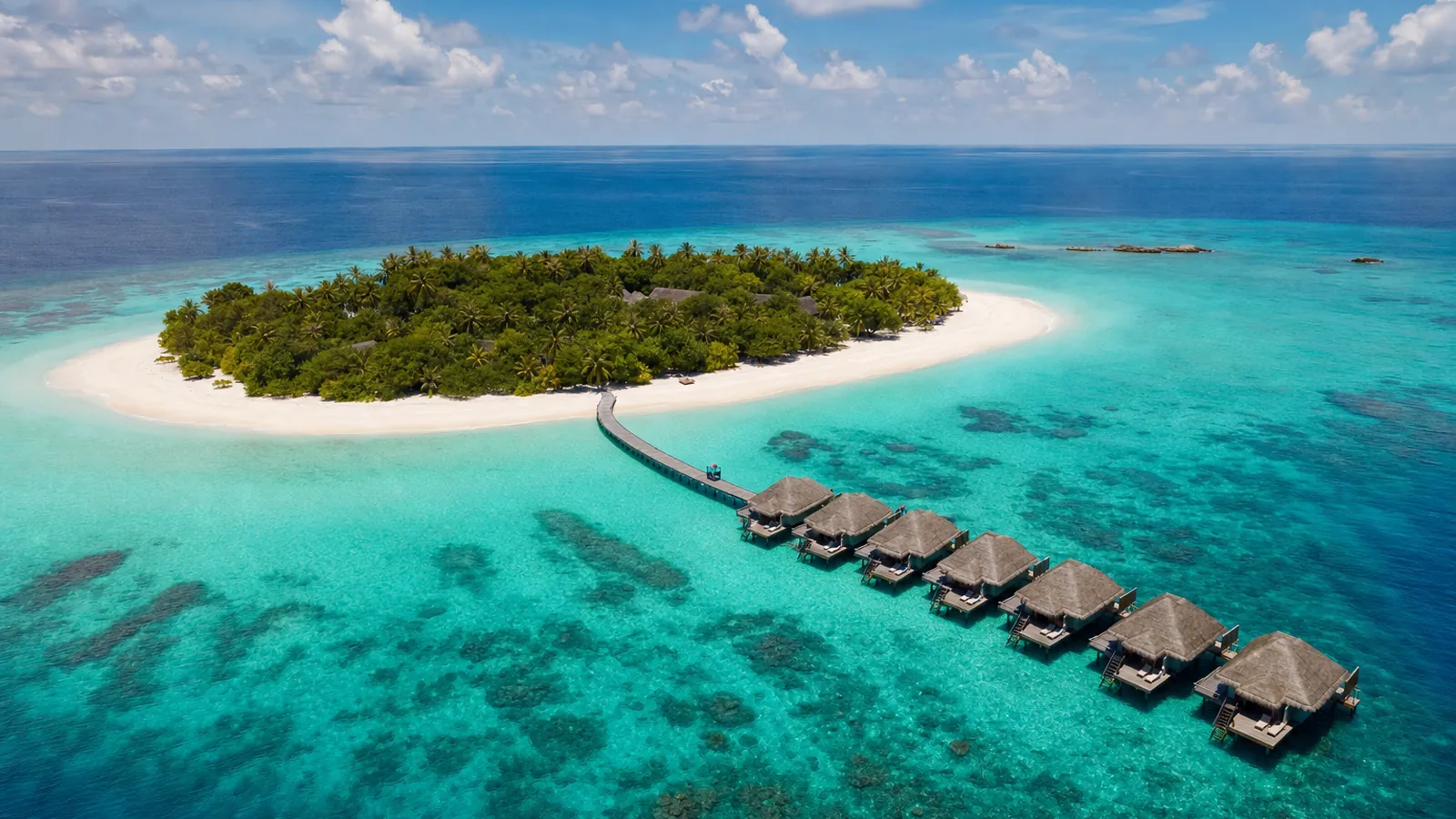
A Maldives vacation isn’t a beach trip with extra steps. It’s a different kind of trip altogether. One resort, one island, one transfer that determines your entire experience. The country has 1,192 islands across 26 atolls, and almost every resort sits alone on its own. Get the planning right and you land in a postcard. Get it wrong and you spend the first day stuck in Malé waiting for a seaplane that doesn’t fly after dark.
This guide is built for US travelers planning a real trip in 2026. We’re based in the Maldives, licensed by the Ministry of Tourism, and we’ve spent years untangling the same questions you’re about to ask. Costs in USD, gateway-by-gateway flight routing, transfer logic by traveler type, and the small operational details that decide whether your vacation works.
Most beach destinations work the same way. You fly into a major city, you pick a hotel, you get a taxi, you spend your week there. The Maldives doesn’t work like that.
The country is an archipelago of 1,192 coral islands scattered across 26 atolls in the Indian Ocean. Almost every resort occupies its own private island, which means once you check in, you’re staying there. You don’t pop into town for dinner. You don’t hop to another resort for the day. The island you choose is the vacation.
That single fact reshapes every other planning decision. Your transfer isn’t a five-minute taxi ride from the airport. It’s a 15-minute speedboat or a 30-to-90-minute seaplane flight, and seaplanes don’t fly after dark. Your meal plan isn’t optional padding to a hotel booking. It’s the difference between a comfortable vacation and a $5,000 surprise on your final bill, because there’s nowhere else to eat. Your activities aren’t a list of things you might do. They’re whatever your single resort offers, plus the excursions it runs.
This is also why a Maldives vacation has a higher information cost than most beach trips. The 17% Tourism Goods and Services Tax (TGST), the $12 per person per night Green Tax, the 10% service charge, the seaplane operating window, the IMUGA traveler declaration, the difference between a beach villa and a water villa for a family with toddlers, the resort that looks beautiful in photos but sits 90 minutes from the airport when your flight lands at 16:00. None of this is hard once you know it. All of it costs money or time if you don’t.
The good news: once you understand the structure, the rest of the trip plans itself. The page below walks through every decision in order.
The Maldives has two seasons, and they correspond to the two monsoons that shape the Indian Ocean. The locals call them Iruvai (the northeast monsoon) and Hulhangu (the southwest monsoon). Most travel sites simplify this to “dry season” and “wet season,” and that mostly works.
Dry season runs December through April. Skies stay clear, seas stay calm, water visibility for snorkeling and diving is excellent, and humidity drops. This is also when prices are highest, especially over Christmas, New Year and the US winter break. February is statistically the driest month of the year. Temperatures sit around 28-30°C (82-86°F) and barely move all year.
Wet season runs May through November. “Wet” overstates it. You still get seven to eight hours of daily sunshine on average, but rainfall increases, especially in June and July. Water visibility for diving drops on the eastern side of the atolls and improves on the western side. Resorts knock 30-50% off their rates. The trade is real, and worth thinking about honestly.
A US-traveler nuance most guides miss
If you have school-age kids and you’re locked into US school holidays, your real options narrow. Spring break (March-April) is excellent weather and high prices. Memorial Day weekend through July 4th catches the early wet season but with shoulder pricing. Thanksgiving is one of the best value windows of the year — late wet season, weather is improving, and US-traveler demand is comparatively low. Winter break (mid-December through New Year) is the most expensive single window in the Maldives calendar.
The Maldives’ biggest non-beach draw is its marine life, and certain creatures show up only in certain months. If a specific encounter is on your bucket list, plan around it.
| Creature | Best months | Where |
|---|---|---|
| Manta rays (reef + oceanic) | June – November (peak) | Hanifaru Bay, Baa Atoll (UNESCO Biosphere) |
| Whale sharks | September – November and May – June | South Ari Atoll (Maamigili area) |
| Reef sharks, sea turtles | Year-round | Most house reefs across all atolls |
| Tiger sharks, hammerheads | February – May | Fuvahmulah |
| Spinner dolphins | Year-round (best at sunset) | Most atolls, dolphin cruise excursions |
| Bioluminescent plankton | July – November (best on dark moonless nights) | Vaadhoo Island, scattered beaches |

There are no nonstop flights between the USA and the Maldives. Every routing has at least one stop, almost always at a Gulf or European hub. Total elapsed door-to-door is typically 19-30 hours depending on origin city, hub, and connection time. Plan for two days of travel each way.
Five hubs handle almost all US-to-Maldives traffic: Doha (Qatar Airways), Dubai (Emirates), Abu Dhabi (Etihad), Istanbul (Turkish Airlines), and Singapore (Singapore Airlines). Each has different US gateway coverage, different connection patterns, and different fits depending on your origin.
| From | Best routings | Approx. total elapsed |
|---|---|---|
| New York (JFK / EWR) | Qatar via Doha; Emirates via Dubai; Turkish via Istanbul | 18-22 hours |
| Los Angeles (LAX) | Singapore via SIN; Emirates via Dubai; Qatar via Doha | 22-28 hours |
| Chicago (ORD) | Qatar via Doha; Emirates via Dubai; Etihad via Abu Dhabi | 19-24 hours |
| Miami (MIA) | Qatar via Doha; Turkish via Istanbul | 21-25 hours |
| Washington DC (IAD) | Qatar via Doha; Emirates via Dubai; Etihad via Abu Dhabi | 19-23 hours |
| San Francisco (SFO) | Singapore via SIN; Emirates via Dubai | 23-28 hours |
| Houston (IAH) | Qatar via Doha; Emirates via Dubai; Turkish via Istanbul | 21-26 hours |
Round-trip economy fares from major US gateways typically run $1,000 to $1,900 in shoulder months and $1,500 to $2,400 over peak winter weeks. Business class runs $3,500 to $6,000 round-trip and is genuinely worth considering for a flight this long, especially on the return.
One detail US travelers often miss: your arrival time at Malé determines what kind of resort you can pick. That’s the next section.
Seaplanes in the Maldives are operated by three companies: Trans Maldivian Airways (TMA, the largest, with more than 80 resort routes), Manta Air, and Maldivian. They all share Noovilu Seaplane Terminal, the world’s largest seaplane facility, located adjacent to Velana International Airport.
The critical fact: seaplanes only operate during daylight hours. First flights leave around 06:00, last flights typically wrap up by 16:00, with some routes cutting off as early as 15:30 for the most distant atolls. There is no night seaplane service, anywhere, ever.
What this means for US travelers: most flights from the Gulf hubs land at Malé in the morning or early afternoon. Qatar’s QR676 from Doha typically lands around 07:00. Emirates EK654 from Dubai around 14:00. Etihad EY278 from Abu Dhabi around 09:30. These are good arrivals — you have time for a same-day seaplane to your resort. But if your routing has a long layover and you land late afternoon or evening, you’re not making the seaplane.
Late arrival? You have three options.
1. Pick a speedboat-accessible resort in North or South Malé Atoll. These run 24 hours a day. Many guests book this style specifically because of arrival flexibility.
2. Book a domestic flight + speedboat combo (most common for far-southern atolls like Addu, Gaafu Alifu, or Fuvahmulah). Domestic flights run later than seaplanes.
3. Overnight at Hulhulé Island Hotel next to the airport, then catch the first morning seaplane. Roughly $250-400 per night, includes airport-to-hotel and hotel-to-terminal transfers. This is what most travelers in this situation end up doing, and it’s a perfectly fine first night.
The reverse matters too. On your departure day, plan international flights to depart Malé after 09:00 minimum, and ideally after 11:00 if you’re returning from a seaplane resort. Your morning seaplane back to MLE typically lands you at Velana airport by 08:00-10:00, with a buffer for the inevitable schedule shift.

You don’t pick a city in the Maldives. You pick an atoll. Your atoll determines transfer time, resort price band, marine life access, and how much of your week is spent on a plane.
The Maldives has 26 atolls. Maybe ten of them matter for vacation planning. Here’s how to think about them.
The closest cluster of resorts to the airport. 15-90 minutes by speedboat. Excellent for late arrivals, families with young kids, anyone wanting to maximize beach time vs travel time. Resort range from mid-tier to ultra-luxury.
Adjacent to North Malé. Speedboat transfers in the same 30-90 minute range. Strong house reefs. Solid mid-luxury resort selection (Anantara Veli, Velassaru, Cocoa Island, Adaaran Prestige). Easy logistics on both arrival and departure.
UNESCO World Biosphere Reserve. Hanifaru Bay is the world-best manta ray and seasonal whale shark hotspot, peak June-November. Ultra-luxury resorts (Soneva Fushi, Four Seasons Landaa Giraavaru, Anantara Kihavah). 30-45 minute seaplane.
The whale shark atoll. Year-round whale shark sightings near Maamigili, peak May-June and September-November. Strong dive sites. Mix of mid-luxury and luxury resorts (Lily Beach, Conrad Rangali, Vakarufalhi). 25-30 minute seaplane.
Remote luxury. The Standard, Joali, Joali Being, Intercontinental Maamunagau. 45-50 minute seaplane. Far fewer resorts, far fewer guests, far higher rates.
Mid-luxury sweet spot for travelers who want a step out from the busy near-airport atolls without the cost of remote luxury. Many strong resorts at moderate price points. 30-45 minute seaplane typically.
Far southern Maldives. Domestic flight (1-1.5 hours) plus speedboat. Specialty trips: world-class diving, tiger shark encounters at Fuvahmulah, the equator crossing. Best for second-time visitors and dive-focused trips, not ideal for short first-time vacations.
A simple atoll-selection rule of thumb
For a 5-night first trip, stay in North or South Malé Atoll. For 7-10 nights with a marine-life priority, pick Baa (mantas) or South Ari (whale sharks). For 10+ nights or a second trip, consider Raa, Noonu, or the far south.
The Maldives offers three accommodation paths. Most US travelers default to the first without realizing the others exist.
One island, one resort. About 165 of them across the country. This is the canonical Maldives experience: overwater villas, infinity pools, butler service, gourmet dining, no other guests outside your resort. Pricing runs from roughly $400/night at the lower end (Adaaran, Bandos, Kuredu) to $4,000+ for the ultra-luxury tier (Soneva Jani, Velaa, Cheval Blanc Randheli, Joali). All-inclusive packages, water villas, and spa programs are standard. Best for first-time visitors, honeymooners, and travelers who want the iconic experience.
Since 2009, Maldivian law has permitted guesthouses on inhabited (non-resort) islands. This opened up the budget path. Maafushi, Dhigurah, Fulidhoo, Thoddoo, Ukulhas, and others offer guesthouse stays from $50-150/night. You eat at local cafés, use public ferry transport ($2-4 one-way) or short speedboat hops, and join shared dive and snorkel excursions. Restrictions: alcohol is not permitted on local islands (some have a “tourist beach” with separate rules and a few have floating bars offshore), and beachwear should be conservative outside designated tourist beach areas. Best for budget travelers, divers, and people who want to actually meet Maldivians rather than only resort staff.
Multi-day cruises on a dedicated boat, typically diving-focused. 7 nights with all dives, full board, and atoll-hopping runs $1,800-3,500 per person. Best for serious divers who want to maximize underwater time and sites. Less suited to first-time visitors who want resort comfort and beach time.
Most US first-timers want path one. Knowing the others exist matters because some couples mix them: a few nights on a local island for $300, then a few nights on a resort island for the iconic experience, all in one trip.

The overwater villa is the iconic Maldives image. But it isn’t always the right choice, and travel sites rarely admit when it’s not. Honest comparison:
| Water villa | Beach villa | |
|---|---|---|
| Typical 2026 rate range | $600-2,000+/night | $400-800/night |
| Space | Compact (60-100 sqm) | Larger (often 90-150 sqm), sometimes with garden |
| Direct lagoon access | Yes, ladder from deck | No, walk to beach (usually 10-20 paces) |
| Beach | None at your villa | Yes, often private or semi-private |
| Family with toddlers | Anxiety-inducing (water edge everywhere) | Strongly preferred |
| Mobility issues | Long boardwalks, stairs to deck | Easy access |
| Light sleepers | Wave sounds at night (some love it, some don’t) | Quiet |
| Privacy | High (villas spaced apart) | Variable by resort |
| Snorkel from your villa | Sometimes (depends on lagoon coral) | Walk to nearby reef |
The honest answer: water villa for honeymoons, anniversaries, and couples with no mobility issues. Beach villa for families, multi-generational trips, longer stays, and travelers who want a real beach to walk on. Many couples split the trip — three nights in a beach villa, three nights in a water villa — to experience both. This costs more but eliminates the regret of choosing the wrong type for the whole stay.
Resort meal plans cause more US-traveler confusion than any other element of Maldives planning. The labels mean different things at different resorts.
Bed & Breakfast (B&B): Room rate plus breakfast. Lunch, dinner, all drinks, and excursions are extra. Lowest base rate but the highest variable cost. A couple typically spends $80-200/day on lunch and dinner alone, before drinks.
Half Board (HB): Breakfast and dinner. Lunch, drinks, and excursions extra. The most common middle option. Adds roughly $80-150/person/day to the room rate.
Full Board (FB): Breakfast, lunch, and dinner. Drinks (including soft drinks at most resorts) extra. Adds roughly $130-200/person/day to the room rate.
All-Inclusive (AI): Meals, most drinks (often including alcohol — but the bar list varies hugely by resort), some snacks, and at lower-tier AI resorts a few activities. Adds $200-500/person/day to the room rate. “All-inclusive” at a Maldives resort is not the same as all-inclusive in the Caribbean. Premium spirits, premium wines, off-island excursions, spa treatments, motorized water sports, and underwater dining are almost always extra.
Quick all-inclusive worth-it test
If you and your partner will eat 3 meals a day and have 4+ drinks daily (any combination of cocktails, wine, beer, soft drinks), AI almost always pays. If one of you doesn’t drink alcohol or you skip lunch routinely, half board often wins by $300-600 over a 7-night stay.
Cost is where most US travelers get caught off guard. The published nightly rate is usually the smallest line item by the time you total everything. Real cost is the rate, plus the tax stack, plus transfers, plus flights, plus on-the-ground extras.
Effective from July 2025, the Maldives Tourism Goods and Services Tax (TGST) is 17%. This applies to room rates, meals, drinks, and most services billed by the resort.
The Green Tax was doubled from January 2025: $12 per person per night at resorts and larger hotels, $6 per person per night at smaller guesthouses. Children under 2 are exempt. This goes to the Maldives Green Fund for environmental protection.
Most resorts add a 10% service charge. This is paid to staff and is not optional.
The cumulative effect is roughly 27-29% added to your base rate by the time you check out. None of it is hidden if you know to look. Most aggregator booking sites still don’t show it correctly.
For deeper detail and a calculator that runs your specific dates and party size, see our full Maldives vacation cost guide.

The water is the activity. Most resorts include in their base rate: house reef snorkeling with provided gear, kayaks, paddleboards, beach volleyball, daily snorkel trips. Most things you have to pay for separately:
Single dive with gear: $80-120. PADI Open Water course: $650-900. Most resorts have onsite dive centers. Liveaboards offer the most diving per day.
$120-220 per person, half-day. Hanifaru Bay (Baa) for mantas in season; South Ari for whale sharks year-round.
$150-400 per couple. A boat takes you to a small uninhabited sandbar, you spend a few hours there, lunch is delivered. Iconic photo opportunity.
$60-120 per person. Most atolls have resident spinner dolphin pods. Sunset cruises run year-round.
$250-900 per couple. Often used for honeymoons, anniversaries, and proposals. Worth booking ahead, often via your travel advisor before arrival.
March-October on the western side. North Malé Atoll has accessible breaks (Cokes, Chickens, Sultans). Outer atolls offer remote surf charters.
Single resort in North or South Malé Atoll, beach villa, half board. Day 1 arrival + check in. Days 2-3 house reef snorkel, sunset cruise, spa. Day 4 sandbank picnic. Day 5 morning beach + departure. Speedboat transfer eliminates seaplane risk.
Single resort in Baa Atoll (June-November) for manta season, or South Ari for whale sharks. Mix of 3 nights beach villa + 4 nights water villa. Add a manta excursion and one private dinner. Half board or all-inclusive depending on drinking habits.
Either 10 nights at one luxury property (Soneva, Joali, Velaa) for full immersion, OR a two-resort trip: 5 nights local-island guesthouse for cultural depth, 5 nights at a luxury water villa for the iconic experience. Combined cost often beats 10 nights at the top tier.
Multi-atoll. Try Raa or Noonu for remote luxury, then drop down to South Ari or Baa for the marine life, finish in Malé Atoll. Or combine with Sri Lanka or Dubai as a multi-centre trip. Best value comes from longer stays at fewer properties.
For day-by-day breakdowns by traveler type, see our detailed Maldives vacation itinerary guide.
Every Maldives vacation looks different. Some travelers want a packaged resort stay; others need detailed US flight and transfer guidance, or are weighing beach villas versus water villas, all-inclusive versus half board, or private resorts versus local-island guesthouses. Use the guides below to go deeper into the part of your trip that matters most.
Compare resort packages, inclusions, transfers, meal plans, and quote options. See Maldives vacation packages.
Plan flights, arrival timing, US gateway routes, and same-day resort transfers. Read the USA travel guide.
Understand when all-inclusive is worth it, what’s included, and what’s usually extra. Compare all-inclusive options.
Choose the right beach resort, lagoon, villa style, and transfer type. Plan a beach vacation.
Compare private island resorts, local islands, guesthouses, and island-hopping style trips. Explore island vacation options.
Learn when a water villa is worth it and when a beach villa may be the better value. Compare overwater bungalow stays.
Use these tools to estimate cost, check arrival timing, compare flight routes, and shortlist resort styles before requesting a quote.
Estimate your all-in cost in USD, including resort, flights, transfers, taxes, and extras. Use the cost estimator.
Check whether your Malé arrival time works for a same-day seaplane transfer to your resort. Check seaplane timing.
Compare common US gateway routes through Doha, Dubai, Abu Dhabi, Istanbul, and Singapore. Find your flight route.
Shortlist resort styles by budget, villa type, meal plan, transfer comfort, and travel style. Find your resort match.
This isn’t a sales pitch as much as a structural fact: a Maldives-local agency competing on a US-targeted page can offer pricing transparency, transfer expertise, and operational ground truth that aggregators and US-based bloggers structurally can’t match. The trade is that you talk to us before you book rather than self-serving an inventory feed. For most US travelers spending $5,000-25,000 on a once-in-a-lifetime trip, that conversation is worth having.
Tell us your dates, party size, and rough budget. We’ll send 2-3 tailored options with full USD pricing including all taxes and transfers, within 24 hours.

For two people on a 7-night trip in 2026, including round-trip flights from a major US gateway, transfers, taxes, and resort accommodation: roughly $5,000-8,000 for a budget local-island guesthouse trip; $7,000-10,000 for a mid-range 4-star resort with half board; $15,000-25,000 for a luxury water villa with all-inclusive; and $25,000+ for ultra-luxury properties like Soneva, Joali, or Velaa. Flights from US East Coast typically run $1,000-1,900 economy round-trip; West Coast routes run $1,200-2,200. Business class roughly triples flight cost.
December through April for the most reliable weather, clearest seas, and best snorkeling visibility. February is statistically the driest month. May through November sees lower prices (often 30-50% off), more rain, but excellent marine life, including manta and whale shark encounters in Baa and South Ari atolls. For US travelers, Thanksgiving week is one of the best value windows — late wet season weather is improving, US demand is comparatively low, and rates haven’t yet jumped for Christmas.
For US travelers, 7 nights is the sweet spot. Five nights feels rushed once you account for two days of flying. Ten nights is generous and lets you split between two resorts or atolls. Fourteen nights is excellent for second-time visitors or multi-atoll trips. The minimum that makes the long flight worthwhile is 5 nights; anything shorter and you’re spending more time getting there and back than enjoying the destination.
No advance visa is required. US passport holders receive a free 30-day visa on arrival at Velana International Airport. Maldives Immigration officially requires a Machine Readable Zone (MRZ) passport with at least 1 month of validity from arrival, but most US travelers still aim for 6 months of validity to avoid airline check-in or onward-destination issues. You also need a return or onward ticket and proof of accommodation (resort or guesthouse booking confirmation). Every traveler must complete the IMUGA Traveler Declaration online within 96 hours before arrival and again within 96 hours before departure, including children. Save the QR code on your phone.
Yes. The Maldives is one of the safest destinations in South Asia. Resort islands have negligible crime since they operate on closed-island principles. Local islands are also safe but more conservative — alcohol is prohibited, and beachwear should be modest outside designated tourist beach areas. The main practical risks are sun exposure, water-related accidents, and the remoteness of medical facilities for serious emergencies. Travel insurance with medical evacuation coverage is strongly recommended.
Yes, but only at resorts and on liveaboard vessels. Alcohol is prohibited on all inhabited local islands and at the airport for arriving and departing passengers (you cannot bring duty-free alcohol into the country). Resort all-inclusive packages typically include a selection of beers, house wines, and standard cocktails — premium spirits and premium wines are usually extra. If alcohol is important to your trip, choose a resort island, not a local-island guesthouse.
Pack light: the seaplane luggage limit is 20kg checked plus 5kg hand baggage per person. Essentials: lightweight clothing, multiple swimsuits, reef-safe mineral sunscreen, polarized sunglasses, wide-brimmed hat, rash guard for sun protection while snorkeling, light cover-up for resort restaurants, sandals plus one pair of sneakers (for excursions), insect repellent, basic medications, an underwater camera or GoPro, a UK-style 3-pin Type G plug adapter, and an unlocked phone for an eSIM. Skip dressy shoes (flip-flops dominate), heavy jeans, jackets, and most “just in case” items.
Yes, with the right resort. Family-friendly Maldives resorts have kids’ clubs (typically ages 4-12), shallow lagoon access, family villas with separate kid bedrooms, and family-oriented dining and activities. Strong family resort options include Kandima Maldives, Meeru Island Resort, Kuramathi Maldives, Kuredu, Villa Park, Sun Siyam Olhuveli, Anantara Dhigu, and selected Atmosphere and OBLU resorts depending on child ages, room setup, and offer period. Some resorts (and specific islands within multi-island resort groups) are adults-only, so always verify the child policy before booking. For families with toddlers, beach villas are strongly preferred over water villas due to the constant water-edge proximity. See our Maldives family vacation guide for resort recommendations and ages-allowed details.
A Maldives all-inclusive (AI) typically covers breakfast, lunch, dinner, most non-premium drinks (including alcohol), some snacks, and at lower-tier resorts a small list of activities. It does NOT typically cover: premium spirits, premium wines, off-island excursions like manta/whale shark trips, spa treatments, motorized water sports, signature restaurants, underwater dining, or seaplane transfers. Caribbean-style “everything included” doesn’t apply. For full clarity see our Maldives all-inclusive guide.
Yes. The most common combinations are Maldives + Dubai (most US flights route via Dubai anyway, so adding 2-3 nights costs little extra in flight terms), Maldives + Sri Lanka (45-minute flight from Malé to Colombo, makes a strong cultural-plus-beach pairing), Maldives + Singapore (West Coast US flights often route via Singapore), and Maldives + Bali. For multi-centre planning specifically tailored for US travelers, see our Maldives multi-centre holidays guide.
We respond within 24 hours with 2-3 tailored options, full USD pricing, and zero pressure to book. Licensed by the Maldives Ministry of Tourism.