

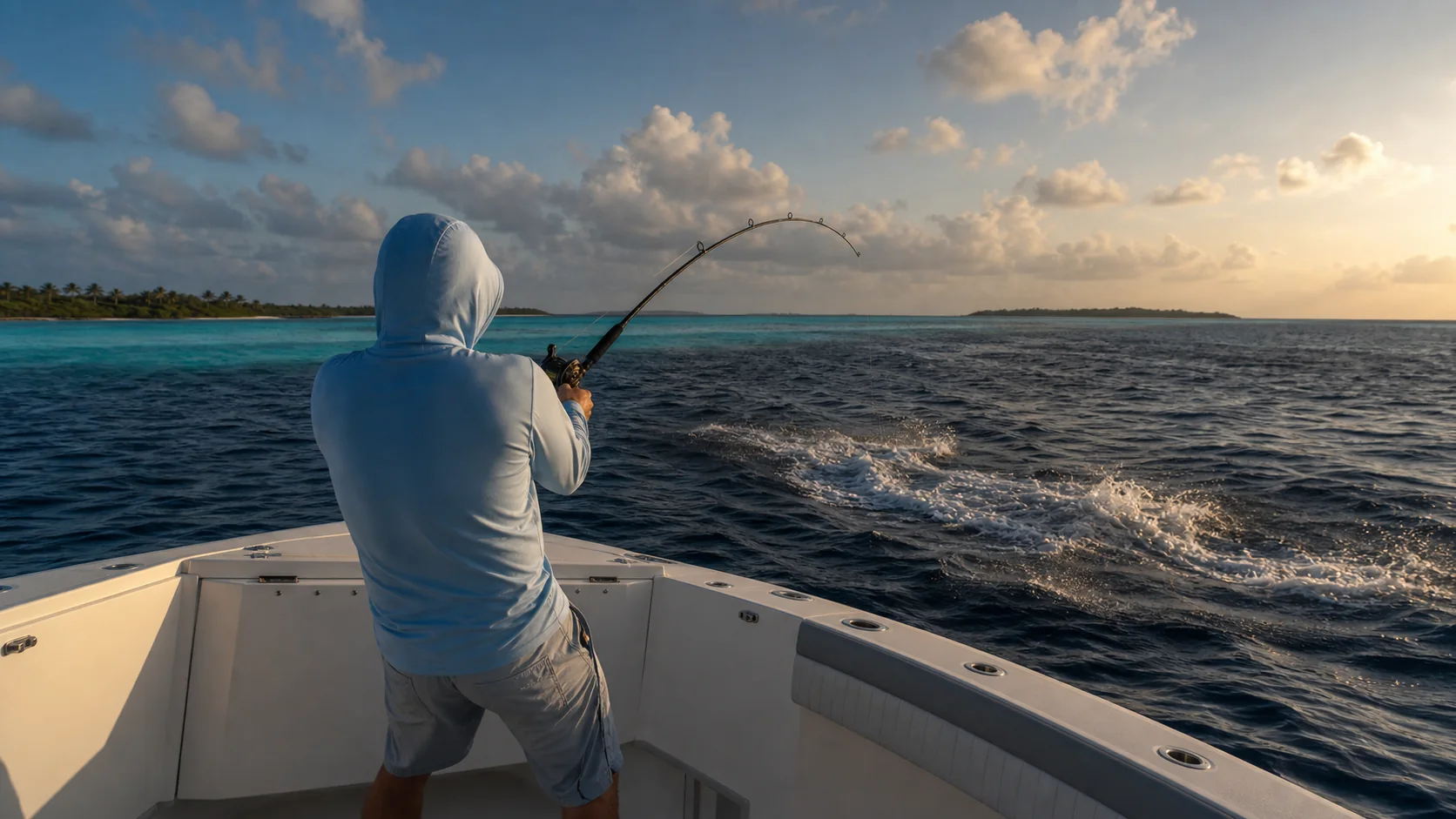
The Maldives is one of the most productive big-game and reef-popping destinations in the Indian Ocean. Twenty-six atolls and over 1,100 fish species across the archipelago, deep blue water within minutes of most islands, and year-round fishing for Giant Trevally, dogtooth tuna, yellowfin tuna, sailfish, marlin and wahoo. The catch is not booking a boat. It is matching the right atoll, the right season and the right vessel to the species you actually want to chase. That is what this guide and our trip designer do.
Tell us your dates, target species, group size and accommodation style. We will come back with a planned trip including vessel, atoll, transfers, accommodation and costs, not just a boat name.
Build My Maldives Fishing Trip Chat on WhatsAppNovember to April, northeast monsoon, calm seas, prime trolling
May to October, southwest monsoon delivers reef-edge action
Huvadhoo, the dogtooth tuna and GT grounds in the far south
Male’ or Ari, short transfers and a broad species mix
3 to 4 nights minimum, 5 to 7 nights ideal for remote atolls
Yes, and the geography is the reason. The Maldives is a 26-atoll archipelago stretching roughly 871 km north to south through the central Indian Ocean, made up of over 1,100 islands, sandbanks and reef structures. What that means in fishing terms is that on almost any day, in almost any atoll, you’re within thirty minutes of three different fishing environments: shallow flats and lagoons inside the atoll, reef edges and channel mouths where the structure drops away, and open deep blue water on the outside of the atoll where the pelagic predators live.
That combination is what makes the Maldives different from most destinations. You can pop a reef edge for Giant Trevally in the morning, troll a channel mouth for yellowfin in the afternoon, and finish on a sandbank flat with a fly rod chasing triggerfish before sunset, sometimes within the same atoll, sometimes within sight of the same island.

The Indian Ocean current systems push warm water and bait through the channels between atolls, and the deep blue water sits less than a kilometre offshore from many reef edges. Yellowfin tuna feed on the outside of atolls year-round. Giant Trevally use the reef channels as ambush points. Dogtooth tuna hold over deep pinnacles and seamounts. Billfish migrate through during the dry season. This is not a marginal fishery extended by good marketing. The structure genuinely produces fish.
One honest caveat: there are no catch guarantees in the Maldives, the same as anywhere else. Weather windows close. Wind shifts move fish off productive marks. The northeast monsoon can deliver three flat-calm days and then one rough one. Any captain promising “guaranteed” anything is overselling. What is reasonable to expect, with the right vessel and a good captain reading conditions, is consistent action across most of the year.
The species list is long. Here are the headline catches and what realistically targets each one, broken down by technique, season and what happens to the fish at the end.
| Species | Best techniques | Peak months | Catch & release? |
|---|---|---|---|
| Giant Trevally (GT) | Popping, fly, casting | May to Oct strongest, year-round possible | Always released |
| Dogtooth tuna | Vertical jigging, live bait, deep structure | Nov to Apr | Always released |
| Yellowfin tuna | Trolling, live bait, popping | Nov to Apr | Usually kept |
| Sailfish | Trolling, teasing | Nov to Apr | Always released |
| Blue and black marlin | Trolling lures and skirted baits | Nov to Apr | Always released |
| Wahoo | High-speed trolling, jigging | Nov to Apr peak, year-round | Usually kept |
| Mahi-mahi (dorado) | Trolling, casting around FADs | Year-round | Usually kept |
| Bluefin trevally | Casting, fly, jigging | Year-round | Usually released |
| Bonefish, triggerfish, permit | Fly fishing on flats | Nov to Apr | Always released |
| Grouper, snapper, jobfish, coral trout | Bottom fishing, jigging | Year-round | Usually kept |
Catches vary by season, conditions, and angler experience. Photos and statistics reference past trips; no specific catch is guaranteed.
If one fish gets anglers on a flight to Male’, it is the Giant Trevally. The Maldives is one of the few places on earth where you can target GT year-round, and the southwest monsoon from May to October produces the most consistent popping action. Reef-edge ambush points, channel mouths and sandbank drop-offs all hold fish, and a well-presented popper or stick bait can draw blistering surface strikes from fish over thirty kilos. Heavy PE6 to PE8 spinning gear is standard. Every Maldives GT is released, regardless of size. See our Giant Trevally fishing guide for the full species deep-dive.

Dogtooth tuna sit in the top tier of saltwater fish to land. They live over deep pinnacles, seamounts and channel drop-offs, hit jigs with savage runs, and have a reputation for breaking gear that is not up to the job. The Maldives, particularly the southern atolls, is one of the few destinations where consistent dogtooth fishing is possible. Vertical jigging with 200 to 300 gram knife jigs on heavy slow-pitch or speed-jigging gear is the standard method. Releases only.
Yellowfin tuna are the workhorse of Maldives offshore fishing. They hit trolled lures in the channels and outside reef edges, can run from 10 kg juveniles to genuine giants over 80 kg, and are good eating. Most boats keep a yellowfin or two for the table and release the rest. Sailfish and marlin are caught during the northeast monsoon when surface conditions favour billfish, and wahoo are an almost everyday catch on high-speed trolling spreads.

The shallow flats and sandbank zones inside the atolls hold a different fishery: sight-cast fly water for bonefish, triggerfish, milkfish, indo-pacific permit and bluefin trevally, with the occasional shot at a flats-tailing GT. The fly fishery is real but specialised, and the best windows are during the northeast monsoon when wind and visibility cooperate. See our dedicated page on saltwater fly fishing in the Maldives.
The Maldives spreads over 871 kilometres of ocean, and the atolls are not interchangeable. Where you fish depends on what is biting that month, how far you are willing to travel from Male’ and what species you are chasing. Here are the atolls that consistently produce, ranked by their reputation among visiting anglers.
The premier destination for serious Maldives sport fishing. Huvadhoo sits in the deep south, well away from the cruise-boat traffic, and the channel structure here is genuinely exceptional: wide channels, deep drop-offs, productive pinnacles. The best-known dogtooth and Giant Trevally grounds in the country.
Best for: dogtooth tuna, GT, multi-day expeditions, fly fishing on flats. See our full Huvadhoo fishing guide.
Laamu has the southern Maldives feel: fewer boats, longer transfers from Male’, and richer pelagic grounds. Anglers willing to fly down for a multi-day liveaboard or guesthouse-based trip get cleaner water and less-pressured fish than they would up north.
Best for: GT popping, yellowfin, week-long trips. Read our Laamu fishing guide.
Ari is the workhorse atoll for fishing add-ons to a wider Maldives trip. Easier access from Male’, a strong mix of resort-based fishing and dedicated charters, and consistent offshore trolling water on the western edge. Whale shark migrations through Ari add an extra dimension during the southwest monsoon.
Best for: mixed-species days, resort add-ons, shorter trips. Ari fishing details here.
Closest to Velana International Airport, so the obvious choice for short-stay charters and first-time visiting anglers. Half-day and full-day private charters out of Hulhumale’ hit channel mouths and reef edges that produce GT, wahoo and yellowfin within an hour of leaving the harbour. More boat traffic than the southern atolls but the easiest atoll to fish on a tight schedule.
Best for: day charters, first-timers, anglers based at airport-area resorts. North Male’ fishing options.
South Male’ sits across the Vaadhoo Kandu channel from North Male’ and offers a quieter alternative for anglers who want short transfers from the airport without the busiest reefs. Strong reef-edge structure, good channel mouths for GT and yellowfin, and a useful base for liveaboards heading south. Slightly longer transit than North Male’ but less rod pressure.
Best for: short stays with less boat traffic, mixed-technique days, southern Maldé departure for liveaboards. South Male’ fishing options.
Northern atolls with strong resort-based fishing programmes and excellent offshore trolling during the northeast monsoon. Baa is a UNESCO biosphere reserve, which constrains some inshore fishing but does not affect offshore work. Good water for sailfish during the dry season.
Best for: sailfish, mixed trolling, resort-paired fishing. See how Baa compares to the other atolls.
The southernmost atoll, near the equator. Addu has a different fishery from the central Maldives: strong fly fishing flats, equatorial yellowfin grounds, and one of the most remote feels of any inhabited Maldives atoll. Requires a domestic flight to Gan, then a transfer.
Best for: fly fishing, equator-zone expeditions, serious distance anglers. Addu fishing guide.
Not sure whether Huvadhoo, Laamu, Ari or Male’ fits your dates and budget? Match me to the right atoll →
Almost every Maldives sport fishing trip falls into one of three formats: a resort excursion, a private day charter from a guesthouse-based island, or a multi-day liveaboard or island camp. They are not interchangeable. Each suits a different angler.

If you are going to the Maldives primarily for the beach holiday and want to add a day of fishing, take the resort excursion. The vessels are equipped, the crew speaks English, and you are back at the resort by lunchtime or sunset.
If you are serious about catching fish and want better value, stay on an inhabited local island and book a private charter. You will pay roughly half what a resort charges for the same boat and you will meet local captains who fish these waters every day. We list fishing-friendly guesthouses across the atolls in the Trip Builder.
If fishing is the trip (five days, seven days, a repeat visit, or a serious species mission), go with a multi-day liveaboard or a dedicated island fishing camp. This is the only format that puts you on remote southern atolls like Huvadhoo where the best dogtooth and GT water sits.
Resort excursion, private day charter, or multi-day liveaboard. We will build the option that matches your dates, target species, group size and budget.
Design My TripThe Maldives covers almost every saltwater technique worth knowing. What you will actually do on any given day depends on your target species, the atoll structure you are fishing and what conditions allow.
Popping is the signature Maldives technique. Heavy stick baits and pencil poppers cast from the bow toward reef edges, channel mouths and bommies, worked aggressively across the surface to draw strikes from GT and other reef predators. The action is visual. The fish either annihilates the popper or rolls on it without committing. Standard gear runs PE6 to PE8 line on heavy spinning reels with 80 to 100 lb fluorocarbon leader. Expect tired shoulders by midday and a fish or two that will rearrange your tackle.

Vertical jigging targets the deep structure that holds dogtooth tuna, amberjack, jobfish and grouper. Knife jigs in 200 to 300 gram weights dropped to depth and worked back up, either with the long sweeping strokes of slow-pitch jigging or the aggressive short jerks of speed jigging. The Maldives has the structure for both styles. Dogtooth in particular hit jigs with a violence that can destroy gear, so use the heaviest setup the conditions allow. See our guide to dogtooth tuna fishing in the Maldives.

Trolling is the workhorse big-game technique. Daisy chains, skirted lures, deep-diving plugs and rigged baits run on outriggers behind the boat at four to eight knots, depending on target species. Wahoo prefer high-speed trolling at 10 to 14 knots with deep planers. Marlin and sailfish work better at slower trolling speeds with teasers in the spread. Yellowfin will hit almost anything pulled past them when they are feeding. Most full-day charters include all three patterns at different times of day.
The shallow flats and sandbank zones inside the Maldives atolls hold a credible saltwater fly fishery. Bonefish, triggerfish, milkfish, indo-pacific permit and bluefin trevally are all sight-fishable on the flats during the dry-season tides, and there are flats-tailing GT shots in the right water. Standard kit runs 8 to 10-weight for the smaller species and 12-weight for trevally. Huvadhoo and Addu produce the most consistent fly conditions. See our dedicated Maldives fly fishing guide.
Reef fishing on a traditional dhoni with handlines is the traditional Maldivian style and still the format most resorts run for non-anglers. Bottom fishing with cut bait or feathered hooks produces snapper, grouper, jobfish and the occasional unexpected catch. Evening or night trips run with simple gear and a barbecue on the beach afterward. If casual fishing is what you are after rather than serious sport fishing, see our Maldives fishing experiences page instead. It is a better fit than this guide.
The Maldives does not have a “closed” fishing season. Something is biting somewhere on every day of the year. What changes is which atoll fishes best, which species are running, and what conditions you will fish in. Two monsoons drive the calendar: the northeast monsoon from November to April brings the big-game pelagic season, and the southwest monsoon from May to October delivers the strongest GT popping action.
| Species | Jan | Feb | Mar | Apr | May | Jun | Jul | Aug | Sep | Oct | Nov | Dec |
|---|---|---|---|---|---|---|---|---|---|---|---|---|
| Giant Trevally | ● | ● | ● | ● | ● | ● | ● | ● | ● | ● | ● | ● |
| Dogtooth tuna | ● | ● | ● | ● | ● | ● | ● | ● | ● | ● | ● | ● |
| Yellowfin tuna | ● | ● | ● | ● | ● | ● | ● | ● | ● | ● | ● | ● |
| Sailfish | ● | ● | ● | ● | ● | ● | ● | ● | ● | ● | ● | ● |
| Marlin | ● | ● | ● | ● | ● | ● | ● | ● | ● | ● | ● | ● |
| Wahoo | ● | ● | ● | ● | ● | ● | ● | ● | ● | ● | ● | ● |
| Mahi-mahi | ● | ● | ● | ● | ● | ● | ● | ● | ● | ● | ● | ● |
| Fly fishing flats | ● | ● | ● | ● | ● | ● | ● | ● | ● | ● | ● | ● |
Peak season Good fishing Fair, condition-dependent Off-peak, possible but inconsistent
This is the dry season: calmer seas, lighter winds, better visibility, and the strongest big-game fishing of the year. The wind blows from the northeast, which protects the east sides of atolls from swell while the west sides take the chop. Trolling is the default technique, billfish move through, and surface conditions favour all-day offshore work. January through March is the genuine peak; April starts the transition.
The wet season. Winds shift to the southwest, the protected sides of atolls flip, and rain showers become a near-daily feature for shorter windows. This sounds worse than it fishes. The southwest monsoon is the GT popping season. The wave action and current shifts push baitfish onto reef edges and drive aggressive surface feeding. Days are split between weather windows. Big-game offshore work continues but with more chop.
April, May, October and November are the transition months. Conditions can be excellent (flat days, both species mixes overlapping) or unpredictable. The risk is weather variance; the reward is fewer boats and overlap between northeast and southwest seasonal fish. For a deeper breakdown, see our Maldives fishing season guide. Our Maldives fishing spots guide also rates every atoll for fishing pressure, access and species.
Pricing for Maldives sport fishing is wider than most destinations because the format range is so broad. A sunset reef trip and a 6-night liveaboard are both “Maldives fishing trips” and one costs eighty dollars while the other costs five thousand. Here is an honest breakdown of what each format actually costs, with the typical inclusions.
2 to 3 hours, shared dhoni, handline gear, from most resorts and guesthouses
4 hours, private boat, big-game gear, full crew, from a resort base
8 hours, private boat, big-game gear, lunch on board
Same 8-hour day, lower mark-up, local island base
3 fishing days, accommodation, meals, domestic transfers, gear
5 fishing days, remote atolls, all-inclusive, full big-game setup
Top-tier liveaboard, captain and crew, premium gear, smaller groups
Required for southern atolls (Huvadhoo, Laamu, Addu). Sometimes included in packages
For a fuller breakdown including how vessel size, fuel range and crew tier affect pricing, our detailed cost guide goes deeper.
Two government charges apply to almost every Maldives tourism service in 2026. TGST (Tourism Goods and Services Tax) has been 17% since 1 July 2025, applied to accommodation, charter services, food and beverages at tourist establishments, and most other services purchased by visitors. Green Tax is a per-night environmental fee: USD 12 per person per night at resorts, integrated tourist resorts and tourist vessels including liveaboards, and USD 6 per person per night at smaller guesthouses and hotels on inhabited islands with 50 rooms or fewer. Children under two are exempt.
What is typically included in a charter price: vessel, fuel, crew, fishing licence, fishing gear, soft drinks and water, ice. What is typically extra: alcoholic drinks, lunch on day trips that do not specify lunch, tips to crew (USD 20 to 50 per angler per day is standard), and any specialist gear you want to bring or rent.
Maldives fishing regulations are reasonable, easy to follow, and mostly handled by your captain. A few are worth knowing in advance.
Giant Trevally, dogtooth tuna, sailfish and marlin are released regardless of size. This is not a legal rule for sport fishing in most cases. It is the accepted conservation practice across professional captains and the basis of the fishery’s long-term health. Yellowfin tuna, wahoo, mahi-mahi and reef species are typically kept within sensible limits, often eaten fresh on board or at the base island that evening.
A number of reefs across the Maldives carry reserve status and are off-limits to fishing. These include most resort house reefs and designated marine protected areas. Your captain knows where these are. Outside these specific areas, channel fishing, reef-edge fishing and offshore fishing are all permitted with proper licensed arrangements.
Spearfishing is currently restricted for visiting anglers in the Maldives, and the regulatory framework around it has been under review. Do not plan a trip around spearfishing unless current rules and licensed arrangements have been confirmed in advance. We do not include spearfishing in HolidayVibe trip designs.
Sharks are not a sport fishing target in the Maldives. From 1 November 2025, a narrow, regulated deep-water gulper shark fishery was reopened under licence. This is a commercial, deep-sea operation restricted to a maximum of forty licensed vessels, operating only December to June, in offshore zones outside the atolls. It does not affect tourism waters and is not part of sport fishing. Reef sharks remain fully protected. Sport fishing trips that accidentally hook a shark release it immediately.
Your charter holds the fishing licence. You do not need to apply for anything personally. If you are bringing your own rods, reels and tackle through customs, declare them honestly; sport fishing gear is not restricted, and Maldives customs handles visiting anglers regularly without drama. Lithium batteries for electric reels follow standard airline rules.
Most charters supply everything you need. The decision about bringing your own gear comes down to preference for specific rods, reels, lures or flies that you trust.
To make the trip-format choices concrete, here are three real-world itinerary outlines. We will customise the actual trip around your dates, group size and target species. These are illustrations of how a Maldives fishing trip flows.
We design every trip around your dates, target species, group size and preferred accommodation level. Tell us what you want to catch and we will build the trip backward from there.
Plan a Custom Fishing Trip WhatsApp +960 992 7007There is no shortage of places selling Maldives fishing: international booking agents, local charter brands, and listing sites packed with boats by the hour. HolidayVibe does something different. We design the trip, not just the boat.

Yes. The Maldives sits on a 26-atoll archipelago in the central Indian Ocean with deep channels, reef edges, flats and drop-offs all within minutes of most islands. Anglers target Giant Trevally, dogtooth tuna, yellowfin tuna, sailfish, marlin, wahoo and bonefish across two distinct monsoon seasons, with strong fishing available year-round.
November to April (the northeast monsoon) is the prime big-game window with calmer seas and strong trolling action for yellowfin, sailfish, marlin and wahoo. May to October (the southwest monsoon) produces the most consistent Giant Trevally popping and reef-edge action. There is no closed season, only weather windows that move around the archipelago.
Huvadhoo (Gaafu Dhaalu and Gaafu Alifu) is widely considered the premier atoll for serious sport fishing, particularly for dogtooth tuna and Giant Trevally. Laamu offers less pressured grounds for multi-day trips. Ari and the Male’ atolls are easier to reach from the capital and suit shorter charters. Baa and Noonu produce strong northern-atoll trolling. The right atoll depends on your dates, target species and travel budget, and our team can match the atoll to what you want to catch.
Yes. Visiting anglers can fish through licensed charter vessels, resort fishing programmes and guesthouse-based fishing trips. Reef fishing on protected reserve reefs is restricted, and spearfishing remains prohibited for tourists. Fishing licences are handled by the charter, not the angler. Catch-and-release is the standard for Giant Trevally, dogtooth tuna, marlin and sailfish.
Half-day private big-game charters typically run USD 700 to 900, full days USD 1,000 to 1,500. A 4-night guesthouse-based fishing package starts around USD 1,200 per person. Multi-day liveaboard or island-camp trips run USD 3,000 to 6,000 per person depending on tier. All Maldives tourism services attract 17% TGST (from 1 July 2025) and a Green Tax of USD 12 per person per night at resorts and tourist vessels, or USD 6 at smaller guesthouses with 50 rooms or fewer.
Headline species include Giant Trevally, dogtooth tuna, yellowfin tuna, blue marlin, black marlin, sailfish, wahoo and mahi-mahi. Reef and flats fishing produce bluefin trevally, bonefish, triggerfish, coral trout, grouper, red bass, jobfish and barracuda. Fly anglers target trevally species, bonefish, milkfish and indo-pacific permit on the shallow flats.
Yes, the Maldives is one of the world’s most productive Giant Trevally fisheries. GT can be caught year-round, with the southwest monsoon (May to October) producing the strongest popping action around reef edges. Huvadhoo and Laamu atolls hold the best concentrations. Catch-and-release is the universal practice.
Yes. The Maldives has a respected saltwater fly fishery focused on the shallow sand flats and surf zones, targeting trevally species, bonefish, triggerfish, milkfish and indo-pacific permit. Huvadhoo and Addu atolls in the south offer the most consistent fly fishing conditions. 8 to 12-weight rods cover most situations.
Catch and release is the accepted practice for Giant Trevally, dogtooth tuna, marlin and sailfish, all released regardless of size. Reef fish (grouper, snapper, jobfish) and tuna species other than dogtooth are typically kept for the table within sensible limits. Sharks are not a target species for sport fishing in the Maldives.
A charter is a single half-day or full-day boat hire, best if you already have accommodation sorted. A fishing package combines accommodation, transfers, daily fishing and meals (usually a guesthouse base or liveaboard) and is better value over three days or more. Serious anglers travelling specifically to fish almost always benefit from a package because it puts you in the right atoll for the species and season.
Open the Trip Builder and tell us your dates, target species, group size, accommodation preference and budget. We will come back with a real planned trip covering vessel, atoll, transfers, accommodation and daily fishing, costed transparently and ready to book.
Open the Maldives Fishing Trip Builder WhatsApp UsOr email sales@holiday.com.mv