Maldives 2 Week Itinerary: Local Islands, Resorts and Island Hopping
Four real routes for a 14-day Maldives trip. Local island first, resort finish, ferry-day realism, and 2026 planning ranges. From a Maldives Ministry of Tourism-licensed agency in Malé.
A 14-day Maldives itinerary works best with 2 to 4 bases across two weeks. The structure most first-time long-stay travelers want: 6 to 9 nights on local islands like Maafushi, Fulidhoo, and Dhigurah for culture and marine life, then 4 to 7 nights at a private resort like Velassaru, Baros, or Lily Beach for the overwater villa finish. Stay at least 3 nights per base. Budget couples can do all 14 nights on local islands for $1,400 to $4,500 per couple; the local + resort split runs $4,500 to $9,000+; luxury honeymoons run $12,000 to $35,000+, excluding international flights.
The mistake most 14-day travelers make is treating the trip as one long stay on a single island, or as a transfer schedule with 5 or 6 stops. This guide walks four routes we book most: best-of-both-worlds (local + resort finish), budget local-island hopping, unhurried honeymoon, and multi-atoll diving. The "is 2 weeks too long" question has a route-design answer, not a time-length one.
Quick answer: what is the best 2-week Maldives itinerary?
Best overall: 7 to 9 nights on local islands, then 5 to 7 nights at a private resort.
Best budget route: Maafushi, Fulidhoo, Dhigurah and Ukulhas or Rasdhoo, using shared speedboats and ferries where practical.
Best honeymoon route: a short local island or easy arrival stay, followed by a longer private resort stay with a beach villa and water villa split.
Best adventure route: South Ari for whale sharks, Baa Atoll for manta season, North Ari for diving and island hopping.
Best rule: 2 to 4 bases maximum. More than that turns the trip into a transfer schedule.
Avoid: changing islands every 1 or 2 nights unless the trip is specifically built as a fast island-hopping adventure.
Is this a 13-night or 14-night Maldives itinerary?
Most "2 week" or "14 day" Maldives packages are 13 nights / 14 days. Day 1 is your arrival day (often a half-day after the international flight), Day 14 is your departure day, and the 13 nights are the actual stay length. The 14 nights / 15 days version exists for travelers with the flexibility, and it adds one extra night which usually goes into the resort finish (Route A) or one of the route's slow stretches.
This guide treats both versions as valid. The routes below work at either length. Where it matters operationally (transfer days, resort vs local-island split), we flag it.
Version
Best for
Effective island time
13 nights / 14 days
Standard "2 week" package, fits two work weeks with travel days, the typical booking pattern
12 full island days plus arrival and departure half-days
14 nights / 15 days
Travelers with flexibility, honeymoons, the unhurried version
13 full island days plus arrival and departure half-days
Cost difference between the two versions: roughly $300 to $600 on local islands, $400 to $900 mid-tier resort, $1,500 to $3,500 luxury. The extra night usually pays for itself in trip rhythm rather than activity count.
Is 2 weeks too long for the Maldives?
The honest answer: yes if the route is poorly designed, no if it is smartly designed. Travelers who get bored at 2 weeks usually fall into one of two patterns. The first stays on a single local island or resort for 14 nights, runs out of new experiences by Day 8, and spends the back half restless. The second changes islands every 1 to 2 nights, runs out of energy by Day 6, and spends the back half exhausted. The version that works falls in the middle.
The key principle: 2 to 4 bases across 14 days. Local islands first, resort finish if budget allows. Stay at least 3 nights per base. Group transfers by atoll so the trip feels varied without turning into a transfer schedule.
Below is the decision matrix we use when planning 2-week trips. The "right" number of bases depends on what you want from the trip.
Number of bases
Best for
Verdict
1 base (14 nights at one resort)
Pure relaxation, milestone honeymoon, ultra-luxury slow stay
Works for the right resort, can feel repetitive at most properties
Usually too much for most travelers, becomes a transfer schedule
For most travelers, 3 bases is the sweet spot for 2 weeks in the Maldives. The four routes below cover the main shapes around this principle. Pick the route that fits your trip, or use them as starting points and we'll customize from there.
Why 14 days beats 7 days in the Maldives
Most travelers compare 7-day and 14-day Maldives trips on cost, then settle on 7 days because the total looks lower. That math misses how the experience changes. The longer length doesn't just give you more days, it changes what's actually possible: weather buffer, multi-atoll coverage, marine-life season alignment, and the local + resort split all become viable at 14 days in ways they don't at 7.
Factor
7-day trip
14-day trip
Weather window
One or two rainy days can dominate the trip
Two to three weather days absorbed without losing the experience
Bases
One, maybe two with a tight transfer
Two to four comfortable bases
Atoll coverage
One atoll typically
Two to three atolls feasible
Marine-life timing
Must hit the peak window for what you want to see
Chase multiple species across the trip (whale sharks + mantas)
Villa variety
One villa type, usually
Beach villa + water villa split achievable
Local + resort split
Hard to do well, one side gets shortchanged
Built in, the most-booked 2-week shape
Per-night equivalent cost
Higher (international flight amortized over 7 nights)
Lower (international flight amortized over 14 nights)
Cultural depth
One island or one resort
Local-island culture and resort experience, both
This isn't an argument that 14 days is right for every trip. Many travelers do better with a focused 7-day brief. But if you're already deciding between the two, the per-night value math actually favors the longer trip once international flight cost is factored in. If 14 days is too much for your dates, our 7-day Maldives itinerary covers the shorter version in detail.
Across the 14-day trips we book from Malé, the pattern is consistent. Travelers who set three bases with at least three nights each come home wanting to return. The ones who try five or six islands, or stay 14 nights at one resort, come home with stories about logistics or boredom. The 14-day length is a feature, not a problem, if the route is built around ferry days and atoll geography first, hotel preference second.
HolidayVibe Maldives TeamMaldives Ministry of Tourism licensed travel agency, based in Malé
Route A
Best of Both Worlds: Local Islands + Resort Finish
The most-booked 2-week shape. Local islands first for 6 to 8 nights to ease in, then a private resort for the final 5 to 7 nights as the trip's wow finale. Covers culture, lagoon time, marine life, and the iconic resort experience without rushing any of them.
Who this is for
First-time long-stay travelers from the US, UK, or Europe. Couples wanting both the cultural side and the comfort side. Budget-conscious travelers who still want a resort ending. Anniversary trips that need both depth and luxury. This is the route many long-stay travelers are really looking for: local island variety first, then a private resort finish. The operational realism is in the named islands and transfer logic below.
Day-by-day for this route
Days
Base
What you'll do
Day 1
Maafushi (or Hulhumalé buffer)
Arrive MLE, speedboat or shared transfer, easy first night, beach walk
Days 2-4
Maafushi or Gulhi
Bikini beach, snorkeling, sandbank picnic, dolphin cruise, local cafés
Days 5-7
Fulidhoo (Vaavu) or smaller local island
Nurse shark snorkeling, quiet beach time, local island rhythm
Days 8-10
Dhigurah or South Ari area
Whale shark excursion, longer beach, snorkel safari, more guesthouses
Days 11-13
Private resort
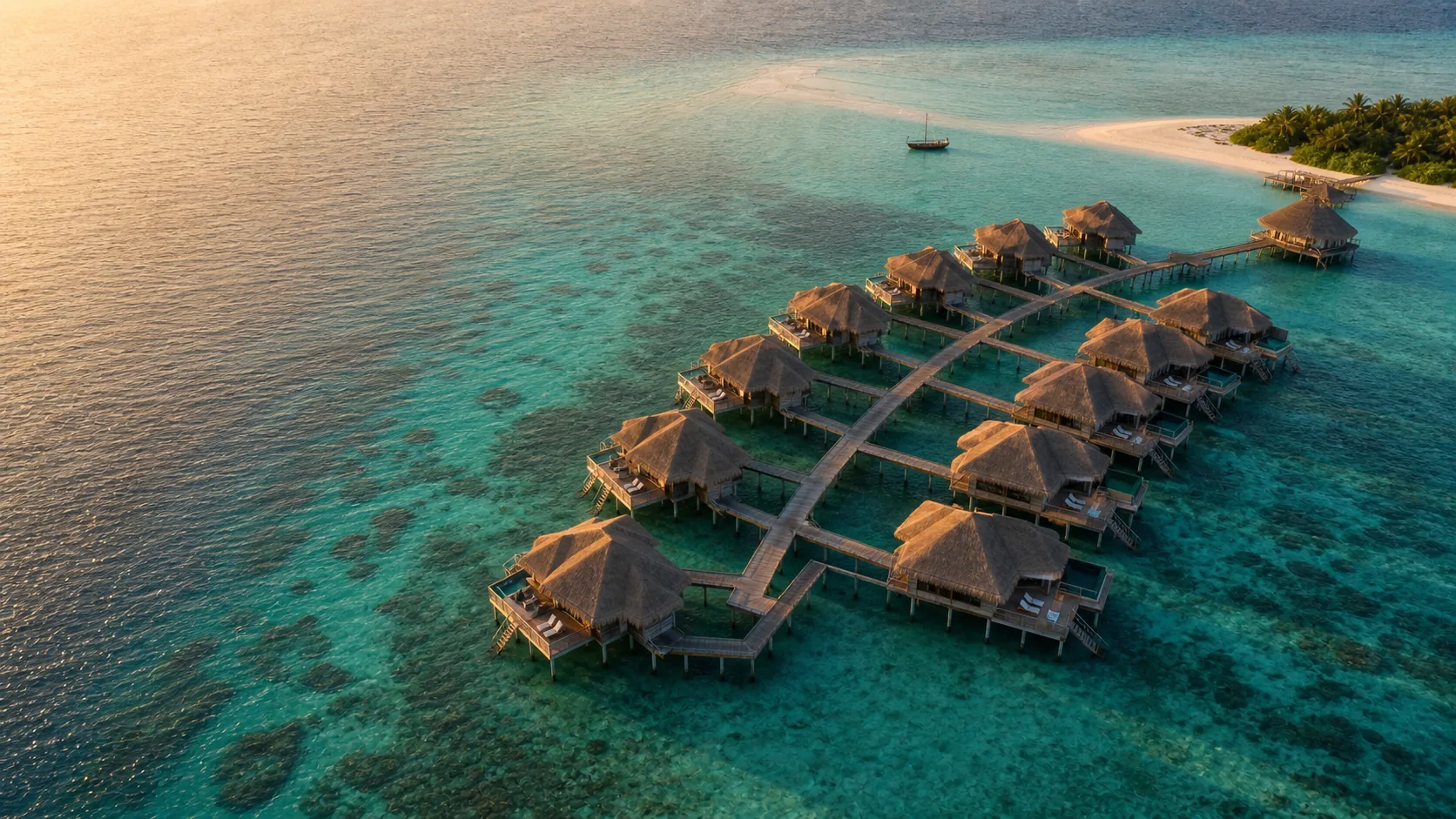
Spa, beach villa + water villa split, resort excursions, fine dining
Day 14
Resort to MLE
Final breakfast, transfer to airport, international flight home
This is a planning framework, not a fixed route. The exact order depends on ferry days, speedboat schedules, your resort's transfer options, and your international flight times.
Where the resort finish goes
Examples of resorts travelers consider for the Route A resort finish. All within reasonable transfer distance from the local-island side of the trip. We don't guarantee availability or fixed pricing on this list, but these properties consistently work for this shape.
Speedboat zone (20 to 40 min from MLE): Sheraton Maldives Full Moon Resort & Spa, Velassaru Maldives, Baros Maldives, Coco Bodu Hithi. Short-hop seaplane (25 to 35 min): Lily Beach Resort & Spa (South Ari), Reethi Beach Resort (Baa), Sun Siyam Vilu Reef (Dhaalu). For the ultra-luxury finish: Gili Lankanfushi, Four Seasons Kuda Huraa, One&Only Reethi Rah.
Estimated cost
Route A planning range
$4,500 to $9,000+
Per couple, excluding international flights. 6 to 8 nights local island guesthouses + 5 to 7 nights resort, half-board or all-inclusive, RT speedboat transfers, 2 to 3 excursions. Ranges factor in typical Maldives tax and Green Tax assumptions; final quotes must be checked by property, transfer route, and travel date.
Swap-in variants. Tighter budget, switch to Route B. Honeymoon couple, switch to Route C. Diver, switch to Route D. Want only 7 nights instead of 14, see our 7-day Maldives itinerary.
Route B
Budget Local Island Hopping
Pure local-island route, no resort finish. Four bases across 14 days, using shared speedboats and public ferries where the timetables fit. The cheapest way to spend 2 weeks in the Maldives, and the most culturally immersive.
Who this is for
Backpackers, budget couples, divers wanting to spread dives across multiple atolls, slow travelers, people who care more about authentic island life than overwater villas. Repeat Maldives visitors who've already done a resort week and want to see the country differently.
Day-by-day for this route
Days
Base
What you'll do
Days 1-4
Maafushi (Kaafu)
Bikini beach, multiple operators, sandbank excursion, ease into local-island life
Days 5-7
Fulidhoo (Vaavu)
Nurse shark and stingray snorkel, smaller island feel, local cafés
Days 8-11
Dhigurah (South Ari)
Whale shark trip, longer beach, more guesthouse choice, snorkel safaris
Days 12-14
Ukulhas, Rasdhoo, or Thoddoo (North Ari)
Quieter local island, varies by ferry schedule and your interests
Critical operational note. This route's viability depends on ferry timetables. The Maafushi to Fulidhoo connection only runs certain days. Dhigurah to North Ari frequently requires routing through Malé. The route order may need to flip if ferry days don't align with your arrival and departure dates. Build the route around ferry days, not the other way around.
Where to stay
Guesthouses on each local island. Maafushi and Dhigurah have the widest selection (20+ options each). Fulidhoo has 6 to 8 active guesthouses. Ukulhas, Rasdhoo, and Thoddoo each have 4 to 10 guesthouses. Rates typically run $60 to $150 per night for mid-range guesthouses, $40 to $80 for basic options, including breakfast and often half-board.
Estimated cost
Budget version (basic guesthouses, ferries where possible)
$1,400 to $2,500
Per couple, excluding international flights. 4 local islands, basic guesthouse half-board, mix of shared speedboats and public ferries, 4 to 5 excursions across the trip. Ranges factor in typical guesthouse Green Tax assumptions; final quotes vary by property and route.
Comfortable version (better guesthouses, more excursions, shared speedboats)
$2,500 to $4,500
Per couple, excluding international flights. Same 4 islands, better-rated guesthouses, more shared-speedboat transfers, full excursion calendar, optional resort day pass.
Swap-in variants. Want a resort finish, switch to Route A. Want serious diving, switch to Route D. For the wider budget framework across all trip lengths, see our Maldives budget itinerary.
Route C
Honeymoon 2-Week Itinerary
For honeymoon couples doing the proper unhurried version. Mostly resort, with a short cultural element optional at the start. The version where the Maldives stops feeling like a vacation that needs to be efficient and starts feeling like a vacation that has time.
Who this is for
Newlyweds taking the trip seriously. Anniversary couples doing a milestone version. US, UK, or Europe travelers using the long-haul flight cost effectively. Couples who would rather spend their 14 nights at one or two great properties than rushing between four.
Day-by-day for this route
Days
Base
What you'll do
Days 1-2
Hulhumalé buffer or easy speedboat resort
Arrival, settle in, recover from long-haul flight, lagoon walk
Days 3-6
Short local island or affordable resort
Cultural day, slower pace, lagoon snorkel, dinner with locals
Overwater deck mornings, slow swims, sunset cocktails, final flight home
Where to stay for the luxury portion
Examples of resorts travelers consider for the Route C luxury portion. The 10-night resort stay opens up most of the cluster's named resorts depending on tier preference.
Per couple, excluding international flights. 2-night buffer + 4-night cultural/affordable + 4-night beach villa + 4-night overwater at luxury resort, half-board or all-inclusive. Ranges factor in typical tax assumptions; final quotes vary by resort, season, and meal plan.
Ultra-luxury 2-week honeymoon
$20,000 to $35,000+
Per couple, excluding international flights. Single ultra-luxury resort for the full 12 nights post-buffer (Gili Lankanfushi, Four Seasons, or pinnacle property), premium villa categories, full meal package, honeymoon perks included.
Variants by tier. For the mid-luxury version (Velassaru, Baros, Coco Bodu Hithi), figure $12,000 to $15,000. For ultra-luxury (Gili Lankanfushi, Four Seasons), figure $16,000 to $22,000. For pinnacle properties (One&Only Reethi Rah, Cheval Blanc Randheli, Soneva Fushi), figure $22,000 to $35,000+.
Route D
Diving and Marine Life
Multi-atoll dive program across 14 nights. The version that uses 2 weeks for what 2 weeks is actually for in the Maldives: serious underwater range. Whale sharks plus manta rays plus multiple dive sites plus optional PADI Advanced certification, all in one trip.
Who this is for
Divers, advanced snorkelers, whale shark and manta ray focused travelers, marine life photographers, anyone working on PADI Advanced or specialty certifications. Couples where one or both partners want diving as the trip's center.
Day-by-day for this route (varies by season)
Days
Base
What you'll do
Days 1-5
Dhigurah or South Ari resort
Whale shark trips (typically reliable year-round, stronger August to October), house reef dives, atoll-edge dive sites
Days 6-9
Rasdhoo, Ukulhas, or North Ari resort
Hammerhead dawn dives at Rasdhoo Madivaru (typically strongest December to April, advanced cert required), varied house reefs
Days 10-14
Baa Atoll (Jun-Nov for mantas) or central atoll resort finish (Dec-May)
Hanifaru Bay manta snorkel in season, or resort dives + decompression for non-manta months
Liveaboard plus resort variant
An alternative shape for the same audience: 7 nights on a liveaboard covering Northern or Central Atoll routes, then 7 nights at a resort to decompress. The liveaboard covers far more dive sites and atolls than a land-based program, but the back half at a resort prevents the trip from becoming pure dive logistics. Active liveaboard operators in 2026 include Carpe Diem Maldives Cruises, Emperor Maldives, and Scubaspa. A 7-night liveaboard typically runs $1,800 to $3,500 per person and includes 16 to 20 dives. Pair with a 7-night resort stay (Sheraton Full Moon, Velassaru, Baros) for the decompression half.
Where to stay (land-based version)
Examples of resorts and guesthouses travelers consider for the Route D land-based version. The seaplane resort is fully viable at this length.
Lily Beach Resort & Spa (South Ari, luxury all-inclusive with whale shark access). Sun Siyam Vilu Reef (Dhaalu, mid-luxury). Reethi Beach Resort (Baa, manta access in season). Soneva Fushi (Baa, ultra-luxury). Constance Halaveli (Ari, luxury). Dhigurah local-island guesthouses (budget version for the whale-shark portion).
Estimated cost
Land-based dive intensive (2 atolls, 16-20 dives)
$5,500 to $14,000
Per couple, excluding international flights. Two dive-focused resorts, dive packages, whale shark and manta excursions, transfers between the two resorts. Ranges factor in typical tax assumptions; final quotes vary by resort, dive package, and season.
Liveaboard + resort hybrid (7+7)
$7,000 to $16,000
Per couple, excluding international flights. 7-night liveaboard with 16 to 20 dives plus 7-night resort, full meal coverage on liveaboard, half-board at resort.
Budget version (Dhigurah local island base for the dive portion)
$2,500 to $4,500
Per couple, excluding international flights. Local-island guesthouse, local dive shop, whale shark trips via shared boat, manta via Baa Atoll guesthouse partner if traveling in season. The strongest value-per-dive option in the Maldives.
Best local islands for a 2-week Maldives itinerary
Seven local islands cover most of the practical options for a 2-week trip. Each has its own personality, transfer logistics, and activity emphasis. Pick 2 to 3 from this list for Routes A or B.
Maafushi
Kaafu Atoll, 30 min speedboat from MLE
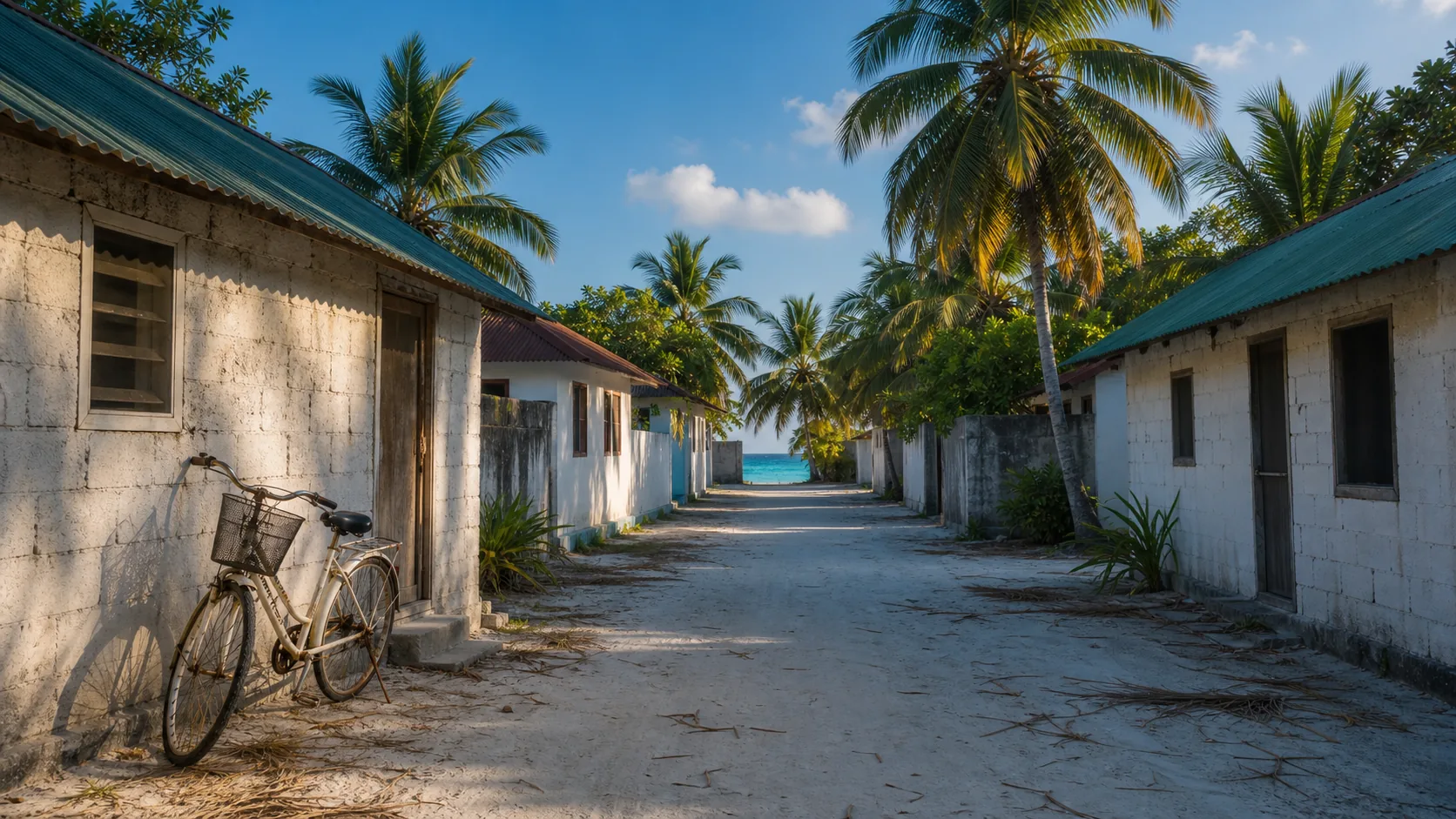
The easiest entry to local-island Maldives. Most operators, widest guesthouse selection (20+ options), reliable bikini beach, multiple daily excursions. The standard first stop for first-time local-island travelers. Some travelers find it too busy after the first few days.
Gulhi
Kaafu Atoll, 25 min speedboat from MLE
Quieter alternative to Maafushi. Same atoll, very short transfer, fewer guesthouses (6 to 8), more village feel. Good for couples who want local-island life without the operator-saturated feel of Maafushi.
Fulidhoo
Vaavu Atoll, ferry or speedboat
Small island, distinctive feel. Nurse shark and stingray snorkeling is the signature activity. 6 to 8 active guesthouses. Ferry from Malé runs certain days only, so build the route around the schedule. Often combined with Maafushi as a "two Kaafu/Vaavu islands" first half.
Dhigurah
South Ari Atoll, ferry, speedboat, or seaplane
Long thin island (about 3 km of beach), known for whale shark proximity year-round. 20+ guesthouses, multiple dive operators, snorkel safari trips. The canonical local-island base for divers and marine-life travelers. Longer transfer from MLE than Kaafu options.
Ukulhas
North Ari Atoll, ferry or speedboat
Cleaner and quieter than Maafushi, with a strong environmental ethos and well-maintained beaches. Bikini beach status varies; check with your guesthouse before booking. 8 to 12 active guesthouses. Good for travelers who want local-island life with a more ECO-aware vibe.
Rasdhoo
North Ari Atoll, ferry or speedboat
The diving base of North Ari. Known for the Madivaru hammerhead dive, typically strongest in the December to April window with dawn dives and advanced certification required. Active dive shops, 4 to 8 guesthouses, smaller and more dive-focused than Dhigurah.
Thoddoo
North Ari Atoll, ferry or speedboat
The fruit farm island. Watermelon and papaya farms across the interior, longer beaches than most local islands, family-friendly feel. 6 to 10 guesthouses. Quieter pace, good for couples who want time away from the more touristy hubs.
For shorter local-island stays, Feridhoo and Omadhoo (both North Ari) are quiet alternatives with smaller guesthouse pools and very few daily visitors. Worth considering as a 2 to 3 night break inside a longer route.
Transfer planning for 2 weeks
This is the operational section that separates a 2-week trip that works from one that doesn't. Most route problems come from not understanding the transfer options before locking in hotel nights.
Seaplane is one of four transfer modes you'll likely use across a 2-week trip, depending on your route.
Public ferry
Cheap, slow, and schedule-limited. Operated mostly by MTCC (Maldives Transport and Contracting Company). Each route runs on certain days only, often 2 to 3 days per week, and public ferry schedules are often reduced or unavailable on Fridays, so always check the current MTCC or local operator timetable before locking hotel nights. Tickets cost $2 to $6 per person depending on route. Plan around the ferry calendar, not against it.
Shared speedboat
The route flexibility middle ground. Operated by various local providers, costs $30 to $70 per person, runs more frequently than public ferries (usually daily or every other day). Most travelers on Routes A and B use shared speedboats for at least one or two transfers.
Private speedboat
Expensive but flexible. Costs $200 to $500 per boat depending on route and distance. Rarely necessary unless the route is awkward or the ferry day doesn't fit your dates. Useful for last-day departures when you need to control timing precisely.
Seaplane
For the resort finish or far-atoll segments. Costs $400 to $700 per person for a return seaplane transfer. Operates 06:00 to 16:00 daylight hours only. For Baa, Lhaviyani, South Ari, or Noonu resorts, seaplane is typically the right transfer. Use our seaplane checker to validate your arrival time against the seaplane window.
Three operational rules to plan around. First, Friday schedules can reduce public ferry frequencies meaningfully, so check whether your transit days fall on a Friday. Second, many local-island-to-local-island routes still pass through Malé even when the islands look close on a map. Third, resort transfers are arranged separately from local-island transfers, so a Route A trip needs both the local-island transfer schedule and the resort's own pickup logic confirmed before booking flights.
Worked example: Maafushi to Fulidhoo can work by public ferry on certain days, or by shared speedboat. The schedule must be checked before locking your hotel nights. If the ferry day doesn't match your intended dates, the route may need to flip (Fulidhoo first, then Maafushi) or use a paid shared speedboat instead. Build the route around the ferry calendar, not the other way around.
Local island vs resort split, side by side
If you're deciding between Route A (local + resort) and Route B (local only), or trying to figure out how to split the 14 nights, this comparison covers the main practical differences.
Feature
Local island
Private resort
Cost
Lower
Higher
Food
Local cafés, guesthouse meals, often half-board
Resort restaurants, meal plans, more variety
Alcohol
Not available on inhabited local islands
Available at licensed resorts
Dress code
Modest in village areas, bikinis only on designated bikini beaches
Resort wear allowed throughout
Activities
Shared excursions, local operators
Resort-managed excursions, often included in package
Privacy
Lower, shared spaces and beaches
Higher, private villas and beaches
Culture
Stronger, direct contact with locals
Limited, staff interactions only
Water villa
Usually no
Yes
Best use in a 2-week itinerary
First half (Days 1-9)
Final half (Days 10-14)
Maldives 14-day cost at a glance: budget, mid-tier, luxury
Three tiers, per-night equivalents next to 14-night totals. Excludes international flights. Detailed route-by-route breakdown follows below.
Tier
Per-night (couple)
14-night total
Best fit
Budget
$100 to $180
$1,400 to $2,500
Local-island hopping, ferries, basic guesthouses, divers on a budget
Comfortable local
$180 to $320
$2,500 to $4,500
Better guesthouses, shared speedboats, full excursion calendar
Local + resort finish
$320 to $640
$4,500 to $9,000+
The most-booked 2-week shape, local first then resort
Resort-heavy luxury
$640 to $1,300
$9,000 to $18,000
Beach villa + water villa split, mid-luxury resorts
Ultra-luxury honeymoon
$850 to $2,500+
$12,000 to $35,000+
Gili Lankanfushi, Four Seasons, Soneva, Cheval Blanc, One&Only tier
Cost reality across the four routes
Single summary of the named planning ranges from the routes above, in one place so you can compare. Per couple, excluding international flights.
2-week trip style
Typical structure
Estimated local package range
Budget local island hopping (Route B basic)
4 local islands, basic guesthouses, ferries and shared speedboats
$1,400 to $2,500
Comfortable local island (Route B better)
Better guesthouses, more excursions, shared speedboats
$2,500 to $4,500
Local island + resort finish (Route A)
7-9 nights local + 4-6 nights mid-luxury or luxury resort
$4,500 to $9,000+
Resort-heavy trip
Mostly private resort, beach villa + water villa split
$9,000 to $18,000
Luxury 2-week honeymoon (Route C)
Private resort, premium villa, full meal package, spa
$12,000 to $35,000+
Dive intensive land-based (Route D)
Two dive resorts, 16-20 dives, manta + whale shark
$5,500 to $14,000
Liveaboard + resort hybrid (Route D variant)
7-night liveaboard + 7-night resort decompression
$7,000 to $16,000
Notes on the table:
International flights add roughly $1,000 to $2,200 per person from the US, $700 to $1,500 from the UK, and $300 to $700 from regional gateways like Dubai, Doha, or Mumbai.
The ranges factor in typical Maldives tax (TGST 17%) and Green Tax assumptions ($12 per person per night for resorts, $6 for small guesthouses), but final quotes must be checked by property, transfer route, and travel date.
Peak season (Christmas, New Year, Chinese New Year, Easter) runs 20 to 40% higher than the ranges above.
Low season (June through September) runs lower, often with significant savings on the resort portion of Routes A and C.
These are planning ranges, not guaranteed package prices. Final cost depends on travel dates, island choice, transfer route, resort category, meal plan, and activities.
December through April is the dry season with the most reliable weather, peak prices, and peak crowds. January and February are the absolute peak. November and May are shoulder months with lower prices and generally acceptable weather. June through November is the wet season with more rain, lower prices, and typically the strongest manta activity at Hanifaru Bay (Baa Atoll). For a 2-week trip specifically, the wet season is more manageable than for shorter trips because you have buffer to absorb one or two rainy days.
If you're traveling for marine life: South Ari is the main year-round whale shark area, with stronger months often around August through October. Mantas at Hanifaru Bay are typically active June through November, with the strongest action often August through October. Hammerheads at Rasdhoo Madivaru are best chased in the December to April window with dawn dives. These are planning guidance rather than guaranteed sightings, individual day conditions vary. The 2-week length lets you chase the right season for whichever wildlife you want most. See our best time to visit the Maldives guide for the full monthly breakdown.
Local island rules and culture
The Maldives is a Muslim country. Resort islands are international zones where standard resort attire and alcohol are allowed. Inhabited local islands follow Maldivian customs, and traveler etiquette matters more than it does on resorts.
Dress code. Modest clothing in village areas (shoulders and knees covered for both men and women). Bikinis and swimwear are allowed only on designated bikini beaches, which most popular local islands have (Maafushi, Fulidhoo, Dhigurah, Gulhi all have them). Confirm your guesthouse can point you to the bikini beach on arrival.
Alcohol. Not available on inhabited local islands. If you want a cocktail, you can take a resort day pass (most have alcohol included) or wait for the resort portion of your trip in Routes A or C. Some local-island guesthouses run "floating bar" excursions outside territorial waters where alcohol is served, but availability varies.
Friday slowdowns. Friday is the Maldivian Sabbath. Ferry schedules can be reduced or unavailable. Many local businesses close for part of the day. Plan transit days around this where possible.
Cash logistics. USD is widely accepted on local islands and at resorts. Maldivian Rufiyaa is easier for small purchases (street food, local cafés). ATMs are available on Maafushi and Hulhumalé but rare on smaller islands. Bring more cash than you think you need.
How we plan 2-week trips
We're a Maldives Ministry of Tourism licensed agency based in Malé. We work directly with Maldives resorts and local guesthouses across the islands named above, and we check public ferry and shared-speedboat schedules when planning multi-base routes.
What that means for a 2-week trip: real-time ferry and speedboat schedules, current 2026 partner rates, honest swap-in suggestions when a route isn't quite right, and transparent quotes that factor in typical Maldives tax and Green Tax assumptions, with final figures confirmed against your specific dates and properties.
The transfer planning is where local knowledge matters most at this length. Routes that look clean on a map often pass through Malé, ferry days don't always match standard 14-day arrivals, and resort transfers are arranged separately from local-island transfers. We handle these details so you don't have to learn them the hard way. Send us your dates and which route fits closest, and we'll come back with a real plan.
Maldives 2 week itinerary FAQs
Is 2 weeks too long for the Maldives?
The honest answer: yes if poorly routed, no if smartly routed. Travelers who stay on one island for 14 nights often run out of new experiences by Day 8. Travelers who change islands every 1 to 2 nights often run out of energy by Day 6. The version that works falls in between: 2 to 4 bases, local islands first, resort finish if budget allows. Stay at least 3 nights per base. The decision matrix in this guide breaks the options down by base count.
What is the best 2-week Maldives itinerary?
For most first-time long-stay travelers, Route A (Best of Both Worlds) is the strongest plan: 6 to 8 nights on local islands like Maafushi, Fulidhoo, or Dhigurah, followed by 5 to 7 nights at a private resort. This covers culture, marine life, and the iconic resort experience without rushing any of them. Route B is for budget travelers, Route C for honeymoons, Route D for divers.
How many islands should I visit in 2 weeks?
For most travelers, 3 bases is the sweet spot. Two bases works for comfort-focused travelers and honeymoons. Four bases works for active hoppers and divers if transfers are planned around ferry days. Five or more bases usually turns the trip into a transfer schedule. Always stay at least 3 nights per base, ideally 4.
Should I stay on one island for 2 weeks?
For most travelers, no. A single base for 14 nights tends to feel repetitive unless the property is genuinely large and varied (One&Only Reethi Rah, Soneva Fushi, Cheval Blanc Randheli all have enough activity range to support this). Honeymoon couples at one ultra-luxury resort can make it work. Everyone else does better with 2 to 4 bases.
How much does 2 weeks in the Maldives cost?
Per couple, excluding international flights: budget local-island hopping around $1,400 to $2,500, comfortable local-island around $2,500 to $4,500, local + resort finish around $4,500 to $9,000+, resort-heavy around $9,000 to $18,000, luxury honeymoon around $12,000 to $35,000+, dive intensive around $5,500 to $14,000. Add $1,000 to $2,200 per person for US international flights. Ranges factor in typical Maldives tax and Green Tax assumptions; final quotes must be checked by property, route, and travel date.
Can I do the Maldives on a budget for 2 weeks?
Yes. Route B (Budget Local Island Hopping) at $1,400 to $2,500 per couple is the budget-conscious version. It uses public ferries where the timetable fits, shared speedboats for time-sensitive transfers, and basic-to-mid-tier guesthouses. The trip is more cultural and less iconic than a resort version, but the value-per-day is among the best in the Maldives.
Should I split between local islands and a resort?
For most 2-week travelers, yes. The local + resort split (Route A) gives you both the cultural and lagoon variety of local islands and the iconic resort moments (overwater villa, spa, private dining) without spending the full budget on resort nights. Local islands first, resort finish is the structure most travelers find satisfying. Pure resort works for honeymoons and pure relaxation; pure local works for backpackers and culturally-focused travelers.
Which local islands are best for 2 weeks in the Maldives?
For a first-time long-stay traveler: Maafushi (easiest entry, most operators, bikini beach), Fulidhoo (smaller, nurse sharks), and Dhigurah (long beach, whale sharks). For active travelers: add Rasdhoo (hammerheads in season). For a quieter option: substitute Gulhi for Maafushi, or add Ukulhas or Thoddoo. Pick 2 to 3 from this list depending on which atolls fit your route and which marine life is in season.
Can I use public ferries for a 2-week Maldives itinerary?
Yes, especially for Route B. Public ferries (mostly MTCC-operated) cost $2 to $6 per person and connect most popular local islands. The catch is the schedule: each route runs only certain days, often 2 to 3 days per week, with reduced frequency on Fridays. Build the route around the ferry calendar, not against it. Where the ferry day doesn't match, a shared speedboat ($30 to $70 per person) fills the gap.
Can I drink alcohol on local islands?
No. Alcohol is not available on inhabited local islands in the Maldives. If you want a drink during the local-island portion of your trip, options include taking a resort day pass (most have alcohol included), waiting until the resort portion of Routes A or C, or booking a "floating bar" excursion that operates outside territorial waters (availability varies by island).
What should I wear on local islands?
Modest clothing in village areas: shoulders and knees covered for both men and women. T-shirts and shorts that reach the knee are fine. Bikinis and swimwear are allowed only on designated bikini beaches, which most popular local islands (Maafushi, Fulidhoo, Dhigurah, Gulhi) have. Light coverups are useful for walking from your guesthouse to the bikini beach. Resort islands have no such restrictions.
Is 2 weeks enough for diving in the Maldives?
Yes, and it's actually the sweet spot for a serious dive program. Route D covers 16 to 20 dives across two atolls, plus whale shark and manta day-trips, plus the option for PADI Advanced certification. Two weeks is enough time to dive a wide variety of sites without burning out. The liveaboard + resort variant covers even more sites if multi-atoll diving is the priority.
Can I see whale sharks and manta rays in 2 weeks?
Yes, with the right seasonal timing. South Ari is the main year-round whale shark area, with stronger months often August to October. Manta rays at Hanifaru Bay (Baa Atoll) are typically active June through November, with strongest action often August to October. Between June and November both are reliably chaseable in one trip. Route D's third leg flips between Baa Atoll (manta season) and a central-atoll resort finish (December through May) depending on your travel month. These are planning guidance rather than guaranteed sightings.
What is the best time for a 2-week Maldives trip?
December to April is dry season with the most reliable weather. January and February are peak. November and May are shoulder months with lower prices. June to November is wet season with more rain but also typically the highest manta activity at Hanifaru Bay. For 2 weeks specifically, the wet season is more manageable than for shorter trips because you have buffer to absorb a rainy day or two. Pick by what matters most: peak weather (dry season), lower prices and stronger manta windows (wet season), or stronger whale shark windows (often August through October, though South Ari is year-round).
Planning 2 weeks in the Maldives?
Send us your travel month, budget, and which route fits closest. We'll suggest a real plan with ferry days worked out, named resort or guesthouse options, and an estimated package range with typical Maldives tax and Green Tax assumptions factored in.