

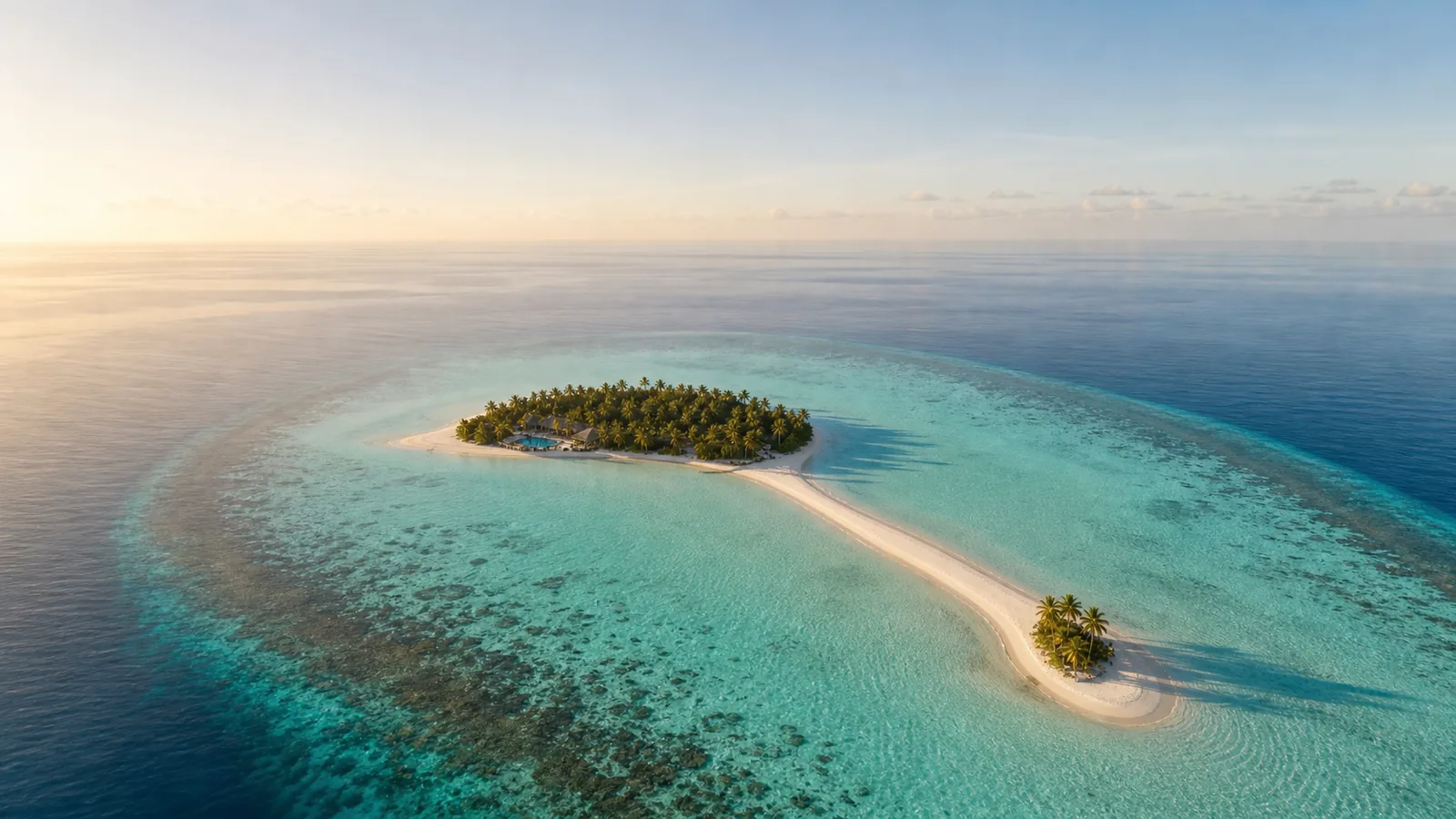
The best time for a Maldives vacation depends on what you’re going for. Honeymoons want flat seas and sunset light. Families want predictable weather and shoulder-season pricing. Divers and surfers want different months altogether. And anyone watching their budget should know that the same villa that costs $1,200 a night in February may cost $500 in September.
We’re a Maldives Ministry of Tourism-licensed agency on the ground in Malé. Here’s the seasonal map we actually use when we plan trips for clients — month by month, by traveler type, and with the operational details aggregator pages tend to skip.
Picking the right month is the first step to a great Maldives trip. WhatsApp us — we’ll match your dates to a resort that’s quoting well for that window.
Get a Custom Quote on WhatsAppThe honest one-line answer is December through April for first-time visitors, with January through March as the strongest window inside that. That’s the dry season — locally called Iruvai — when winds are gentle, seas are calm, rainfall is low, and underwater visibility is at its best.
But the right answer for your trip might be a different month. If you’re going for manta rays, August. If you’re surfing, July. If your priority is value without dramatic weather risk, late November or April. If you have school-age kids and your only window is summer, July and August work — with the trade-off of more variable weather.
The Maldives is hot all year (highs 84–88°F, lows rarely below 75°F). The sea temperature stays at 27–30°C every month. The country sits on or near the equator, outside the main Indian Ocean cyclone belt — there has never been a direct hurricane hit in modern history. What changes between months isn’t whether you can swim, dive, or sit on a beach — it’s how much it rains, how rough the seas are, and how full (and expensive) the resorts are.
The rest of this guide breaks the answer down by month, by activity, by traveler type, and by US-traveler-specific concerns. If you’re trying to decide between two adjacent weeks, the Maldives vacation guide covers the broader trip framework; this page is just the seasonal layer.
The Maldives has two monsoons. The Maldives Meteorological Service formally defines them as the southwest monsoon (mid-May to November) and the northeast monsoon (January to March), with December and April as transitional months. Travel content typically simplifies this into:
| Variable | Dry season (Dec–Apr) | Green / wet season (May–Nov) |
|---|---|---|
| Rainfall (Malé / central) | 50–100mm/month | 150–240mm/month, peaking September |
| Daily sunshine | 8–10 hours | 6–8 hours |
| Wind | Light, NE direction | Stronger, SW direction |
| Sea state | Calm | Choppier, especially at SW-facing beaches |
| Diving visibility | 25–35m | 15–25m |
| Marine-life concentration | Western sides of atolls | Eastern sides of atolls |
| Resort rates | Highest | 30–50% lower |

Many first-time visitors confuse “tropical wet season” with “hurricane season.” In the Maldives, the two are not the same. The country’s equatorial position keeps it outside the cyclone belt that affects the rest of the Indian Ocean. Tropical depressions occasionally brush the northern atolls but typically pass north toward Sri Lanka and India. Wind and wave conditions can run higher during Hulhangu, but resort operations continue year-round — speedboats run, seaplanes fly during daylight hours, kids clubs stay open.
The Maldives stretches almost 900 kilometers north to south, and rainfall isn’t uniform. Per the Maldives Meteorological Service annual averages:
| Region | Annual rainfall | What this means for trip timing |
|---|---|---|
| Northern atolls (Haa Alif, Haa Dhaalu, Shaviyani, Noonu, Raa, Lhaviyani) | ~1,779mm | Driest region; dry season is more pronounced. Often the weather hedge during Hulhangu months |
| Central atolls (Kaafu, Vaavu, Meemu, Baa, Faafu, Dhaalu, Thaa) | ~1,966mm | Most resort capacity; the “average” Maldives weather |
| Southern atolls (Laamu, Gaafu Alifu, Gaafu Dhaalu, Addu) | ~2,218mm | Wettest region; less seasonal contrast — wet season feels less dramatic but dry season is shorter |
There’s a second layer worth knowing. Inside an individual atoll, the monsoon biases marine life east or west. During Hulhangu, plankton-rich water concentrates on the eastern sides; during Iruvai, it reverses to the western sides. Hanifaru Bay sits on the eastern edge of Baa Atoll, which is why it fires May to November. Manta Point in North Malé Atoll is the same calendar. South Ari Atoll’s whale sharks shift between eastern Dhigurah (May–Nov) and the western reefs (Dec–Apr). For marine life-focused trips, the resort’s position within its atoll matters as much as the atoll itself.
The table below blends Maldives Meteorological Service averages with what we observe on the ground. Rainfall figures are Malé / central atolls; northern atolls run lower, southern atolls run higher.
| Month | Weather and sea conditions | Price level | Best for | Watch out for |
|---|---|---|---|---|
| January | Dry, sunny, calm seas. ~75mm rain, 8–9 hrs sunshine | Very high | Honeymoons, luxury, families, diving | Festive spillover into the first week |
| February | One of the driest months. ~50mm rain, 9–10 hrs sunshine | Very high | Best weather, water villas, photography | High demand; book 5–6 months out |
| March | Dry, warm, excellent visibility. ~50–80mm rain | High | Honeymoons, diving, snorkeling | Heat builds through the month |
| April | Transition month, still good. ~130mm rain | Medium-high | Value plus weather, before SW monsoon | Easter premium, late-April showers |
| May | SW monsoon starts. ~215mm rain, 7–8 hrs sun | Lower | Deals, surfers, flexible travelers | More wind; manta season starts late month |
| June | Green season. ~170mm rain, 6–7 hrs sun | Lower | Surfing, value, manta season ramps | Rougher seas at SW-facing beaches |
| July | Wet/green season. ~150mm rain, 7 hrs sun | Medium | US school holidays, mantas, surfing | Rain bursts; family demand |
| August | Wet/green season. ~165mm rain, 7 hrs sun | Medium | Families, mantas, whale sharks | Humidity, rain bursts |
| September | Wettest month. ~240mm rain, 6 hrs sun | Low | Budget luxury, marine life | Highest rain risk of the year |
| October | Improving transition. ~195mm rain, 6–7 hrs sun | Low–medium | Surf, manta, value | Mixed weather, early month wetter |
| November | Shoulder month. ~200mm but shorter bursts, 7–8 hrs sun | Medium | Best value before peak | First half can still be wet |
| December | Peak season returns. ~80–150mm rain, 8–9 hrs sun | Very high | Christmas, New Year, families | Festive supplements (mandatory dinners) |

A few notes on the months that need extra context:
February is the textbook honeymoon month — driest of the year and lowest humidity. April before Easter is one of the year’s best value windows; after Easter, prices drop again into early May. June and July are the best months for low-season honeymoons if marine life matters more than dry skies. September is genuinely the rainy month — book it knowing the trade-off. Late October to mid-November often surprises travelers with how much the weather has improved by month’s end. Early December (first 15 days) is a quietly excellent shoulder window before the festive surge takes over.
Picking the right month for your specific trip type is the most common avoidable mistake. Two minutes on WhatsApp prevents it.
Talk to a Local SpecialistFor pure weather quality — minimal rain, calmest seas, clearest skies, lowest humidity — the answer is mid-January through late March. Inside that window, February stands out: the driest month of the year, lowest humidity, and 9–10 hours of daily sunshine.
Late November and December (before the 20th) often deliver near-peak weather without the peak-season pricing. The first half of April can be excellent before Easter pushes prices up.
If your only flexibility is the height of summer or fall, August is often a better hedge than September — slightly less rain, better light, and resort rates that are still 30–40% below February peak.
The cheapest months for a Maldives vacation are typically inside the green season — May, June, September, and October. Discounts of 30–50% off peak February rates are common, and many resorts add value-in-kind during the green season:
June, September, and October are typically the lowest-priced months. September is the genuinely rainy month — book it knowing the trade-off; rates can run 50%+ below peak. Late November and early December (before the 20th) are the best balance of acceptable weather and lower rates.
What stays constant year-round, regardless of season:
For deeper budget framing, the Maldives vacation cost guide walks through all-in numbers across seasons, and the budget Maldives vacation guide covers the lowest-cost options including local-island stays. To run your own scenario, the estimate your Maldives vacation cost tool builds a fully-loaded number from your inputs.
For a Maldives family vacation, the answer changes depending on whether your kids are school-age or pre-school.
Best weather window for families: December through April — calm seas, predictable weather, the safest snorkeling conditions, and the most reliable transfer experience. If you’re booking with toddlers, this is the easier choice.
Best value window for families: late May, June, September, and October — 30–50% off peak rates and quieter resorts. The trade-off is more variable weather, but rainfall typically comes in bursts rather than all-day events.
Best school-holiday compromise (US travelers): July and August — rain risk is real but manageable, resort kids clubs are at full strength to handle European school holidays, and the rate premium is modest compared with Christmas. Thanksgiving week (third week of November) is a sleeper option: peak weather is returning, US schools are out, and rates haven’t yet hit festive pricing.
If you’re traveling with toddlers and the dates can’t flex, prioritize a speedboat-accessible resort in the central atolls — it removes the seaplane-cutoff timing risk and the longer same-day transfer that wet-season weather can sometimes complicate.
For the family-specific resort table, kids-club age detail, transfer logic, and worked cost examples, see the Maldives family vacation guide. To shortlist matching resorts by transfer type and kids-club age, the find a family-friendly resort match tool is the fastest way in.
For a Maldives honeymoon, weather and sunset light matter more than for any other trip type. The honest call:
A practical operational note: most resorts offer honeymoon perks — sparkling wine, a fruit basket, a sunset cruise discount, sometimes a complimentary candle-lit dinner — for couples married within the previous 12 months. Bring a copy of your marriage certificate.
For broader honeymoon planning context, the existing Maldives honeymoon hub covers resort categories and itinerary ideas. For US-specific honeymoon flight and arrival logic, the honeymoon from the USA guide is the right next read. For water-villa specifics, the Maldives overwater bungalow guide has the configuration breakdown.
The clear-water answer is January through April, with February and March often the year’s strongest. Visibility runs 25–35 meters in the central and northern atolls. Currents are gentler, drift dives are easier, the long sunshine days mean better light underwater. Beginner snorkelers and first-time divers will have the easiest experience here.
But “best for diving” depends on what you want to see:
Visibility during Hulhangu drops to 15–25m — still plenty for reef diving and most snorkelers. The trade-off is that the plankton bringing the visibility down is exactly what brings the big animals in. The best dive trips often combine a dry-season reef week with a green-season liveaboard for the megafauna.
These are two of the marquee Maldives experiences — and they have very different calendars.

Best window: June through October, often peaking around the full and new moons of July, August, and September. Hanifaru Bay sits on the eastern edge of Baa Atoll within a UNESCO Biosphere Reserve. Aggregations can run from a handful of mantas on slower days to over 100 individuals during the strongest plankton events.
Operational details that matter:
Sightings are weather-, tide-, and plankton-dependent — never guaranteed, even in peak season. Position the trip as “best chance,” not certainty.
Best window: year-round, with August through November the peak frequency. The South Ari Marine Protected Area (SAMPA) around Maamigili and Dhigurah is the classic year-round whale shark zone. During Hulhangu (May–Nov), whale sharks cluster on the eastern side near Dhigurah; during Iruvai (Dec–Apr), they move to the western reefs.
Encounters are typically by snorkel from a guided boat. No special license required for guests, but local guides know the recent sighting locations. As with mantas, sightings are likely but not guaranteed.
Surfing in the Maldives runs on the southwest monsoon. The peak surf season is March through October, with June through August usually the most consistent. The classic North and South Malé Atolls breaks — Cokes, Chickens, Sultans, Jailbreaks, plus Pasta Point at Cinnamon Dhonveli — fire on long-period south-southwesterly groundswells.

Best for intermediate to advanced surfers: the named breaks above during the May–August peak. Best for beginners and learners: late season (September–October) when conditions ease slightly and crowds at the lineups thin out. Most surf resorts run package pricing that includes boat transfers to the breaks; rates are noticeably lower outside the June–August peak.
For the strongest luxury experience overall, January through April is the answer — calm seas, clear skies, and properties at full operational strength. For luxury value, the calendar inverts: May, June, September, October, and November offer the same five-star resorts at 30–50% lower rates, often with added value (free seaplane transfers, premium-dining credits, spa credits worth $200–$500).
A few specific timing notes for luxury and all-inclusive bookings:
For deeper coverage of the luxury layer, the luxury Maldives vacation guide goes further into water-villa configurations, premium plans, and resort-by-resort positioning. For the all-inclusive angle, the Maldives all-inclusive vacation guide walks through the meal-plan economics. The dedicated best time to book all-inclusive Maldives offers page covers booking-window strategy specifically.
For US travelers, “best time” isn’t only about weather. It’s also about flight pricing, school holidays, jet lag, MLE arrival timing, and the practical reality that a 22 to 28-hour door-to-door transit makes a 4-night Maldives trip a poor use of money and energy.

A few rules of thumb we apply for US clients:
US calendar windows that work well for the Maldives:
For the US gateway routing detail (JFK / IAD / ORD / LAX / SFO connections, transit times, carrier options), the Maldives vacation from the USA guide carries the full table. To plan your specific routing, the flight routing tool compares options for your home gateway. To check whether your inbound MLE timing supports a same-day seaplane onward connection, use the check seaplane transfer timing tool.
Send us your travel dates and home gateway — we’ll come back with a routing and resort match within a working day.
Get a Custom QuoteWhen you book is a separate decision from when you travel, and the lead time matters more than most travelers realize. Resorts run dynamic pricing — once a property hits roughly 50% inventory sold, prices step up and don’t come back down.
A practical lead-time map:
| What you’re booking | Recommended lead time |
|---|---|
| Festive window (Dec 23 – Jan 5) | 9–12+ months ahead |
| Peak season standard (Jan–Apr) | 6–9 months ahead for villa selection |
| Shoulder (Apr–early May, late Nov) | 4–6 months ahead |
| Green season (May–Oct) | 2–4 months ahead works if you’re flexible |
| Private island or full buyout | 9–18 months ahead |
| Two-bedroom or multi-bedroom villas | 9–12 months ahead for peak; 4–6 months for green season |

A few things worth knowing about how Maldives resort pricing actually behaves:
If you’re booking specifically to optimize an all-inclusive offer, the best time to book all-inclusive Maldives offers page covers booking-window strategy at deeper depth. For broader package framing, the Maldives vacation packages guide walks through what aggregator pricing typically hides.
If you’d like a custom-quoted trip with the season working in your favor, message us on WhatsApp at +960 992 7007 or fill in the booking enquiry form below. The first conversation is free, and we’ll come back with one or two genuinely tailored options within a working day.
For first-time visitors, February or March. February is the driest month of the year (rainfall under 50mm), with 9–10 daily hours of sunshine, calm seas, and the year’s clearest underwater visibility. March extends those conditions and is often slightly less expensive than February. Mid-January through mid-March is the strongest weather window overall. The trade-off is that these are also the most expensive months outside the Christmas–New Year peak.
The answer depends on what you’re going for. December through April for the most reliable weather. May through September for the best resort prices. June through October for manta rays and whale sharks. March through October for surfing. Late November and early December for the strongest balance of peak-quality weather and lower rates before the festive surge.
June, September, and October are typically the lowest-priced months. Discounts of 30–50% off peak February rates are common. September is the genuinely rainy month — book it knowing the trade-off; rates can run more than 50% below peak. October typically improves through the month and can be excellent value in its final two weeks.
The southwest monsoon (locally called Hulhangu) runs from May through November. Rainfall peaks in September (around 240mm in the central atolls) and is lower at the start and end of the season. Rainfall is not uniform across the country: the southern atolls receive about 25% more annual rain than the northern atolls. The rain comes mostly in short, intense tropical showers — even the wettest month averages 6+ hours of daily sunshine.
No — that’s the most common misconception. Most rainfall comes in short, intense tropical downpours, often in the late afternoon. Daily sunshine averages 6–7 hours even in September, the wettest month. Many “wet” days have a few hours of rain and several hours of sunshine. Extended periods of rain are uncommon but do occur, typically lasting one to two days before clearing.
Yes, with caveats. July is mid-Hulhangu, with rainfall around 150mm and 7 hours of daily sunshine. Manta sightings at Hanifaru Bay are at peak. Surfing is at its strongest. Resort rates run 30–45% below February peak. The trade-off is more variable weather, slightly lower diving visibility, and occasional choppy boat transfers. Better as a marine-life or value trip than a strict beach-photography trip.
Yes — August often has slightly better weather than September while still offering significant savings. Rainfall around 165mm, sunshine still 7 hours daily, manta and whale shark season at full strength. European school holidays push some rates up modestly, but the Maldives is still in deep low season for North American demand. Good month for families willing to accept variable weather.
Not “bad” — but it’s the wettest month, with around 240mm of rainfall and the year’s lowest underwater visibility (15–20m). Resort rates are at their absolute lowest. Marine life remains active. Best for budget-conscious travelers and divers willing to trade weather for value. A first-time honeymoon or a family beach trip is probably better in another month.
Yes — late November is one of the year’s best value windows. Peak-quality weather often returns by the last 10 days of the month, before holiday pricing surges in mid-December. Rates run 20–35% below peak. Marine life in Baa Atoll is still active. The first half of November can still be wet; the second half is typically excellent.
Yes, especially in the second half. Early December (first 15 days) is often a quietly excellent shoulder window. From around December 20 through January 5, rates typically run 50–100% above standard peak, with mandatory festive dinners on Dec 24 and Dec 31 ($150–$400+ per adult) added to the room bill. Most resorts enforce 7 to 10-night minimum stays during the festive window. Plan to book 9 to 12 months in advance for any decent villa availability.
January through April for picture-perfect weather; November and early December for the best value with near-peak weather. Honeymooners prioritizing manta-ray encounters can lean June–October in Baa Atoll. Most resorts offer honeymoon perks for couples married within the previous 12 months — bring a copy of your marriage certificate.
December through April for the most reliable weather and calm seas, especially for families with young kids. July and August work for families on US summer school schedules, with the trade-off of more variable weather. Thanksgiving week is an underrated US-family window — peak-quality weather is typically back, schools are out, and rates haven’t yet hit festive pricing.
June through October, especially around the full and new moons of July, August, and September. Hanifaru Bay (Baa Atoll) is the marquee site. Sightings are weather-, tide-, and plankton-dependent — never guaranteed, even in peak season. Best chance, not certainty.
South Ari Atoll has whale sharks year-round, with peak frequency August through November. During the southwest monsoon, sightings cluster on the eastern side near Maamigili and Dhigurah; during the dry season, they move to the western reefs.
Festive window (Dec 23 – Jan 5): 9–12+ months. Peak season standard (Jan–Apr): 6–9 months for villa selection. Shoulder months (Apr, late Nov): 4–6 months. Green season (May–Oct): 2–4 months works if you’re flexible. Private islands or buyouts: 9–18 months. Last-minute green-season deals exist but are unpredictable.
For US travelers, mid-January through March is strongest for weather; Thanksgiving week is an excellent shoulder option (peak weather returning, schools out, rates not yet festive). Avoid 4-night Maldives-only trips from the US — the 22 to 28-hour door-to-door transit makes a minimum 7-night stay essential. Combine shorter trips with Dubai, Doha, Singapore, or Sri Lanka.
Send us your dates, group size, and what you’re going for — honeymoon, family, dive trip, surf trip, marine-life, value. We’ll come back with one or two custom-quoted options where the season is working in your favor.