

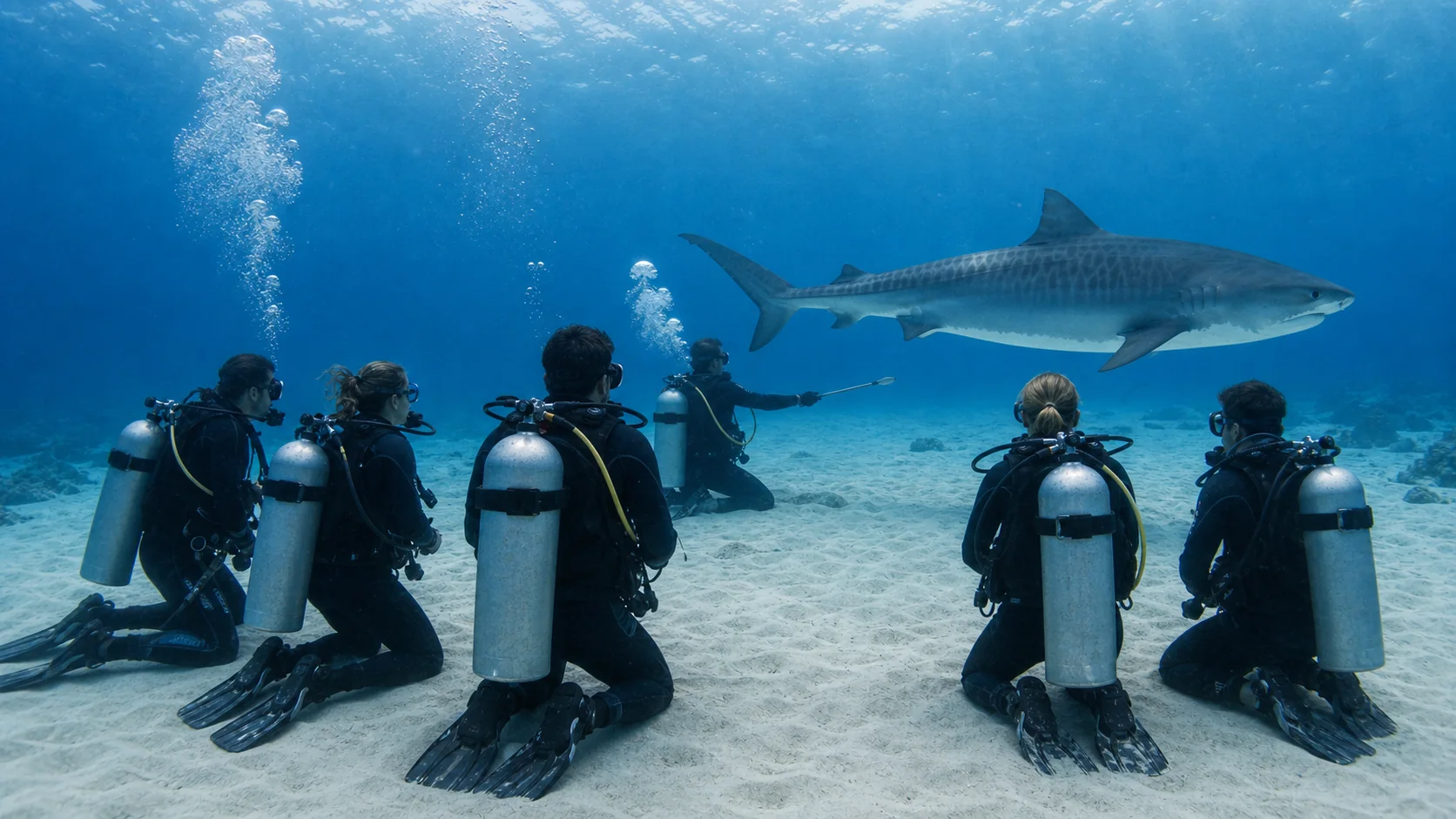
Fuvahmulah shark diving is built around Tiger Harbour, a shallow site at the island’s harbour mouth where resident tiger sharks turn up with exceptional reliability, year-round. You kneel on a sandy plateau at roughly 6 to 10 metres, hold still, and watch four-metre sharks pass within touching distance while shark-safety guides manage the group.
The honest version: this is one of the most reliable tiger shark dives on the planet, but it’s still wild-animal diving with apex predators, so no one should sell it as an absolute guarantee. The sharks here have a calm reputation and Fuvahmulah has no recorded record of a shark attack, but the safety rules exist for a reason. Get them right and it’s one of diving’s great experiences. Get them wrong and you don’t belong in the water with tiger sharks.
This guide covers what the dive is actually like, whether it’s safe, the certification you need, the other sharks you might see, and the part no dive centre will tell you: who should skip it. We’re a Maldives-based agency, so we coordinate the trip and the dive centre rather than selling you our own boat. For the wider destination, flights and costs, start with our Fuvahmulah diving guide.
Tiger Harbour in Fuvahmulah offers near-daily tiger shark encounters at 6 to 10 metres, divable on an Open Water certificate for the shallow dive. It’s exceptionally reliable but never guaranteed, and it suits calm, confident divers with solid buoyancy, not nervous first-timers. Plan three to seven nights and book through a registered dive centre with a small guide-to-guest ratio.
Fuvahmulah is a single island sitting alone in the deep south of the Maldives, with no surrounding atoll ring and no sheltering lagoon. The reef drops straight into open ocean over 1,000 metres deep. That isolation creates strong, nutrient-rich currents that turn the island into a natural cleaning station, nursery and feeding hub for big animals.
Tiger sharks are the headline. For generations, fishermen cleaning their catch at the harbour edge created a steady food source, and over time the sharks settled into a resident pattern around the harbour mouth. The result is a population that stays put rather than passing through, which is why sightings here don’t swing with the seasons the way they do almost everywhere else tiger sharks are found.
Nervous but fascinated? That’s the normal reaction to your first tiger shark dive. Message us on WhatsApp and we’ll talk through whether your certification and experience fit the dive before you commit.
Tiger Harbour is the dive, locally known as Merika Falhagando and for years nicknamed Tiger Zoo. It sits at the entrance to the island’s harbour, a boat ride of about a minute from shore.
Tiger Harbour is a shallow, horseshoe-shaped sandy plateau at the mouth of Fuvahmulah’s harbour, sitting at roughly 6 to 10 metres with a drop-off beyond it. Resident tiger sharks gather here, drawn historically by fish waste from the local fishery. Divers descend, settle into a fixed position on the plateau, and stay still while the sharks circle, with dedicated safety divers watching both the sharks and the group.
The mechanics matter. You don’t swim around chasing sharks. You take a low, stable position on the sand and let the animals come to you, which they do, often several at once. Reputable centres dive Tiger Harbour in small groups with a tight guide-to-guest ratio, and the site runs on a booking system where each dive centre gets an allocated time slot, usually around 30 minutes, so the plateau is never overcrowded. Turn up late for the boat and the dive leaves without you.
One thing the shallow depth hides: while you stay fixed on the 6 to 10 metre sand floor, the plateau shears off almost immediately into a vertical wall that drops past 50 to 100 metres and beyond into open ocean. There’s no lagoon or barrier reef to catch you. Solid buoyancy and the discipline to stay put are not optional here, because a careless slip means drifting out over very deep blue water. The site also sits on the edge of the island’s southern point, where the currents that make Fuvahmulah such a magnet for pelagics run strongest.

No, and you should be wary of anyone who says they are. Fuvahmulah is one of the most reliable tiger shark dives in the world, with a resident population seen on the large majority of dives at Tiger Harbour, in every month of the year. Many operators describe it as an all-year, near-daily site, and that’s fair. But these are wild animals in open water, and weather, sea conditions and the sharks themselves all have a vote. We won’t frame any wildlife encounter as a personal guarantee.
How reliable is reliable? Local dive operators and researchers have identified a large resident population, with figures ranging from more than 200 individuals to as many as 300 cited by some centres, the result of years of photo-identification work. The population is reported to be predominantly female. That body of research is the real reason sightings hold up year-round, and it’s a far better basis for confidence than a marketing slogan.
The dive follows a set routine, and the routine is the safety system. Here’s the shape of it.
It starts on the boat with a full briefing: the plan, the positioning, the hand signals, and exactly how to behave around the sharks. Guides check your gear and the safety equipment. Then a short ride to the harbour mouth and a controlled descent to the plateau, where you settle into your assigned position low on the sand.
From there you stay put. The sharks approach on their own circuit, sometimes passing within a metre or two. Guides and safety divers position themselves between the group and the sharks, redirecting any animal that comes in too close. You keep your buoyancy steady, avoid sudden movements, and don’t reach out. When the slot is up, the group ascends together, does the safety stop staying close to the reef rather than drifting into open blue water, and surfaces as a group to be picked up. Simple, deliberate, and built entirely around not surprising a large predator.
Tiger shark diving in Fuvahmulah has a strong safety record. There is no recorded shark attack in Fuvahmulah’s waters, which divers and researchers attribute to the sharks’ calm, well-fed behaviour and to strict dive protocols. That said, diving with apex predators carries inherent risk, and pretending otherwise would be dishonest. Safety here comes from following the rules, not from the sharks being harmless.
It helps to separate the animal from the myth. Tiger sharks have a fearsome reputation, and films like Jaws cemented it, but the reality at Tiger Harbour is a population habituated to people, observed daily, and remarkably indifferent to divers who behave predictably. The danger in shark diving almost always comes from human error: panic, erratic movement, chasing for a photo, or ignoring a guide. Remove those and the risk drops sharply.
This is why certification and a calm head matter more than bravado. The divers who have trouble are the ones who treat it as a thrill ride rather than a controlled wildlife encounter.
Diving Tiger Harbour runs under established local protocols designed to protect both divers and the shark population, and the centres we coordinate with follow them closely. Three points sit at the centre of it.
A trained local safety diver stays positioned behind or around the group throughout the dive, watching the sharks and the divers and gently redirecting any animal that approaches too closely. Hand-feeding by guests is prohibited outright; the habituation that makes the site work is historic and tied to the harbour fishery, not something divers are there to encourage. And every diver holds a low, stable profile on the plateau, kneeling together without sudden vertical movements or reaching out to touch the animals. That predictability is exactly what keeps the sharks calm and the dive repeatable, day after day.
Send your certification level and dives logged. We’ll check current rules, ratios and availability with registered local centres before you commit.
Plan my shark dive on WhatsAppRequirements vary by operator, which trips a lot of people up. For the shallow tiger shark dive at Tiger Harbour, many reputable centres accept divers from Open Water level, since the plateau sits within the recreational limits an Open Water diver is trained for. Other centres set Advanced Open Water or a Deep Diver qualification as their minimum, especially for the deeper sites.
So the honest answer is: Open Water can be enough for the headline dive, but Advanced Open Water opens up more of Fuvahmulah and gives you more margin in current. Non-certified divers should not attempt a tiger shark dive before completing their training, and some centres can run your certification on the island first.
| Your level | What it means for shark diving |
|---|---|
| Not certified | Not eligible for the tiger shark dive. Train first; some centres certify on-island. |
| Open Water | Enough for the shallow Tiger Harbour dive at many centres. Confirm with the operator. |
| Advanced Open Water | Recommended. Opens deeper sites and gives more margin in current. |
| Deep Diver / experienced | Best for the deep cleaning stations where threshers and hammerheads appear. |
Because requirements differ between operators, we confirm the current certification rules with the dive centre before we book anything. We don’t run the dive boat ourselves, so we check rather than assume.
Most dive pages won’t tell you this, so we will. Tiger shark diving isn’t for everyone, and choosing well means being honest about whether it’s for you.
Think twice if any of these apply. You panic or get anxious underwater. Your buoyancy is shaky or you haven’t dived in a long time. You’re newly certified with only a handful of logged dives. You’re the kind of diver who drifts off, chases wildlife for photos, or doesn’t like following instructions. You want a calm reef pootle rather than a focused, disciplined encounter. None of that makes you a bad diver; it just means Tiger Harbour is the wrong dive, or the wrong dive right now. A refresher and some current dives elsewhere first can change that.
Non-divers and nervous snorkellers should also be realistic: this is a scuba experience built on training and composure, not a boat trip to peer at sharks. If you’re travelling with a non-diving partner, plan their days separately.
Tiger sharks are the reason to come, but they’re not the only draw. Fuvahmulah’s currents pull in a roster of open-ocean species, all of them wild and seasonal, so treat anything beyond the resident tigers as a welcome bonus rather than a booking promise.
| Species | How likely |
|---|---|
| Tiger shark | Resident, seen on most dives year-round |
| Thresher shark | Seasonal, at deeper cleaning stations |
| Scalloped hammerhead | Seasonal, in the blue |
| Silvertip & grey reef | Regular on reef and wall dives |
| Oceanic manta | Seasonal bonus |
| Whale shark | Unpredictable bonus only |
Whale sharks pass through but are never the reason to choose Fuvahmulah; for dependable encounters see our guide to whale shark experiences in the Maldives. For the full species picture, our Maldives marine life guide and marine life spotter guide go deeper. When each species peaks is covered on the season page below.

For tiger sharks specifically, there isn’t really a wrong month. The resident population means the headline dive holds up all year. What shifts is the surface conditions and the seasonal species: threshers, hammerheads and mantas have their better and quieter stretches, and visibility and sea state change with the monsoon.
If you’re timing a trip around a particular species or the calmest water, read our month-by-month guide to the best time to dive Fuvahmulah before you book.
Tiger shark diving rewards a few days, not a flying visit. You want multiple dives to settle your nerves, get your buoyancy dialled in, and give the sharks more chances to show up in numbers, plus a clear no-fly buffer before your flight back to Malé.
Most divers reach the island on the domestic flight from Malé. If you’re routing through the far south instead, you can fly internationally into Gan in Addu and cross to Fuvahmulah by sea: the scheduled government ferry takes roughly 45 to 90 minutes depending on conditions and runs daily except Fridays, with private speedboat charters as a faster, pricier alternative. The full breakdown is in our Fuvahmulah diving guide.
A focused tiger shark hit. Workable, but little margin if a day is lost to weather or the no-fly buffer.
Several days of tiger dives plus the deeper thresher and wall sites. The sweet spot for most divers.
Best for serious shark photography and a weather and sea-condition buffer. The most reliable for rarer species.
Most trips are sold as dive-and-stay packages bundling island accommodation, daily boat dives and often the domestic flights from Malé. Prices vary by season, dive centre, guesthouse category, certification level, number of dives and what’s included, so treat any single figure online as a starting point, not a quote.
For 3, 5 and 7-night formats, inclusions and exclusions, and a quote built around your dates and certification, see our Fuvahmulah shark diving packages. If you’re weighing a boat-based trip instead of staying on the island, our guide to Fuvahmulah liveaboard routes covers the Deep South option.
HolidayVibe Maldives is a Maldives travel agency licensed by the Ministry of Tourism. We don’t operate the dive boat ourselves, and that’s the point: we coordinate with registered local dive centres and check the current requirements, certification rules, guide ratios and availability before we confirm anything.
For a shark trip specifically, that means matching you to a centre with a small guide-to-guest ratio and a strong safety record, confirming your certification fits the sites you want, arranging the Malé to Fuvahmulah flights and your island stay, and building the no-fly buffer into the itinerary. We’ll tell you honestly if the dive isn’t right for your experience level. What we won’t do is promise you a shark.
It has a strong safety record, with no recorded shark attack in Fuvahmulah’s waters, which is attributed to the sharks’ calm behaviour and strict dive protocols. But diving with apex predators carries inherent risk. Safety comes from diving with a registered centre, following the briefing, staying still and low, and never chasing or touching the sharks.
Fuvahmulah is one of the most reliable tiger shark dives in the world, and many operators describe Tiger Harbour as an all-year site with near-daily encounters. Still, sharks are wild animals, so we don’t frame any wildlife encounter as an absolute personal guarantee. Weather, sea conditions and the animals themselves all play a part.
The main site is Tiger Harbour, locally Merika Falhagando and long nicknamed Tiger Zoo. It’s a shallow plateau at the entrance to the island’s harbour, about a one-minute boat ride from shore, sitting at roughly 6 to 10 metres.
It varies by operator. Many reputable centres accept Open Water divers for the shallow Tiger Harbour dive, while others set Advanced Open Water or Deep Diver as their minimum, particularly for deeper sites. We confirm the current requirement with the dive centre before booking.
At many centres, yes, for the shallow tiger shark dive, which sits within Open Water recreational limits. Advanced Open Water is recommended for the wider Fuvahmulah sites and for more margin in current. Always confirm the specific centre’s policy.
The Tiger Harbour plateau sits at roughly 6 to 10 metres, with a drop-off beyond it. The shallow depth is part of what makes the dive accessible to Open Water divers at many centres.
After a full boat briefing and gear check, you descend to the plateau and settle into a fixed, low position. You stay still while the sharks circle, with guides and safety divers managing the group and redirecting any shark that comes in close. The group ascends together, does a safety stop near the reef, and surfaces as a group for pickup.
Resident tiger sharks year-round, plus seasonal thresher sharks and scalloped hammerheads, regular silvertip and grey reef sharks, and the occasional whitetip reef shark. Oceanic mantas and whale sharks turn up as unpredictable bonuses. Only the tiger sharks are reliable; the rest are seasonal and never guaranteed.
Tiger sharks are resident year-round, so there’s no wrong month for the headline dive. Surface conditions, visibility and the seasonal species shift through the year. See our best time to dive Fuvahmulah guide for the month-by-month detail.
Three to seven nights. Three is a short, focused trip with little margin; five is the balanced choice for most divers; seven suits photographers and gives a weather buffer plus better odds on rarer species. All of them need a clear no-fly day before the flight back to Malé.
There is no recorded shark attack in Fuvahmulah’s waters. Divers and researchers credit the sharks’ calm, well-fed behaviour and the strict safety protocols every reputable centre follows. It remains apex-predator diving, so the rules and a registered operator matter, but the fearsome Jaws image doesn’t match the reality at Tiger Harbour.
Tell us your dates, certification level and dives logged. We’ll handle the dive centre, the flights and the timing.
Enquire on WhatsApp Send an enquiry