

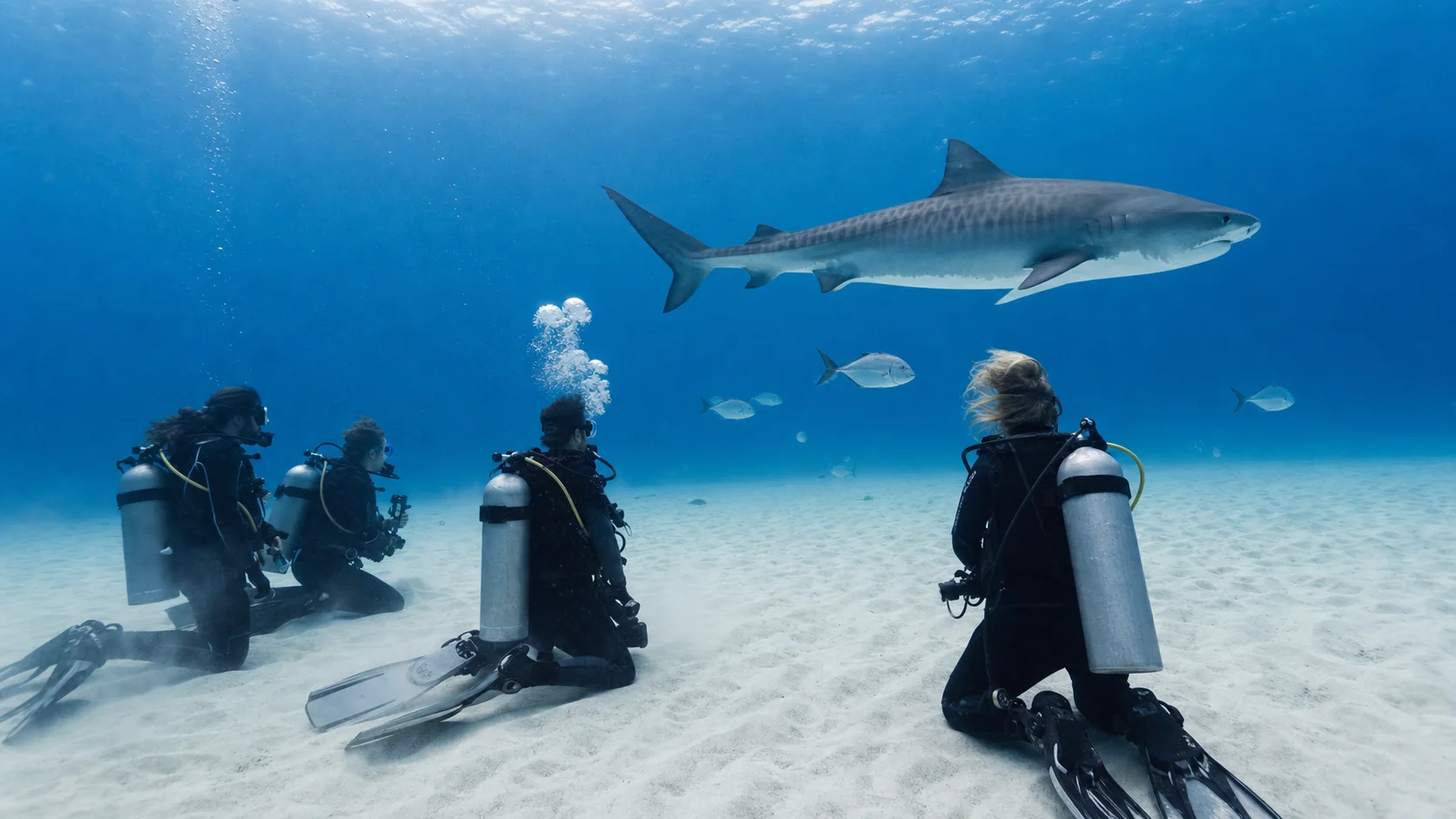
Fuvahmulah diving means dropping onto a shallow sandy plateau called Tiger Harbour, a one-minute boat ride from the island, where resident tiger sharks patrol almost every day of the year. It is the southernmost diving in the Maldives, a single island with no protective lagoon, surrounded by water more than 2,000 metres deep. That geography pulls open-ocean animals right up to the reef.
The catch: this is open-ocean wall diving with real currents. You can dive Tiger Harbour on an Open Water certificate, but an Advanced Open Water qualification opens the deeper cleaning stations where threshers and hammerheads show up, and gives you more margin in current. There is one airline in and out, and you cannot dive the morning you fly home. Plan around both.
Below: what you’ll actually see, whether you’re qualified, when to go, how to get there, what it costs, and how Fuvahmulah fits against the rest of a Maldives dive trip. We’re a Maldives-based agency, not a single dive centre, so this is the whole trip rather than one boat’s sales pitch.
Fuvahmulah is the only place in the Maldives with resident tiger sharks divers can see almost daily, year-round, at a shallow site one minute from the island. Reach it on a 1 hour 25 minute Maldivian flight from Malé, dive it on an Open Water certificate at minimum (Advanced recommended for the deeper sites), and plan four to seven nights with a clear no-fly day before you head home.
Most Maldives diving happens inside sheltered atolls, around lagoons and channel reefs. Fuvahmulah breaks that pattern. It’s a one-island atoll in Gnaviyani, sitting alone in the Equatorial Channel between Huvadhu and Addu in the deep south. No ring of reef, no calm lagoon. The reef edge drops straight into open ocean.
That single fact shapes everything. Nutrient-rich currents sweep up the walls and concentrate pelagic life in a way you rarely get so close to shore. Big animals that you’d normally chase in the blue turn up on ordinary dives here. And because the island sits almost on the equator, the diving runs all year rather than shutting down for a season.

Fuvahmulah is a single-island atoll in the far south of the Maldives, in Gnaviyani Atoll, sitting alone in the Equatorial Channel between Huvadhu and Addu. Unlike most Maldivian atolls it has no surrounding reef ring or lagoon, so its shores drop straight into open ocean more than 2,000 metres deep. That geography makes it the country’s leading destination for diving with large pelagic species, above all tiger sharks.
Researchers and local dive centres have identified a large resident tiger shark population around the island, estimated at more than 200 individuals and overwhelmingly female. Because these sharks are habituated to fish-market waste at the harbour mouth, divers see them on the large majority of dives at Tiger Harbour, in any month of the year.
Planning a Fuvahmulah trip and not sure where it fits in a wider Maldives itinerary? Message us on WhatsApp and we’ll map it out around your dates and certification.
Fuvahmulah has more than 20 named dive sites, but a handful do the heavy lifting. Here’s the short version. For the full tiger shark experience, behaviour and safety, read our dedicated guide to Fuvahmulah’s tiger shark diving.
The signature site, locally Merika Falhagando and once nicknamed Tiger Zoo. A horseshoe plateau at the harbour entrance, roughly 6 to 9 metres on the sand with a drop-off beyond, one minute from shore. Resident tiger sharks here are habituated to fish-market waste, so sightings don’t depend on season. The dive is usually conducted with divers holding position on the plateau while guides and safety divers manage the group, rather than swimming after the sharks.
Cleaning stations at depth where thresher sharks are reported, plus dramatic overhangs and drop-offs. This is where the Advanced certificate earns its place.
Drift and blue-water dives for schooling pelagics, oceanic mantas, hammerheads and the occasional whale shark. Currents range from mild to strong.
The dive centres rotate sites by conditions and what’s showing up, so a typical multi-day trip mixes the shallow tiger plateau with deeper wall and blue-water dives.
Fuvahmulah’s reputation rests on big animals, and it mostly delivers. But “mostly” matters. Tiger sharks are resident and turn up on the overwhelming majority of dives at Tiger Harbour. Everything else is wild, seasonal and never guaranteed, whatever the brochures say.
| Species | How likely | Notes |
|---|---|---|
| Tiger shark | Resident, seen on most dives year-round | The reason people come. Still wild animals, so no absolute guarantee. |
| Thresher shark | Seasonal, deep cleaning stations | Better chance on early, deeper dives. Advanced certification helps. |
| Scalloped hammerhead | Seasonal, in the blue | Reported more often in cooler-water months. |
| Oceanic manta | Seasonal | Cruises the deep drop-offs; sightings vary year to year. |
| Whale shark | Bonus, unpredictable | Possible but not reliable here. For dependable whale sharks, see whale shark experiences in South Ari. |
You’ll also see silvertip, grey reef and whitetip reef sharks, giant trevally, and on lucky days a mola mola. For the wider picture of what swims in Maldivian waters, our Maldives marine life guide covers it.

No, you don’t strictly need an Advanced certificate. Reputable Fuvahmulah dive centres accept Open Water divers for the shallow tiger shark dive, which sits within the 18-metre recreational limit. But Advanced Open Water is strongly recommended, because the deeper sites where threshers, hammerheads and mantas appear run to 30 metres, and the open-ocean currents reward experience.
Be honest with yourself about two things: buoyancy and current. The tiger shark dive asks you to hold a stationary position on the plateau while guides manage the encounter, which is harder than it sounds if your buoyancy is shaky. And Fuvahmulah’s currents range from gentle to genuinely strong. This is not a place to log your first dives since your course two years ago.
Local dive centres run small groups, often a 1:4 guide-to-guest ratio, and every shark dive starts with a proper briefing from guides who hold shark-safety certifications. If you’re rusty, a refresher on day one is money well spent.
Tiger shark diving here runs under strict local protocols, and reputable centres follow them to the letter. That means no hand-feeding of the sharks, no chasing or touching, mandatory pre-dive briefings, controlled group sizes with dedicated safety divers, and divers holding a set position on the plateau rather than swimming around. These rules exist to keep both divers and a habituated wild shark population safe, and they’re why Fuvahmulah’s dives have stayed sustainable as visitor numbers have grown. We only work with centres that take this seriously.
The short answer: any time. Fuvahmulah’s equatorial position means the diving holds up across all months, with water at a steady 27 to 29 degrees and visibility often past 30 metres. Tiger sharks are there year-round.
What changes is the surface and the seasonal species. The drier northeast monsoon months bring the calmest seas and the clearest water. The wetter southwest monsoon brings rougher surface conditions and lower visibility, but also quieter dive sites and, some years, more pelagic activity. For the month-by-month breakdown of conditions and which sharks peak when, see our guide to the best time to dive Fuvahmulah.
Fuvahmulah is a domestic flight from the capital, and there’s only one way to fly it. Maldivian is the sole airline on the route, flying from Velana International Airport (MLE) in Malé to Fuvahmulah Airport (FVM) on a Dash 8 turboprop.
| Detail | Current position |
|---|---|
| Airline | Maldivian (only operator on the route) |
| Route | Malé (MLE) to Fuvahmulah (FVM) |
| Flight time | About 1 hour 25 minutes, non-stop |
| Frequency | Roughly 14 to 15 departures a week, around two a day |
| Aircraft | Bombardier Dash 8 |
Schedules shift by a half hour or so and seats sell out in peak months, so book the domestic leg as soon as your international flights are set. Fares vary, and diver fares booked through dive operators are often cheaper than walk-up airline pricing. We’re authorised to book domestic tickets, so we can tie your FVM flights to your international arrival and your dive schedule in one go.

The no-fly trap most people miss. Your domestic flight back to Malé is still a flight, and you should not dive too close to it. Standard guidance is to leave at least 18 hours after multiple dives before flying, and treating it as a full 24-hour buffer is the safe habit. In practice that means your last dive day ends a clear day before you fly home. Build that gap into your itinerary, or you’ll either skip a flight or skip a dive.
If you’re building a southern itinerary, you don’t have to route through Malé. Divers flying into Gan International Airport in Addu, or already in the Deep South on a liveaboard, can reach Fuvahmulah by sea.
The scheduled option is the government RTL ferry, run by MTCC, between Feydhoo port near Gan and Fuvahmulah. It takes 45 to 90 minutes depending on conditions and runs daily except Fridays. There’s also a longer link from Vaadhoo in Huvadhoo (around two hours). For divers who’d rather not risk a ferry cancellation, private charter speedboats run the Addu crossing too, at a higher cost.
One open-ocean caveat. The Equatorial Channel between Addu and Fuvahmulah is open sea, and crossings get delayed or cancelled in swell. If you’re connecting a ferry to an international flight, leave a generous buffer and confirm the crossing a day or two ahead. For tight connections, the domestic flight from Malé is the more reliable bet.
One message, and we’ll line up your Malé–Fuvahmulah flights, your stay and your dives around a safe no-fly window.
Plan my trip on WhatsAppMost Fuvahmulah trips are sold as dive-and-stay packages that bundle local guesthouse accommodation, daily boat dives, and often the domestic flights from Malé. That makes a single per-night figure misleading, because the diving, the bed and the flight are usually quoted together.
As a rough planning guide, a multi-day diving package on the island typically runs in the mid hundreds to low thousands of US dollars per person for a 4 to 7 night trip, before international flights. Prices vary by season, dive centre, guesthouse category, domestic flight availability, certification level, number of dives, and what’s included. Treat any single number you see online as a starting point, not a quote.
What changes most is trip length. Here’s how the common formats compare for planning purposes:
| Trip style | Planning note |
|---|---|
| 3 to 4 nights | Short shark-focused trip. Limited flexibility once the no-fly day is accounted for. |
| 5 nights | A better balance: Tiger Harbour plus the deeper thresher and wall sites. |
| 7 nights | Best for serious divers and photographers, with a weather and sea-condition buffer built in. |
| Fuvahmulah + resort | Best for couples or mixed diver and non-diver trips, with downtime after the diving. |
For sample 3, 5 and 7-night formats, what’s included and excluded, and a quote built around your dates, see our Fuvahmulah dive packages. For how Fuvahmulah pricing compares with resort-based diving elsewhere, our Maldives diving costs guide sets the context.
Fuvahmulah isn’t a resort island, so the usual Maldives “which resort?” question doesn’t apply. You have three realistic ways to dive it.

The standard choice. Local guesthouses on the island work directly with the dive centres, you’re a one-minute boat ride from Tiger Harbour, and you dive the same sites daily. Best if Fuvahmulah’s sharks are the whole point of the trip.
Fly into Fuvahmulah for the diving, then add a resort stay elsewhere for beach and downtime. This is where the no-fly window and domestic routing need care, and where we earn our keep stitching the legs together.
Some divers reach Fuvahmulah as part of a Deep South liveaboard route, often combined with Addu, rather than staying on the island. It’s a different trip with its own trade-offs. We cover when a boat beats an island stay in our guide to Deep South liveaboard routes.
Three mistakes come up again and again, and all of them are avoidable.
The first is treating it as a tick-box day trip. People try to bolt a single Fuvahmulah day onto a resort holiday and end up spending more time in transit than underwater. The domestic flight, the no-fly window and the daily dive rhythm only make sense across several days. Give it the time it needs or skip it.
The second is overestimating the seasonal sharks. The tiger sharks are the reliable draw. Threshers, hammerheads and mantas are seasonal and shy, and some weeks they simply don’t show. If a thresher is the dealbreaker for your trip, build in extra dive days and go in the right months rather than booking two days and hoping.
The third is underestimating the currents. This is open-ocean diving, not a sheltered lagoon. Strong current days happen, drift dives in the blue are part of the deal, and your buoyancy and air consumption will be tested. Arrive current on your skills, not planning to knock the rust off when you get there.
Should Fuvahmulah be your whole trip, or one chapter of it? Quick steer:
You want reliable tiger sharks and a real shot at threshers and hammerheads, you’re a confident diver, and pelagics matter more than soft coral gardens or a luxury beach.
You want manta cleaning stations, whale sharks on demand, gentle reef diving or a resort base. South Ari, Baa and Vaavu suit that better. See the full Maldives diving guide.
Plenty of divers do both: a few hard days of Fuvahmulah sharks, then a softer resort stay to decompress. That’s a strong itinerary if your dates allow it.
Not for you if… Fuvahmulah isn’t the right call if you want beginner-friendly resort diving, luxury overwater villas on the same island, guaranteed whale sharks, or calm lagoon conditions. Choose it for shark-focused diving, not for a classic Maldives resort holiday.
We’re a Maldives Ministry of Tourism licensed travel agency based in Malé. For Fuvahmulah specifically, that means a few practical things: we book the Maldivian domestic flights and align them with your international arrival, we coordinate with island dive centres rather than tying you to one, we check your certification against the sites you want, and we build the no-fly buffer into the itinerary so you’re not caught out on departure day.
We won’t promise you a whale shark or a flat sea in monsoon season. We will tell you straight what’s realistic for your dates and sort the logistics that turn a good idea into a booked trip.
Yes. Tiger Harbour, locally Merika Falhagando, is the dive site that was widely nicknamed Tiger Zoo. It’s the shallow plateau at the harbour mouth where resident tiger sharks gather, around 5 to 10 metres deep and a one-minute boat ride from the island.
They’re as close to reliable as wild-animal diving gets. The tiger sharks at Tiger Harbour are resident and show up on the large majority of dives, year-round, because they’re habituated to fish-market waste rather than dependent on season. But they’re wild animals in open water, so no responsible operator can promise a guarantee.
An Open Water certificate is enough for the shallow tiger shark dive at most centres. But Fuvahmulah is open-ocean diving with currents, and the deeper pelagic sites need Advanced Open Water. If you’re newly certified or rusty, plan a refresher and be honest about your buoyancy before booking.
Yes, Fuvahmulah is worth it if you’re a certified diver after tiger sharks, deep walls and open-ocean pelagic life rather than a soft resort diving holiday. It’s less suitable for nervous beginners, non-diving beach travellers, or anyone who wants luxury resort comfort on the same island.
Swimming and diving in Fuvahmulah should be done with local guidance, because the island is exposed to open ocean, currents and surf. For scuba diving, use a registered dive centre, follow the shark briefing, stay with the group and avoid entering unfamiliar water alone.
Fly with Maldivian from Velana International Airport in Malé to Fuvahmulah Airport. It’s the only airline on the route, the flight takes about 1 hour 25 minutes on a Dash 8, and there are roughly two departures a day. Book early in peak months.
Four to seven nights is the usual range. That gives you several days of diving across the tiger plateau and deeper sites, plus a clear no-fly buffer before your flight back to Malé. Shorter than four nights and the flight logistics start eating into your dive time.
Sometimes, but treat it as a lucky bonus rather than a reason to go. Whale sharks pass through unpredictably. If dependable whale shark encounters are your goal, South Ari Atoll is the better choice.
Leave a clear buffer before your domestic flight to Malé. Standard guidance is at least 18 hours after repetitive dives, and a full 24 hours is the safe habit. In practice, finish diving a day before you fly out and build that gap into your itinerary from the start.
Tell us your dates and certification level. We’ll handle the flights, the dive centre and the timing.
Enquire on WhatsApp Send an enquiry