

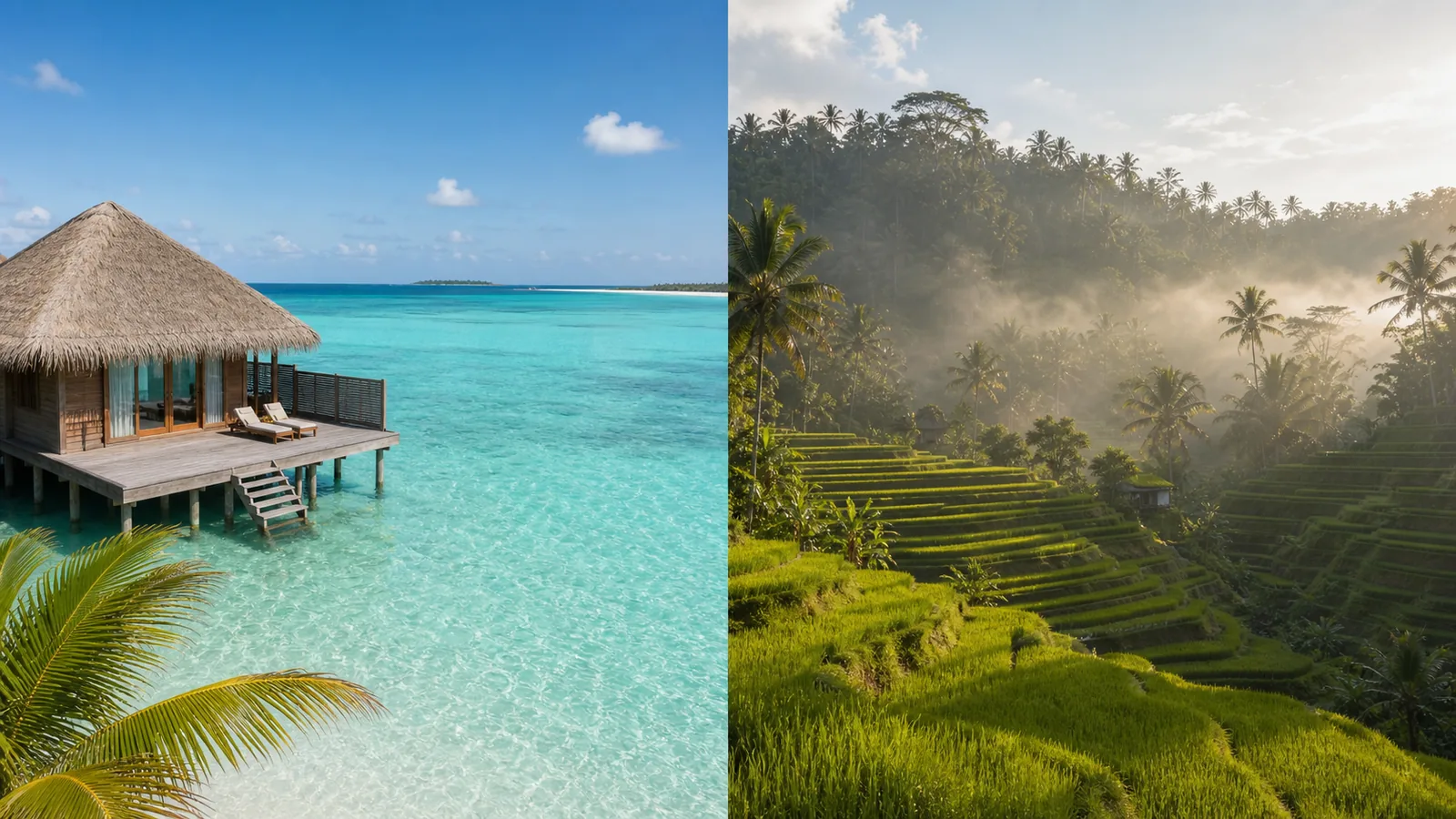
Maldives and Bali keep getting compared because they’re both warm, beautiful, and a long flight from the United States. They’re also two completely different products. Maldives is a resort vacation: you fly to one private island, you stay there, and the resort is the trip. Bali is a destination vacation: you fly to Indonesia’s most-visited island and you move around, eat out, do things.
Picking between them isn’t really about which place is prettier. It’s about what kind of week you actually want. This guide gives you the honest version, including real 2026 costs, transfer math, and entry-rule changes that most blog posts miss.
| Dimension | Maldives | Bali | Verdict |
|---|---|---|---|
| Best for | Quiet, water-focused, romantic, all-inclusive resort stays | Variety, culture, food, surf, social travel, mixed itineraries | Depends on style |
| Geography | 1,192 coral islands across 26 atolls in the Indian Ocean | One large volcanic island (153 km wide) in Indonesia | Different |
| Mid-range cost (per person, per day) | $300 to $600 | $80 to $150 | Bali |
| Beaches and swimming | Calm shallow lagoons, white sand, healthy reefs offshore | Surf beaches, dramatic cliffs, mostly golden-grey sand | Maldives |
| Snorkeling and diving | Manta rays, whale sharks, healthy reefs, 20 to 30m visibility | Decent in north Bali, rough in south | Maldives |
| Surfing | Limited, resort-based, May to October | World-class breaks at Uluwatu, Padang Padang, Canggu | Bali |
| Food and dining | Resort restaurants only, varies by property | Deep restaurant scene, $3 warungs to fine dining | Bali |
| Culture and sightseeing | Limited outside resort islands | Hindu temples, art villages, ceremonies, varied scenery | Bali |
| Top accommodation | Overwater villa or beach villa on a private resort island | Pool villa, jungle retreat, beachfront resort | Different |
| Average resort transfer | $250 to $700 per person speedboat, $850 to $1,500 seaplane (round trip) | $20 to $60 taxi from DPS airport | Bali |
| Best months | November to April (northeast monsoon, dry) | April to October (dry season) | Opposite |
| Entry rule (US passport) | Free 30-day visa on arrival | e-VOA ($35) plus tourist levy ($10) | Maldives |
| Recommended trip length | 5 to 7 nights | 7 to 12 nights | Different |
| First-time honeymoon | If you want privacy and water | If you want photos, food, and stories | Personal |
| Families | Selected family resorts only, expensive | Wider variety, cheaper, more day-trip options | Bali (usually) |
Most articles compare Maldives and Bali like they’re competing for the same trip. They’re not.
When you book Maldives, you book a resort island. The island is your trip. You eat at the resort, you sleep at the resort, you snorkel off the resort’s house reef, and the resort books your spa and excursions. Most resort islands take 10 minutes to walk around. There’s no off-resort dining, no town to wander into, no rental scooter. The water is the entertainment, the silence is the point, and the staff-to-guest ratio is roughly 2:1. After three days, your name is the password.
When you book Bali, you book a place to base out of. You’ll likely move at least once during the trip, say three nights in Ubud for the rice paddies and culture, then four nights in Seminyak or Uluwatu for the beach and food. You’ll eat at restaurants you found on Google Maps. You’ll rent a scooter or hire a driver for $40 a day. You’ll see waterfalls, climb a volcano at sunrise if you’re feeling brave, get a massage for $15. The island gives you the trip.
 Maldives
 Bali
Bali
Once you internalize that distinction, most of the rest of this comparison follows from it.
Bali. By a lot. But the gap depends on what you’re willing to spend on the Maldives side, and where the cost actually goes.
Here are two real, comparable sample weeks. Both for a couple, both 7 nights, both in 2026 USD, both excluding international flights.
 Maldives
 Bali
Bali
That’s about $145 per person per day. You can spend a lot less (Bali on a backpacker budget runs $40 to $50 per day) or a lot more (a Bukit Peninsula clifftop villa with butler service can hit $1,200 per night). Bali stretches both directions.
That’s about $510 per person per day. And this is a sensible mid-range Maldives trip, not luxury. Add a seaplane transfer instead of speedboat ($1,200 to $1,500 round-trip per couple), upgrade to a water villa (often $300 to $500 per night extra), or go all-inclusive with premium drinks ($200 to $400 per person per day extra), and you’re at the $12,000 to $20,000 zone fast.
Where does the gap come from? Three places. Real estate: every Maldives resort sits on its own island it had to build, so room rates start higher. Logistics: everything you eat, drink, and use is shipped or flown in. Tax stack: when you see a $400 per night villa rate, your final folio includes 17% TGST, 10% service charge, and the Green Tax. That’s roughly 27 to 29% on top of the base before you’ve added a single dinner. The current rates are set by the Maldives Inland Revenue Authority.
Bali doesn’t have this problem. Restaurants compete with each other, supply chains run from Java, taxes are baked in. A $50 dinner is a $50 dinner.
Honest budget reality: if your ground budget is under $3,500 per person for a 7-night trip, Bali is the realistic option. Maldives below that number means a local-island guesthouse on Maafushi or Dhigurah, which is a different kind of trip closer to a Bali budget stay than a private-island resort experience.
For a deeper Maldives-only number, we maintain a full Maldives vacation cost breakdown with budget, mid-range, and luxury examples. You can also model your own week with the Maldives cost estimator.
This is the most-asked version of this comparison, and the answer depends on what kind of honeymoon you actually want.
Maldives wins for the “we want to disappear” honeymoon. Overwater villa with a private pool and steps directly into the lagoon. Floating breakfast that arrives by butler. No phone signal you have to honor. No restaurants to book. No outfits to plan beyond a swimsuit and one nice dinner shirt. Six days of not making a single decision.
Bali wins for the “we want to remember the trip” honeymoon. Sunrise hike up Mount Batur with coffee at the rim. Cooking class in Ubud. Cliffside dinner at Rock Bar. Massage in your private villa pool. Scooter ride through rice paddies you’ll have photos of for the rest of your life. The honeymoon is a story, not a state.
Both work. Neither is wrong. The mistake is picking the one that doesn’t match how you actually relax. We’ve worked with US couples who booked the Maldives and found themselves bored on day four because they’re not wired for stillness. We’ve also worked with couples who tried to combine both and spent the second half of their honeymoon exhausted from logistics.
A few practical honeymoon points:
If you’ve already chosen the Maldives side, our Maldives honeymoon from the USA guide covers resort selection, transfer logic, and the all-inclusive question for couples in detail. The overwater bungalow guide goes deeper on villa categories and what’s worth the upgrade.
For most US families, Bali is the easier and cheaper choice. There’s more variety, kids can be loud, and meals out keep everyone interested. Bali also has waterparks, monkey forests, beach clubs with kids’ areas, and a lot more day-trip optionality for a 6 to 12 year old who’d be bored on a 200-meter island.
That said, Maldives can absolutely work for families if you pick the right resort. Family resorts like Kandima Maldives, Meeru Island Resort, Kuramathi, Kuredu, Sun Siyam Olhuveli, Anantara Dhigu, and Lily Beach have proper kids’ clubs, family villas, and shallow lagoons that are safer for younger swimmers than Bali’s stronger surf. The trade-off is cost: a Maldives family vacation for a couple plus two kids in school holidays usually starts at $9,000 to $12,000 for a week before flights. Bali for the same family can be done at $3,500 to $5,000.
Safety point we always raise with families: most Maldives water villas have a railing-free deck two feet above open ocean. They’re spectacular for couples and a real risk for toddlers. If you’re traveling with a child under five, book a beach villa, not a water villa, and confirm the resort has a fenced pool. Some resorts within multi-island groups (like OBLU SELECT Lobigili) are adults-only, so verify the child policy before booking. This is one of the most common Maldives planning mistakes we fix.
For Maldives-side family planning, see our Maldives family vacation guide.
This is where the two destinations diverge most clearly.
A typical Maldives day: wake up in a villa over the water. Coffee on your deck. Snorkel off your reef before breakfast. Long breakfast. Lounge. Lunch. Spa or another swim. Sunset cocktail with the dolphins (you’ll likely see them). Dinner. Repeat. Some days you’ll do an excursion: a snorkeling boat trip, a sandbank picnic, a sunset cruise, a manta ray search if you’re at a resort near Hanifaru Bay between June and November.
A typical Bali day: breakfast on your villa terrace. Drive an hour to a temple, waterfall, rice terrace, or volcano. Lunch at a warung or jungle cafe. Massage. Pool time. Dinner at a restaurant you Googled this morning. Maybe a beach club, maybe a quiet dinner at a clifftop restaurant in Uluwatu. Different scenery every day.

A few activity-specific notes:
If you came specifically for beaches and water, the Maldives wins this on every dimension that matters. White sand, calm shallow lagoons in shades of blue you’ve only seen in screensavers, water temperature consistently 27 to 29°C, no surf at most resort beaches, healthy reefs starting 5 to 50 meters offshore.

Bali’s beaches are a different proposition. The famous ones in the south (Kuta, Seminyak, Canggu) have golden-grey sand, strong surf, and rip currents that local lifeguards take seriously. They’re great for surfing, beach clubs, and sunsets. They’re not great for swimming or relaxing in shallow water. The exceptions are Nusa Dua and parts of Sanur on the east coast, plus the Bukit Peninsula coves below Uluwatu. Lovina in the north has black volcanic sand. None of it looks like Maldives, and trying to compare them on this front isn’t fair to either.
The honest framing: Bali has dramatic, varied coastline and a strong surf scene. Maldives has the world’s best swimming-and-snorkeling beaches. If beaches are the entire reason you’re traveling, see our Maldives beach vacation guide for resort recommendations and atoll selection.
Bali has one of Southeast Asia’s strongest food scenes. Local warungs serve full meals for $3 to $5. Mid-range restaurants in Seminyak, Canggu, and Ubud are at international standard for $15 to $30 a head. The high end (Locavore, Mauri, Apéritif) competes with capital cities anywhere. Vegetarian, vegan, and gluten-free are widely accommodated.
Maldives food is your resort’s food. There’s no off-resort dining option (unless you’re on a local island with guesthouses, which has small cafes and home-cooked Maldivian food). Resort food quality varies. The five-star resorts have multiple restaurants and proper international chefs. The four-stars often have one main buffet plus one specialty, and quality slips on day five if you eat the same buffet every night.
If food is central to your vacation, Bali wins easily. If you’d happily eat at the same hotel for seven days because the view from the table is the point, Maldives is fine. The all-inclusive question (when it’s worth it, when it isn’t) is covered in our Maldives all-inclusive holidays guide.
Maldives has two seasons. The dry season (northeast monsoon, locally called Iruvai) runs roughly November to April, with the absolute peak in January to March: low humidity, calm seas, near-perfect weather. The wet season (southwest monsoon, Hulhangu) runs May to October, with the heaviest rain typically June to August. Wet season doesn’t mean rain all day, it usually means short, intense afternoon storms and otherwise sunny mornings. Resort prices drop 20 to 40% in wet season, and June to November is the best time for manta ray sightings around Hanifaru Bay in Baa Atoll.
Bali has two seasons too, and they’re inverted. Dry season runs April to October. Wet season runs November to March, with the heaviest rain in January and February. Bali wet season also means short bursts of rain, not constant downpour, but high humidity and surf is rougher. Best months for general travel: May, June, September. July and August are dry but crowded and pricier.
| Month | Maldives | Bali | Best pick |
|---|---|---|---|
| December to March | Peak dry season, high prices | Wet season, lower prices | Maldives |
| April | End of dry season, still good | Start of dry season, good | Either |
| May, June, September | Wet but workable, lower prices | Peak dry, lower-than-July prices | Bali |
| July, August | Wet season, manta season starts | Peak dry, peak crowds, peak prices | Either, see notes |
| October, November | Transition, manta season strong | Transition, into wet | Maldives |
This is why Maldives and Bali pair so well as a combined trip in either direction, except for a narrow window in April to May and October to November when both are between seasons. From the US, the practical implication is: if you’re traveling December to March, the Maldives is in its best season. If you’re traveling June to September, Bali is in its best season. For Maldives-only timing, see our best time to visit the Maldives guide.
Both are long flights. Neither has a direct route from any US city.
To Maldives (Velana International Airport, code MLE): the most reliable routings from the US East Coast go via Doha (Qatar Airways), Dubai (Emirates), or Istanbul (Turkish Airlines). From the West Coast, add Singapore (Singapore Airlines, sometimes via Tokyo) as a fourth option. Total travel time is typically 22 to 26 hours including layover. From JFK you’re looking at $1,400 to $2,400 round-trip economy in 2026 prices, depending on season.
To Bali (Ngurah Rai International Airport, code DPS): routings usually go via Tokyo (ANA, JAL), Singapore (Singapore Airlines, Scoot), Hong Kong (Cathay), Doha (Qatar Airways), or Seoul (Korean Air). Total travel time is typically 22 to 28 hours. East Coast economy fares run $1,300 to $2,200 round-trip in 2026.

US-specific operational note: a flight arriving at Malé after 16:00 generally cannot connect to a same-day seaplane transfer to your resort. Trans Maldivian Airways and Manta Air don’t operate seaplanes after sunset. If your inbound flight lands late, you’ll either spend a night at Hulhulé Island Hotel near the airport at your own cost, or you’ll want to pick a resort served by speedboat (which operate later) or domestic flight (Maafaru, Kooddoo, Kaadedhdhoo, Kadhdhoo, and Hanimaadhoo can be reached by night domestic flight). This is one of the most common mistakes US travelers make and one of the most expensive to fix on the day.
Full US-side flight routing from JFK, LAX, ORD, MIA, IAD, SFO, and IAH is in our Maldives from USA guide.
Maldives has fewer hoops at entry. Bali has more paperwork now than it did pre-2024, but it’s all online and straightforward if you do it before flying.
Technically you can do both. Practically, most US travelers shouldn’t try.
The flight from Velana (MLE) to Denpasar (DPS) is usually one-stop via Singapore, Kuala Lumpur, or Colombo, taking 9 to 12 hours including layover. Garuda Indonesia, Singapore Airlines, Scoot, and Batik Air are the main operators in 2026.
A reasonable combined trip looks like 10 to 14 nights total: 5 nights Maldives, then 6 to 8 nights Bali (or the reverse). The order matters. Most travelers prefer Bali first (active, social) then Maldives second (rest, recover, decompress before flying home). Some prefer the opposite to “earn” the Bali pace by starting calm.
The reasons most US clients end up picking just one:
If a combined Asia plus ocean trip is what you’re really after, easier pairings exist for both destinations:
Most travelers who really want both Maldives and Bali find it less stressful to do them as two separate trips a year apart, and use a different second destination on each. We help build these multi-centre routings for US travelers when it’s the right call. See our Maldives multi-centre holidays hub for combinations and routing notes.
Choose both, in the same trip, only if you have at least 14 to 16 nights total, $15,000+ per couple to spend on the ground, are confident with long-haul travel and don’t mind a 9 to 12 hour internal flight, and want a true once-a-decade trip where the cost is roughly the sum of both.
| Traveler type | Better fit | Why |
|---|---|---|
| Honeymooners wanting privacy | Maldives | Private island, overwater villa, no movement needed |
| Honeymooners wanting variety | Bali | Restaurants, temples, day trips, lower daily cost |
| Budget travelers | Bali | Wider low-cost accommodation and food range |
| Luxury travelers | Maldives | Private island, ocean villa, butler-led service |
| Food lovers | Bali | Substantially deeper restaurant scene |
| Snorkelers | Maldives | Healthier reefs, calmer water, manta and whale shark season |
| Surfers | Bali | Famous breaks at Uluwatu and Padang Padang from any south base |
| Divers | Either | Maldives for pelagics; Bali for macro and wreck (Tulamben, Menjangan) |
| Families wanting activities | Bali | Day trips, waterparks, varied food, lower cost |
| Families wanting resort routine | Maldives | Kids’ clubs, shallow lagoons, all-in-one resort setup |
| Digital nomads | Bali | Cafes, coworking, longer-stay visas, infrastructure |
| Travelers who hate moving around | Maldives | One island, one resort, no decisions for 7 days |
| Travelers who get bored easily | Bali | Different scenery every day |
| First international trip | Bali | More to see, easier to feel like you saw a real place |
HolidayVibe Maldives is a Ministry of Tourism licensed agency based in Malé. We don’t sell Bali. We’ll happily tell you to book Bali if your situation calls for it. What we do is build Maldives trips for US travelers where the headline number you see is the all-in number you actually pay.
If you’ve decided Maldives is the right fit, or you’re 80% sure and want to talk through the last 20%, we’d rather you ask us before you book than after.
Tell us your travel dates, who’s coming, and your trip style. We’ll send back a real all-in quote with transfers, taxes, and meals worked in. Same-day reply on WhatsApp.
Bali is significantly cheaper. A comfortable mid-range week in Bali costs $80 to $150 per person per day, including a private villa, food, and activities. Mid-range Maldives runs $300 to $600 per person per day before international flights. The gap comes from the Maldives’ island-resort economics, imported supply chain, and 27 to 29% tax stack (17% TGST, 10% service charge, $12 per person per night Green Tax). Bali also has cheap public transport, $3 to $5 warung meals, and $15 hour-long massages.
It depends on what kind of honeymoon you want. Maldives is better if you want to disappear with your partner in a private overwater villa with butler service, butler-delivered breakfasts, and silence. Bali is better if you want a honeymoon with stories, photos, sunrise volcano hikes, restaurant dinners, and varied scenery. Maldives suits couples who relax by being still. Bali suits couples who relax by being active. Both are excellent. Pick the one that matches how you actually unwind, not what looks best on Instagram.
For Maldives, 5 to 7 nights is the sweet spot. Less than 4 nights doesn’t justify the long flight; more than 8 nights at one resort and many travelers get restless. For Bali, plan 8 to 12 nights so you can split between Ubud (3 to 4 nights) and a beach base like Seminyak, Canggu, or Uluwatu (4 to 7 nights). A combined Maldives plus Bali trip realistically needs 14 to 16 nights including travel days, which is more than most US travelers can take.
Yes, but it’s a long trip. The flight between Malé and Denpasar is one-stop via Singapore, Kuala Lumpur, or Colombo, taking 9 to 12 hours including layover. A practical combined itinerary is 5 nights Maldives plus 7 to 8 nights Bali. Most travelers do Bali first, Maldives second so they end on rest before the long flight home. Total ground cost typically runs $9,000 to $15,000 per couple before international flights. If your trip is under 12 nights, pick one destination and pair it with an easier stopover instead.
No, the Maldives has better beaches by every measure that matters for swimming and relaxing: white powdery sand, calm shallow lagoons, water temperature 27 to 29°C, healthy reefs starting just offshore. Bali has dramatic varied coastline and a strong surf scene, but most southern Bali beaches have golden-grey sand, strong currents, and aren’t great for swimming. The exceptions are Nusa Dua, Sanur, and a few coves on the Bukit Peninsula. If beaches are your main reason to travel, choose the Maldives.
The Maldives is better for snorkeling on every measure that matters: visibility consistently 20 to 30 meters, healthy reefs typically starting 5 to 50 meters offshore, calm shallow lagoons, and pelagic life like manta rays, whale sharks, and reef sharks at known sites including Hanifaru Bay (June to November) and South Ari Atoll. Bali snorkeling is decent in the north (Menjangan Island, Amed) but currents are stronger and visibility is more variable. Most southern Bali beaches aren’t snorkel-friendly at all.
Bali wins clearly. World-class breaks at Uluwatu, Padang Padang, Bingin, and Canggu are accessible from any south Bali base, with surf shops, lessons, and board rentals everywhere. The Maldives also has surf, mostly in North Malé and Central Atolls between May and October, but it’s resort-based, less varied, and harder to access without a surf-focused liveaboard or a specific surf resort. If surfing is the trip, choose Bali.
Bali is generally better for a first international trip. There’s more to see, easier movement around the island, food and culture beyond your hotel, and a wider price range. Maldives is a more specific product: you fly all that way to stay on one resort island. If your first international trip is also your honeymoon and you want maximum disconnection, Maldives works. If it’s a curiosity trip and you want to feel like you saw a real place, Bali delivers more.
Maldives dry season is November to April, with peak weather January to March. Bali dry season is April to October, with peak weather May, June, and September. The two seasons are roughly opposite, which means most months of the year, one of the two is in its better season. December to March favors Maldives. June to September favors Bali. April to May and October to November are shoulder months for both, and either can work if you accept some chance of rain.
Both are very safe for tourists. Bali has more typical urban risks (scooter accidents, occasional petty theft in tourist areas, methanol-tainted spirits at unlicensed bars) but no serious threat to visitors who use common sense. Maldives is one of the safest tourist destinations in the world: violent crime against tourists is essentially zero, and you spend most of your time on a private island where staff outnumber guests roughly 2:1. Solo female travelers are comfortable in both with normal precautions.
For Maldives, no advance visa is needed. US passport holders get a free 30-day visa on arrival. You’ll need to complete the IMUGA Traveler Declaration online within 96 hours of arrival and again within 96 hours of departure. For Bali, US travelers must apply for an e-VOA before flying, costing IDR 500,000 (about $35 USD), plus the Bali Tourist Levy of IDR 150,000 (about $10). Both can be done online via the official Indonesian immigration and Love Bali portals.
Bali has one of Southeast Asia’s strongest food scenes. Warungs serve full local meals for $3 to $5, mid-range restaurants run $15 to $30 a head, and high-end Bali competes with capital cities globally. Vegan, vegetarian, and gluten-free are widely accommodated. Maldives food is whatever your resort serves: five-star resorts have multiple restaurants and excellent chefs, four-stars typically have a main buffet plus one specialty restaurant. Variety is limited because there’s no off-resort dining unless you’re staying on a local island.
Yes, if your idea of relaxing is doing nothing. Maldives delivers a single quiet resort island for the entire trip with no decisions to make beyond which restaurant to eat at. Bali asks you to drive, navigate, and choose constantly, which some travelers find energizing and others find exhausting. The honest test: if you came back from your last vacation feeling like you needed another vacation, Maldives is the better fit. If you came back energized and wanting more, Bali probably suits you better.