

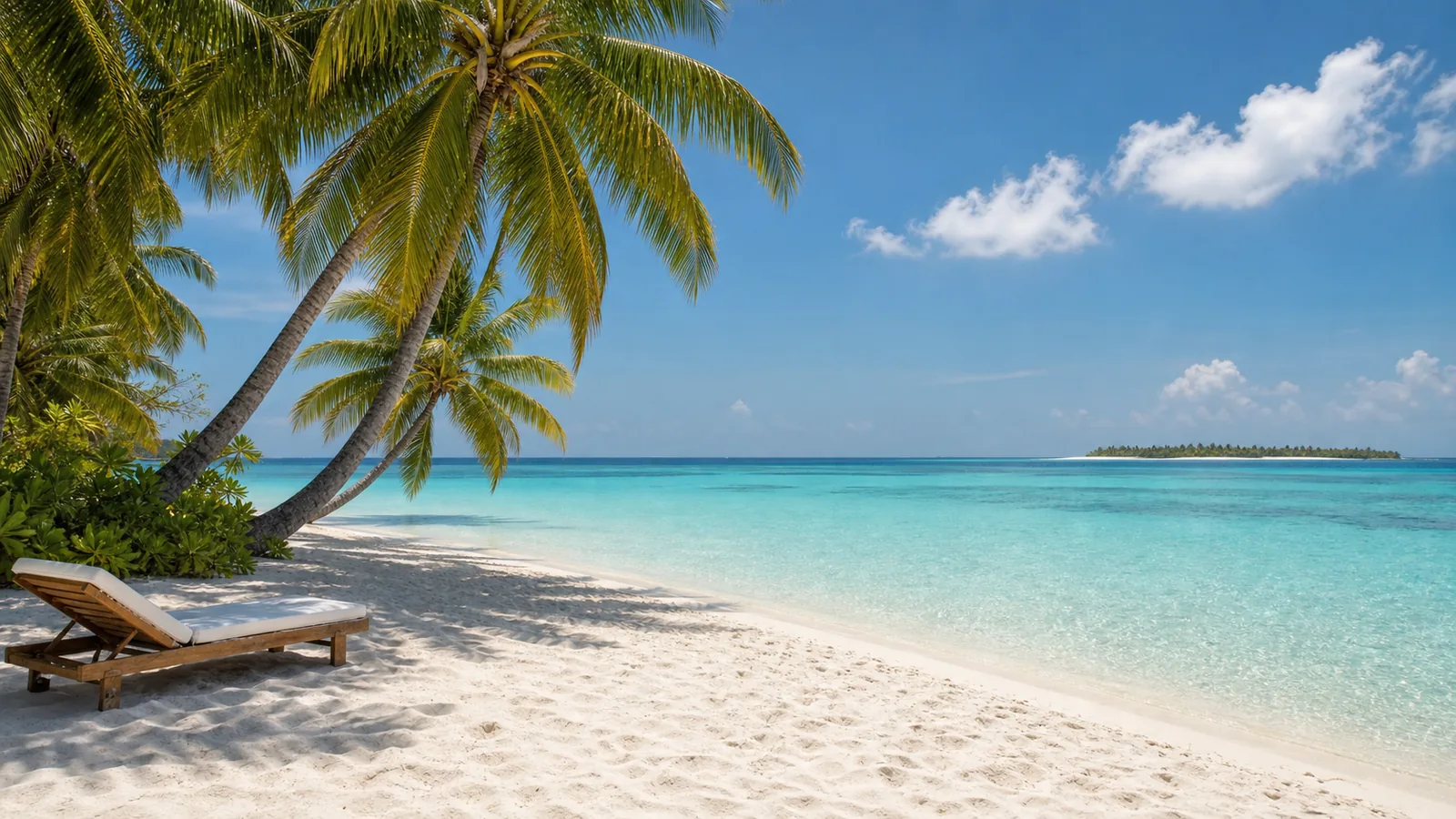
The short answer: A Maldives beach vacation gets sold as one experience and is actually three. The luxury overwater-villa version, where you barely touch the sand. The resort-island beach villa version, often the most balanced choice for US travelers because it gives the private island experience without paying water-villa rates for every night. And the local-island guesthouse version, which lowers the cost meaningfully and adds bikini-beach rules to the trip. The trick is picking the right atoll, the right villa type for a beach-first trip, and the right week of the year. The cost tables further down the page show planning examples for each tier in 2026, so you can see how flights, transfers, taxes, meals, and excursions stack up.
For most US travelers, the beach is the headline reason to visit the Maldives. That sounds obvious until you scroll the OTAs and realize half the inventory is structured around overwater villas where the “beach” is something you photograph rather than walk on. A beach-first trip needs different decisions than the standard Maldives package.
This page is what we’d tell a friend who said “I want a beach vacation, not a water-villa Instagram trip.” We’re a Maldives Ministry of Tourism-licensed travel agency physically based in Malé, and we plan beach holidays for US travelers most weeks of the year. The picks below come from that work, not from a press junket.
For broader Maldives planning context (transfers, taxes, customs rules, the vape ban that took effect in late 2024), our Maldives vacation tips guide covers everything that applies to any Maldives trip. This page focuses specifically on the beach side of the trip.
Easy speedboat transfer, calm lagoon, clear meal plan, and a resort that matches your arrival time at MLE.
Beach pool villa for privacy, sunset views, romantic beach dining, and a quieter island atmosphere.
Beach villa (not water villa) for safety, shallow lagoon, kids’ club, short transfer, flexible dining.

Two things make Maldives beaches measurably different from other tropical destinations.
The sand is biological, not mineral. Most beach sand on Earth is ground-down rock, which means hard granules that get hot underfoot and feel rough on skin. Maldivian beach sand is parrotfish-processed coral. Fish bite chunks of coral reef, digest the algae off it, and excrete the carbonate as fine grains. The result is a chalk-fine grain that stays cool even at 1:00 PM and feels like talc. This isn’t marketing copy; it’s measurable. If you’ve ever wondered why Maldives beach photos look almost too white, that’s why.
The lagoons are atoll-protected. Each Maldivian island sits inside a ring-shaped reef with calm shallow water inside (the lagoon) and deeper open ocean outside. The lagoon stays waist-deep for 50–100 meters from the beach before dropping toward the reef edge. This makes swimming, snorkeling, and especially paddleboarding unusually safe. Currents inside the lagoon are minimal. Wave action is muted. It’s the closest thing to a natural infinity pool that exists at scale.
The combination of chalk-fine cool sand and protected calm lagoon is what people are responding to when they say Maldives beaches are “different.” It’s not just the photo-quality water color (though that’s also real, driven by the white sand reflecting sunlight up through the shallow water).
Best is subjective. These are the ten that come up most consistently in client feedback after their trips.
| Beach | Atoll | Type | What stands out |
|---|---|---|---|
| Bikini Beach, Maafushi | Kaafu (South Malé) | Local-island tourist beach | Most accessible bikini beach, 90 min by ferry from Malé |
| Bikini Beach, Rasdhoo | Alif Alif | Local-island tourist beach | Larger sand strip, fewer crowds, snorkel-friendly shallows |
| Reethi Faru Beach | Baa | Resort beach | Powdery sand, palm-shaded, top-tier house reef |
| Lily Beach (Huvahendhoo) | South Ari | Resort beach | Famous house reef, turtle sightings, soft white sand |
| Vaadhoo Beach | Raa | Local-island | Bioluminescent “Sea of Stars” on dark moonless nights |
| Hulhumalé Beach | Kaafu | Public beach | Closest beach to MLE, 15-minute taxi from arrivals |
| Fulhadhoo | Baa | Local-island | Most secluded local-island beach, almost no infrastructure |
| Dhigurah | Ari | Local-island | 1.5 km of unbroken white sand, whale shark base |
| Veligandu Island Beach | Rasdhoo | Resort beach | Sandbank-style spit, exceptional shallow lagoon |
| Baros Island Beach | North Malé | Resort beach | Premium beach experience, 25-minute speedboat from MLE |
What this list isn’t: a definitive ranking. Different traveler types respond differently to different beaches. A surfer rates Thulusdhoo’s beach above Reethi’s because the wave is the point. A photographer rates Vaadhoo above everywhere else because of the bioluminescence. A family with toddlers wants the calmest lagoon, which usually means Veligandu or a North Malé sandbank-style beach.
For a personalized match, our resort matchmaker tool takes 90 seconds and returns three options based on your trip style.

The Maldives is a Muslim country, but tourism handles the dress-code question through physical separation. The short version:
Resort islands. Anything goes. Bikinis, swim trunks, no-shirt poolside, dresses, whatever you want. Resort islands are leased private islands operating under tourism law, not local civic law. Every beach on every resort island is a “bikini beach” in practice.
Local (inhabited) islands. Modest dress in public, with covered shoulders and knees. Swimwear is allowed only at designated tourist beaches, almost always at one end of the island, marked with a sign reading “Bikini Beach” or “Tourist Beach.” Inside that strip, regular swimwear is fine. Outside it, locals may ask you to cover up. In practice, nobody is hostile about this; it’s framed as a friendly reminder. But repeated violations can result in fines.
Sandbanks and uninhabited islands. Bikini-fine. These are excursion destinations from a resort or guesthouse, not inhabited spaces.
Public beaches at Hulhumalé. This sits in a gray zone. There’s a designated “Bikini Beach” section near the south end, but the broader Hulhumalé beachfront is public and used by Maldivian families. Wear a cover-up to and from the marked strip.
The named local-island beaches with established tourist sections include Maafushi, Rasdhoo, Gulhi, Dhigurah, Thulusdhoo, Fulidhoo, Thoddoo, and Ukulhas. If you’re staying at a resort and don’t plan a local-island excursion, none of this affects you. If you’re doing a split-stay or a guesthouse trip, plan around it.

This is the decision most US travelers get wrong on a beach-focused trip.
The default assumption is that water villas (overwater bungalows) are the premium choice. They are, but only if the goal is the overwater aesthetic. For a beach vacation specifically, the math often points the other way.
Best-value idea: Beach villa for the bulk of the trip, then 1–2 nights in a water villa at the end. You get the iconic overwater experience without paying water-villa rates for a full week.
For the deeper breakdown, our overwater bungalow guide covers when each villa type is worth it.
The Maldives has 26 atolls; only 7–8 are practical for most beach vacations. Here’s how they map to traveler type.
| Atoll | Travel time from MLE | Best for | Beach character |
|---|---|---|---|
| North Malé (Kaafu) | 20–60 min speedboat | First-timers, families, short trips, late arrivals | Soft white sand, calm lagoons, busiest |
| South Malé (Kaafu) | 30–90 min speedboat | Couples, divers, value-conscious | Less crowded than North Malé, similar quality |
| Baa Atoll | 30 min seaplane | Honeymoons, marine-life lovers | Powdery sand, top house reefs, mantas Jun–Nov |
| Ari Atoll | 25–45 min seaplane | Divers, snorkelers, whale shark seekers | Long unbroken beaches, whale sharks year-round |
| Raa Atoll | 45 min seaplane | Privacy seekers, photographers | Quieter, fewer resorts, Vaadhoo bioluminescence |
| Lhaviyani | 35 min seaplane | Mid-range value | Underrated, good beaches, less commercial |
| Vaavu | 90 min speedboat | Budget local-island, Fulidhoo guesthouses | Local-island culture, simpler beaches |
| Addu (Seenu) | 1.5 hour domestic flight | Divers, southerners | Different geography, naturally connected islands |
A useful filter: if your MLE arrival is after 14:30, restrict your atoll choice to North or South Malé. Seaplanes don’t fly after 16:00, and you’ll lose your first night to the airport hotel otherwise. This is the single biggest planning mistake we untangle for clients.
Three tiers, three planning examples for a 7-night trip for two adults from the US, including international flights. These are illustrative ranges in 2026 USD, not fixed quotes. Your actual numbers will vary by season, specific resort, flight routing, and meal plan. Use them to model what a Maldives beach trip looks like at each price point, and ask for an exact all-in quote before you book.
| Line item | USD |
|---|---|
| Round-trip flights (US gateway → MLE economy) | 1,800–2,400 |
| Speedboat transfer to local island (return, 2 pax) | 70–140 |
| Guesthouse 7 nights ($90–180/night incl. taxes) | 700–1,300 |
| Half-board upgrade (3 dinners, 7 breakfasts) | 280–420 |
| Half-day snorkel excursion + full-day sandbank trip | 220–340 |
| Bikini beach access, lagoon snorkeling, kayak rentals | 50–120 |
| All-in 7-night total | 3,120–4,720 |
Best fit: travelers comfortable with simpler accommodation, no alcohol on-site, modest dress off the bikini beach, and a more authentic Maldivian experience.
| Line item | USD |
|---|---|
| Round-trip flights | 1,800–2,400 |
| Speedboat transfer (round-trip, 2 pax) | 200–280 |
| Beach villa 7 nights ($380–550/night before tax) | 2,660–3,850 |
| 17% TGST on dining + beverages + spend | 280–420 |
| 10% service charge on all on-island spend | 200–300 |
| Green Tax (2 adults × 7 × $12) | 168 |
| Half-board upgrade vs BB | 350–500 |
| Two excursions (sandbank, sunset cruise) | 280–400 |
| All-in 7-night total | 5,940–8,320 |
Best fit: most US couples and families. The price-quality sweet spot.
| Line item | USD |
|---|---|
| Round-trip flights | 1,800–2,400 |
| Seaplane transfer (round-trip, 2 pax, billed at resort) | 450–800 |
| Beach pool villa 7 nights ($1,200–2,200/night before tax) | 8,400–15,400 |
| TGST + service charge | 1,200–2,400 |
| Green Tax | 168 |
| Half-board to all-inclusive upgrade | 1,400–2,000 |
| Two excursions + spa day | 800–1,400 |
| All-in 7-night total | 14,200–24,500 |
Best fit: honeymoons, anniversaries, milestone trips, travelers who want zero friction.
What the headline rate hides during peak weeks. Most resorts charge a festive supplement during December 23–January 5, Chinese New Year, and Easter week. The supplement is typically $200–600 per villa per night on top of the room rate. Many resorts also require a mandatory gala dinner at $400–800 per couple on December 24 and 31. If your dates overlap any of these windows, ask explicitly for the festive supplement and gala dinner rates before booking.
These are the resorts our clients return to most often. Listed by tier, not ranked within each.
For honeymoon couples, our honeymoon-from-USA spoke goes deeper on the romance-tier picks. For families, the family vacation guide covers the resorts with the best kids’ clubs and beach safety.
If a 4-star resort beach villa runs over budget, a local-island guesthouse is the substitute that actually works. Three islands consistently deliver.
Maafushi (Kaafu Atoll, South Malé). The most established local-island guesthouse scene in the country. 90 minutes from Malé by public ferry ($3 each way) or 30 minutes by speedboat. Bikini Beach is well-marked, sand is good, snorkeling lagoon is shallow and protected. Guesthouses in the $80–180/night range. Limitations: no alcohol on-island (alcohol-tour boats run from Maafushi to a floating bar nearby for guests who want a drink), busier than other local islands.
Dhigurah (Alif Dhaal, Ari Atoll). 1.5 km of unbroken white sand at the south end of the island, the longest single beach on any Maldivian local island. Whale shark snorkeling base. Quieter than Maafushi. 25 minutes by speedboat from Malé seaplane operations or 4 hours by public ferry. Guesthouses $70–160/night.
Fulidhoo (Vaavu Atoll). The smallest of the three, closest to a “Robinson Crusoe” feel. Tiny scale, friendly local population, excellent snorkeling. 90 minutes by speedboat. Best for travelers who want quiet over amenities.
For more on the local-island route, our Maldives island vacation guide covers the full spectrum.

Resort beaches are great. The non-resort beaches you visit on excursions are sometimes better.
Sandbank picnic. $80–250 per couple. The resort drops you on a tiny strip of sand in the middle of the lagoon, sometimes 50 meters long, sometimes 200, with a picnic basket, an umbrella, and snorkel gear. Pickup three or four hours later. There is, genuinely, nobody else there. Worth the cost on at least one trip.
Uninhabited island day trip. $120–300 per couple. Half-day to a different uninhabited island with snorkeling stops en route.
Sunset dolphin cruise. $100–180 per couple. Resort dhoni cruise during the 5:00–7:00 PM window. Spinner dolphins are reliable in most atolls. Includes drinks, sometimes light food.
Bioluminescent plankton tour (Vaadhoo / Mudhdhoo). $150–250 per couple. Late-evening boat trip to a beach with active bioluminescent plankton. July through January, dark moonless nights only. Photography is hard but the in-person experience is striking.
Beach BBQ on a private beach. $200–400 per couple. Resort sets up tables, candles, and a grill on a beach edge or sandbank. Almost always worth it as a one-night splurge.
The two we recommend skipping: jet ski tours (loud, disruptive, banned in some marine reserves) and “submarine tours” (oversold to families, generally underwhelming).

Most beach vacations involve some beach-side meals. The question is whether all-inclusive is the right meal plan or not.
A quirk worth knowing: at 4-star resorts, the buffet at lunch is usually the weakest meal of the day. Skipping it for a beach-side burger or sandbank picnic improves the trip noticeably. AI plans force you to eat the buffet to “use” the plan, which often degrades the actual experience.
For the deeper breakdown by resort, our all-inclusive guide covers which AI plans are honest.
Beach quality is a year-round constant. Beach experience changes by season.
Iruvai (December–April, dry season). Calm seas, 30+ meter underwater visibility, sunny skies. Premium pricing. February and early March are the peak weeks; everything books out 5–6 months ahead. Christmas/New Year is the most expensive single window of the year.
Hulhangu (May–November, wet season). Tropical showers, often passing in 30 minutes. Resort rates 30–50% lower. Underwater visibility 15–25 meters (still excellent). Surf season runs May–October on the south and west sides of atolls.
The window we steer most US clients away from: late November through December 22. Peak-season rates kick in mid-December but the early-November rains haven’t fully cleared.
For more, our best time to visit guide goes month-by-month.

Two transfer types, very different operations.
Speedboat (resorts in North or South Malé Atoll). Operates 24/7. Faster for nearby resorts (20–60 minutes from MLE). $100–200 round-trip per person. Works regardless of arrival time. The right pick for late US arrivals or any resort in the Malé atolls.
Seaplane (resorts in Baa, Ari, Raa, Lhaviyani, and farther). Operates daylight only, approximately 06:00 to 16:00. Cannot fly after dark. $400–700 round-trip per person. Scenic in itself (the flight is one of the trip’s highlights). The catch: if your international arrival lands at MLE after 14:30, you’ll likely miss the cutoff and be forced to overnight at Hulhulé Island Hotel ($180–250/night) before catching the 06:00 seaplane the next morning. The resort night you’ve already paid for goes unused.
Domestic flight + speedboat (resorts in Addu, far southern atolls). A domestic flight on Maldivian Airlines or FlyMe to a regional airport, then speedboat. Day or night operations.
For US travelers, the practical rule: if your flight lands after 13:30, book a North or South Malé Atoll beach resort. If you can land before 13:30, the country opens up.
The full routing detail by US gateway is in our getting to the Maldives from the USA guide.
Three current rules catch first-time visitors off guard. The list applies to every Maldives trip; we surface them here because beach travelers tend to skip the operational reading.
For the full pre-arrival checklist, see the Maldives tips guide.
In rough order of frequency:
For a deeper breakdown, our Maldives vacation tips guide covers all of these in more detail.
Run through this in the four days before your flight. The IMUGA window opens exactly 96 hours out, so this list is built around that timing.
Beach pool villa at Lily Beach, Conrad Rangali, or Soneva Fushi. Add 1–2 nights in a water villa for the iconic overwater finale.
Beach villa (not water villa) at Meeru, Coco Bodu Hithi, or Bandos. Speedboat resort in North Malé for safest arrival logistics.
Patina Maldives, Ritz-Carlton Fari, St. Regis Vommuli, or Soneva Fushi. Beach pool villa with private pool and butler service.
Local-island guesthouse at Maafushi, Dhigurah, or Fulidhoo. Add 1 day-pass to a nearby resort for the private-beach experience.
Prioritize house reef quality. Lily Beach, Meeru, Coco Bodu Hithi, and Reethi Faru consistently rate top-tier for step-off-the-sand snorkeling.
Speedboat resort in North or South Malé. Skip seaplane atolls; you’ll lose 6–8 hours to transfer that you can’t afford on a short trip.
We’re a Maldives Ministry of Tourism-licensed travel agency physically based in Malé (license MOT.O1.RS.TA.25.RD9933). We book the same resorts every week. The functional difference vs booking through Expedia, Booking.com, or a US-based travel agent comes down to four things on a beach trip:
If you want a beach-vacation quote with the all-in number, WhatsApp +960 992 7007 with your dates, traveler count, and rough budget. Reply within 24 hours, two or three options.
There isn’t a single answer, but the most consistently highly-rated beaches across our client feedback are Reethi Faru (Baa Atoll) and Lily Beach (South Ari) for resort beaches, Dhigurah for local-island beaches, and Veligandu Island for sandbank-style spits. The right beach depends on your trip type: families want calm shallow lagoons, photographers want palm canopy, divers want house reef quality.
Yes at every resort island, where anything goes. On local (inhabited) islands, only at marked tourist beaches called “Bikini Beach” or “Tourist Beach,” usually at one end of the island. Outside that strip on a local island, dress modestly with shoulders and knees covered. Sandbanks and uninhabited-island excursions are bikini-fine because they’re not inhabited spaces.
A beach villa sits directly on the sand, usually under a palm canopy, ten paces from the lagoon. A water villa sits on stilts over the lagoon on a wooden walkway. Water villas cost 25–60% more, offer direct ladder access to the lagoon, and have iconic sunset views. Beach villas are quieter, family-safer, and put you closer to the actual beach experience.
The water clarity is comparable to the best Caribbean spots; the sand is finer (parrotfish-derived coral grain vs ground-rock granules in the Caribbean) and stays cooler underfoot. Maldivian lagoons are calmer because of the atoll-protected geography. Travel time from the US is much longer, though, at 22–32 hours each way vs 4–8 hours for the Caribbean.
For two travelers from the US, a 7-night trip in 2026 typically falls between roughly $3,100 (budget local-island guesthouse) and $24,500+ (ultra-luxury beach pool villa) all-in. The mid-tier sweet spot, a 4-star beach villa, usually plans out around $5,900–8,300 all-in. These are planning estimates, not fixed prices, and your actual total depends on flights, season, transfer type, meal plan, and villa category. The published room rate is typically about 60% of the real total once flights, transfers, taxes, and meals are added.
November through April for guaranteed dry-season weather and calm seas. February and early March are the peak weather weeks. The most underrated window is late April through mid-May, with peak-season-quality weather at shoulder-season prices. May through October is the wet season with 30–50% lower rates and brief tropical showers.
Yes. The atoll-protected lagoon geography means 50–100 meters of waist-deep calm water from the beach before any current or depth change. Wave action inside the lagoon is minimal. The risks are sun exposure, dehydration, and reef cuts (wear water shoes on rocky entries) rather than currents or surf. Outside the reef channel, currents can be strong, so pay attention to lifeguard markers.
Yes. A local-island guesthouse on Maafushi, Dhigurah, or Fulidhoo typically costs $90–180 per night including taxes, with bikini beach access and snorkeling lagoon. A 7-night budget trip for two from the US usually plans out around $3,100–4,700 all-in including flights, depending on routing and season. Limitations: no alcohol on-island, modest dress off the bikini beach, and a more authentic (less polished) accommodation experience.
Reef-safe sunscreen (some resorts ban non-reef-safe brands), a personal snorkel mask (better than rentals), a dry bag, rash guard or UV shirt, water shoes for rocky reef entries, modest cover-up clothing for any local-island excursion, a UK Type G three-pin power adapter, and small USD bills for tips. Don’t pack vapes (banned), alcohol (confiscated), or drones without an advance Civil Aviation Authority permit.
Beach access at your resort is included in the room rate. Beach lounges, umbrellas, and most non-motorized water sports (kayaks, paddleboards, snorkel gear) are usually included. Motorized water sports (jet skis, parasailing), spa, premium dining venues, and excursions are extra. Check the resort’s specific inclusion list before booking, since it varies meaningfully by property.
Yes, through a multi-stop itinerary or a liveaboard cruise. The two most common structures: a split-stay (3–4 nights at one resort, then 3–4 at a second), or a resort-plus-local-island combination. Multi-stop adds 2–4 hours of transfer time per move; we usually recommend it only for travelers staying 10+ nights total. Liveaboards (5–7 nights on a small cruise vessel hopping atolls) are an alternative for serious divers and snorkelers.
Yes if you can absorb the 22–32 hour travel each way and you want a clearly different beach experience than the Caribbean or Mexico. The water quality, sand quality, and lagoon calmness are genuinely superior. The trade-off is logistics, including transfers, IMUGA, and customs rules, that simpler beach destinations don’t require. If a 5-night trip is your only available window, the Caribbean is better optimized for that length. If you can do 7+ nights, the Maldives is in another category.
A Maldives beach vacation is the kind of trip where small planning details (which atoll, which villa type, what arrival time, what meal plan) compound into a meaningfully better or worse week. We’ve planned this trip a few thousand times. Send us your dates and we’ll come back with options where the all-in number is the number.