

West Beach · Baa Atoll
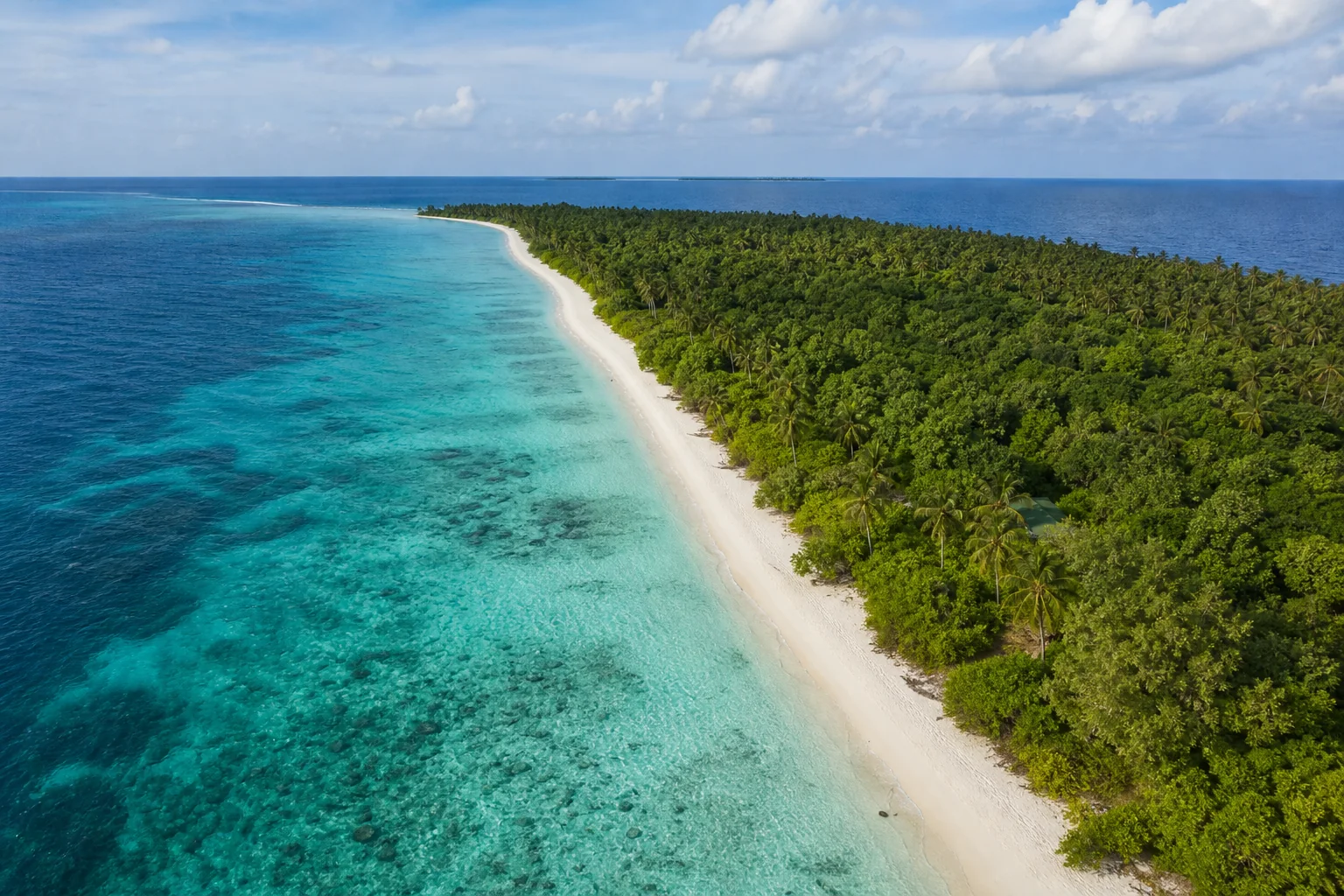
Fulhadhoo Bikini Beach is the designated tourist beach running along the western and southwestern shore of Fulhadhoo island, Baa Atoll, commonly reported at over one kilometre long, some sources cite roughly 1.2 km, though there’s no official surveyed measurement, and its width and the visibility of a sandbank at the western end shift with tide and season. It’s the one place on the island where swimwear is permitted, everywhere else, modest dress applies.
The beach is free to use. Some sections have sunbeds or simple shade, often maintained by nearby guesthouses, but this isn’t a resort beach with consistent infrastructure end to end. A shaded path lined with palm trees leads from the village to the sand, one of the more distinctive approaches among Baa Atoll’s local-island beaches, and it’s worth treating that walk as part of the experience rather than just a route to get through.
At a glance
| Feature | What to expect |
|---|---|
| Location | Western and southwestern shore of Fulhadhoo |
| Locally known as | West Beach |
| Entry fee | None |
| Reported length | Commonly over 1 km, often cited around 1.2 km; no official survey confirms an exact figure |
| Sand | Fine white coral sand |
| Water | Shallow turquoise lagoon in most sections |
| Sandbank | Becomes more visible at the western end around lower tide, not a fixed daily feature |
| Swimwear | Permitted here only |
| Village dress | Shoulders and knees covered |
| Sunbeds | Present in some sections, often guesthouse-maintained, not guaranteed everywhere |
| Toilets, showers, lifeguard | Not reliably confirmed, ask your guesthouse rather than assume |
| Alcohol | Not sold or served anywhere on the island |
| Best for | Couples, families comfortable with limited infrastructure, photographers, slow travellers |
The beach
Fulhadhoo’s west coast has a quieter, more natural feel than the compact tourist beaches on some busier local islands. Vegetation runs close to the sand, and the length of the shoreline means visitors spread out rather than cluster in one small marked-off area. At low tide, the western end broadens into a sandbank-style stretch of exposed pale sand and shallow water, one of the most photographed spots on the island.
Because the beach faces west, it also happens to be the best-oriented spot on Fulhadhoo for watching the sunset, a detail worth factoring in if photography or a quiet end-of-day walk matters to your stay. The shoreline itself is fine, pale coral sand rather than the coarser sand found on some other local islands, and the shallow lagoon extends far enough out in most sections that the water stays warm and calm on an average day.
The beach doesn’t look identical every day. Its appearance shifts with several factors at once, which is why two photos of the “same” beach can look like different places entirely.
| Factor | Why it matters |
|---|---|
| Tide | Controls how much sand and sandbank is exposed at any given moment |
| Wind direction and wave action | Affects water clarity and how calm the lagoon looks |
| Seasonal sand movement | Beach width can shift gradually month to month |
| Recent weather | Storms can temporarily change the shoreline shape |
| Sun angle and cloud cover | Changes the lagoon’s colour intensity in photos |
| Natural debris | Leaves, coral fragments and occasional seaweed are normal on a living coastline |
Aerial shots taken at low tide in strong midday sun tend to make the lagoon look broader and brighter than it will on an overcast day or at high tide. Choose Fulhadhoo because you want a genuine, living island coastline framed by an iconic palm-lined approach, not because you’re expecting a manicured resort shoreline that looks the same in every photo.
Getting there
The beach sits on the western side of the island, away from the village and harbour, which face the opposite direction. Most guesthouses are within walking or cycling distance, though the exact time depends on where you’re staying and which part of the beach you’re heading to, the start of the beach is typically closer than the far western sandbank end.

| Method | Best for | What to confirm |
|---|---|---|
| Walking | Most guests | Actual distance from your specific guesthouse |
| Bicycle | Easier access | Whether your guesthouse supplies one |
| Buggy or cart | Families, luggage, mobility needs | Whether pickup is available |
| Guesthouse beach transfer | Selected properties | Whether it’s included or a paid extra |
The sandbank
Treat “1.2 km” as a commonly cited figure, not a confirmed measurement. What’s more reliably true: this is one of the longer designated tourist beaches among Maldivian local islands, and its usable width changes with tide rather than staying fixed.
The sandbank at the western end is real and well documented, but it isn’t guaranteed to be fully exposed whenever you show up. At high tide, much of that sand disappears underwater, the beach reads narrower, and waves can reach closer to the vegetation line. Check a tide forecast for your dates, or ask your guesthouse when low tide falls that day, there’s no single “best time” that holds true every day of the year.

Swimming safety
The western lagoon is shallow in many sections and can be suitable for relaxed swimming when wind and sea conditions are settled. Depth, current, wave action and the amount of exposed sand all change with tide and weather, and conditions aren’t uniform along the full length of the beach. Independent accounts describe stronger current through the main western stretch and calmer water toward the northern end, better suited to children and weaker swimmers, ask your guesthouse which section is most suitable that day, especially if you’re travelling with children or aren’t a confident swimmer.
Before entering the water, check: wind strength, wave direction, water depth, tide movement, coral or rock underfoot, nearby boat activity, and ask your guesthouse about that day’s conditions.
| Do | Don’t |
|---|---|
| Keep children within reach | Assume a lifeguard is present, none is reliably confirmed |
| Ask locally which section is calmest that day | Swim far from shore alone |
| Use a flotation device if unsure | Enter during visibly rough conditions |
| Wear footwear if coral fragments are present | Assume every section has the same depth and current |
Families
Fulhadhoo can work well for families who want a quiet beach holiday and are comfortable without resort-style infrastructure: carrying your own water and snacks, walking or cycling to the beach, supervising children closely, and adjusting plans around tide and weather. It isn’t a beach to describe as universally safe for unsupervised children, there’s no confirmed staffed lifeguard service.
Distance from your guesthouse to the beach, whether a buggy or bicycle is available, child life jackets, shade, and current lagoon conditions for the section nearest your stay.
Snorkelling
This is a swimming and relaxation beach first. Light snorkelling is possible in places, but conditions vary by entry point, tide and visibility, and accounts of how good it is genuinely differ. Fulhadhoo’s stronger snorkelling, Coral Garden and Fish Point, sits a short boat ride away, not a swim-out from this beach.
Full detail: Fulhadhoo snorkelling guide.
Facilities
| Facility | What to expect |
|---|---|
| Sunbeds | Present in some sections, often guesthouse-maintained, not guaranteed along the whole beach |
| Shade | Some natural tree cover plus occasional bamboo canopies; changes through the day |
| Towels | Usually supplied by your guesthouse if included in your stay |
| Drinking water | Bring your own |
| Restaurants and shops | Don’t rely on finding any along the beach, particularly toward the far western end; bring water and snacks from the village |
| Toilets, showers, changing rooms | Not reliably documented, confirm with your guesthouse rather than assume |
| Lifeguard | No confirmed staffed public service |
| Waste bins | Availability limited in places, take rubbish back with you |

Dress code
Swimwear, including bikinis, stays on this designated beach. Cover shoulders and knees in the village, harbour, shops and streets.
In early 2026, following a public petition on tourist dress standards on Maldivian local islands generally, the Fulhadhoo island council introduced an enforcement measure, reported at MVR 750, for dress-code violations in public areas outside the beach. The specific news report we found describes this as a fine on guesthouses whose guests are found in swimwear off the designated beach, not a fine issued to the tourist directly, though other descriptions circulating online, including some AI-generated summaries, characterize it as a direct tourist fine. Given that inconsistency, the safest approach is simple either way: follow your guesthouse’s current guidance and keep swimwear on the beach.
| Where swimwear is fine | The designated beach only |
| Reported penalty | MVR 750 |
| Who the primary source describes as liable | Guesthouses, for their guests’ conduct |
| When introduced | Early 2026, following a public petition on local-island dress standards |
| Practical takeaway | Cover up before leaving the beach, regardless of who’s technically liable |
Alcohol
Not sold or legally served anywhere on Fulhadhoo, it’s an inhabited local island. Don’t bring your own. If alcohol matters to your trip, a resort day visit or a resort-finish itinerary is the workaround, not this island.
Timing
| Time | Good for | Trade-off |
|---|---|---|
| Morning | Cooler temperatures, softer light, quiet | Less dramatic photo colour than midday |
| Midday | Brightest turquoise lagoon for photos | Strong UV, hot sand, limited shade |
| Late afternoon into sunset | Best light, cooler walking, the beach faces west | Busiest time if other visitors are around |
Seasons
| Period | Beach conditions | Trade-off |
|---|---|---|
| December to April | Generally calmer, drier | Higher demand and room rates |
| May to November | Quieter, sometimes better value | More rain and wind, more variable sea conditions |
Sunshine isn’t guaranteed even in the dry season, and rain rarely lasts a full day even in the wet season. Choose December to April if the beach is your main priority; choose May to November if you’re comfortable trading some weather certainty for quieter stays and possible savings.
Packing
Facilities are minimal by design, so what you bring with you matters more here than on a resort island where everything is provided.
| Item | Why you’ll want it |
|---|---|
| Swimwear and a rash guard | For the beach itself |
| Sun hat and reef-safe sunscreen | Shade is limited in places, especially midday |
| Reef shoes | Useful if coral fragments or rock are underfoot |
| A cover-up or sarong | Doubles as village-appropriate covering on the walk back |
| Drinking water and a dry bag | No shops or restaurants directly on the beach |
| T-shirt or blouse, longer shorts or trousers | Required once you leave the designated beach area |
| Footwear for the walk | Sandy paths and village streets |
Accommodation
A property listed as “beachfront” doesn’t automatically mean it’s on this specific bikini beach, it might face a different shoreline where swimwear rules don’t apply. Before booking, ask the questions that actually determine your day-to-day beach access:
| Question | Why it matters |
|---|---|
| How many minutes from the property to the designated beach, and to which end of it? | “Near the beach” can mean very different things in practice |
| Is a bicycle included? | Makes reaching the far western sandbank end easier |
| Is beach transfer available, or is it a walk regardless? | Affects how much daily effort getting there takes |
| Are sunbeds reserved for guests, or shared and first-come? | Determines whether you’ll always find a spot |
| Are towels included? | One less thing to pack or improvise |
Full comparison: Fulhadhoo guesthouses.
Transfer
Fulhadhoo is roughly 101 km northwest of Male. Most visitors arrive by scheduled speedboat, commonly reported at around two to three hours, exact schedules, departure points and fares should be confirmed for your travel dates before booking.
Full detail: Male to Fulhadhoo speedboat guide.
Photography
The palm-lined path to the beach, the low-tide sandbank, and the western sunset are the most photographed elements. Morning gives softer colour with fewer harsh shadows, midday gives the brightest lagoon blue, late afternoon gives the warmest light.
If you’re flying a drone, check Maldives aviation and security requirements, ask your guesthouse and the island council for current guidance, and don’t fly low over other beachgoers, boats, wildlife, or private guesthouse areas. Respect residents’ privacy, ask before photographing people in the village.

Good practice
| Guideline | Why |
|---|---|
| Take rubbish back to your guesthouse | Waste bin availability is limited on the beach itself |
| Don’t break or collect coral | Protects the reef for future visitors and residents |
| Don’t chase, touch or feed turtles, rays or fish | Disturbs natural behaviour and can be harmful to the animal |
| Avoid standing on living reef | Coral is easily damaged and slow to recover |
| Keep noise down | This is a lived-in island community, not an isolated resort |
| Ask before photographing residents | Basic courtesy in a small, close-knit community |
| Respect the bikini-zone boundary | Keeps the arrangement working for future visitors, rather than risking it being tightened |
Is it for you
Yes, particularly if you want a long, natural local-island beach over a compact tourist strip.
| Good fit | Not a good fit if you’re expecting |
|---|---|
| Couples | Beach bars |
| Families comfortable with limited infrastructure | Alcohol |
| Solo travellers wanting quiet | Full resort service |
| Photographers | A confirmed lifeguard |
| Slow travellers pairing beach time with snorkelling or diving | Multiple beachside restaurants or a shoreline that looks identical every visit |
Two similar names
| Fulhadhoo | Fulidhoo | |
|---|---|---|
| Atoll | Baa Atoll | Vaavu Atoll |
| Beach length | Commonly cited over 1 km | Considerably shorter |
| Transfer from Male | Roughly 2 to 3 hours | Considerably shorter |
| Known for | Length, low-tide sandbank, quiet | Proximity to Male, channel diving |
If a source describes a short beach paired with a sub-90-minute transfer from Male, it’s very likely Fulidhoo, not this beach.
Full disambiguation: Fulhadhoo island guide.
Fact check
| Claim in circulation | What we found |
|---|---|
| “Named a top beach by Lonely Planet” | We could not verify this claim in Lonely Planet’s current Fulhadhoo or Maldives coverage, so we have not repeated it. |
| “MVR 750 fine issued directly to tourists” | The specific news report we found describes it as a fine on guesthouses for their guests’ conduct, not a direct tourist fine, though other summaries describe it differently. |
| Beach length exactly 1.2 km | A commonly cited figure, not an official survey. Treat as approximate. |
| Consistent facilities along the whole beach | Sunbeds, shade and other extras are reported in some sections, often guesthouse-maintained, not uniformly along the entire length. |
Local insight
Book with us
HolidayVibe Maldives is a Ministry of Tourism licensed travel agency based in Male. We match you to a guesthouse with genuine beach proximity, not just a name that implies it, and coordinate your transfer and excursions alongside it.
Message us on WhatsApp: +960 9927007
Chat with us on WhatsAppCommon questions
On the western and southwestern shore of Fulhadhoo, away from the village and harbour. Most guesthouses are within walking or cycling distance.
Commonly reported at over one kilometre, often cited around 1.2 km, though there’s no official surveyed figure for the exact zone.
Yes, no entrance fee. Guesthouse-provided sunbeds, bicycles or transfers may come with their own separate terms.
No, swimwear stays on this designated beach. Cover shoulders and knees in the village, harbour and shops.
The Fulhadhoo island council introduced an enforcement measure, reported at MVR 750, in early 2026. The specific report we found describes it as a fine on guesthouses for their guests’ conduct, though other sources describe it differently. Follow your guesthouse’s current guidance either way.
The main western stretch has been reported as having stronger current than the calmer northern end. Ask locally which section is safest on the day you swim.
Yes, at the western end, more visible around low tide. It isn’t guaranteed to be fully exposed on every visit, check a tide forecast.
In some sections, often maintained by nearby guesthouses, not guaranteed along the entire beach.
Not reliably confirmed. Ask your guesthouse what’s actually available rather than assuming resort-style facilities.
It can suit families in the calmer sections when conditions are good, but there’s no confirmed lifeguard, so close supervision matters.
Some snorkelling is possible, but conditions vary and accounts differ on how good it is. The island’s better reef sites require a short boat trip.
No, Fulhadhoo is an inhabited local island and doesn’t sell or serve alcohol anywhere.
Morning for quiet and soft light, midday for the brightest lagoon colour, late afternoon into sunset for the best overall light, the beach faces west.
No, different islands in different atolls. Fulhadhoo is in Baa Atoll with a longer beach and longer transfer; Fulidhoo is in Vaavu Atoll, considerably closer to Male.
Only with appropriate permission, check Maldives aviation rules, ask your guesthouse and the island council, and never fly low over other people, boats or wildlife.
Continue reading