

Baa Atoll · UNESCO Biosphere Reserve
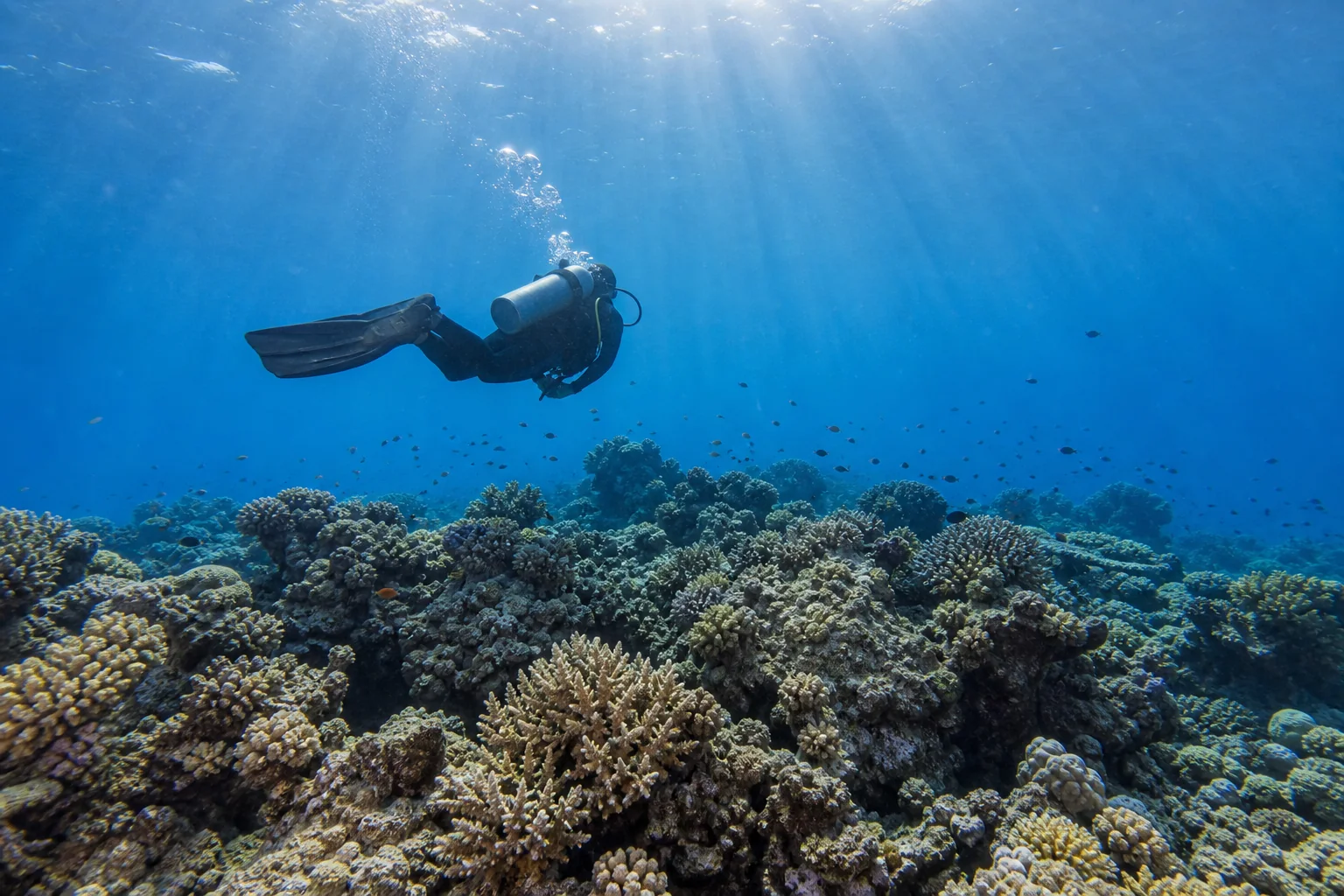
Fulhadhoo offers genuinely good, budget-accessible diving inside the Baa Atoll UNESCO Biosphere Reserve, with an on-island dive centre (SSI and PADI affiliated), around 15 dive sites plus the Dhoru Kandu reef pass, and warm 28 to 30°C water year-round. Because the island sits in its own small mini-atoll at Baa’s southern tip, its reefs see far less dive traffic than the atoll’s resort-heavy centre.
Two things to get straight before you book. First, Hanifaru Bay, the famous manta aggregation site, is a snorkelling-only marine protected area, no scuba diving is permitted there, from Fulhadhoo or anywhere else. Second, Fulhadhoo isn’t Fulidhoo, a different island in a different atoll with its own well-known dive scene. Both mix-ups appear constantly in search results, including AI-generated answers.
At a glance
| Fact | Detail |
|---|---|
| Dive sites | Around 15, plus the Dhoru Kandu reef pass |
| Dive centre | On-island, SSI and PADI affiliated |
| Courses | Discover Scuba through Divemaster; Nitrox and night dives reported available |
| Typical boat schedule | Up to three boat dives a day reported; exact daily structure varies, confirm for your dates |
| Water temperature | 28 to 30°C year-round |
| Depth limit | 30 m (Maldives national recreational limit) |
| Inner-atoll conditions | Calmer, suits newer divers; visibility can drop on some tides |
| Outer-atoll conditions | Better visibility, more current, bigger animals |
| Hanifaru Bay | Snorkel-only, diving prohibited; day trips possible in season |
| Nearest airport | Dharavandhoo (DRV), domestic |
| Recompression chamber | None on the island; confirm the evacuation plan on arrival |
The honest case
The case for: Baa Atoll holds over 1,200 reef fish species and 250 coral species, the richest counts in the Indian Ocean, and Fulhadhoo’s position in the separate Goidhoo mini-atoll means you’re diving reefs that most of Baa’s resort and liveaboard traffic never reaches. Conditions on the inner reefs are forgiving enough for new divers, which is genuinely uncommon in the Maldives, where many well-known sites demand experience with current. Costs run local-island level, not resort level.
Who shouldn’t pick it: divers whose main goal is high-adrenaline channel diving with heavy current on every dive (other atolls serve that better), anyone whose trip depends on diving Hanifaru Bay (impossible, it’s snorkel-only), and anyone wanting guaranteed big-animal encounters on a fixed schedule. Sightings here, as everywhere, depend on season, tide and luck.
Two kinds of diving
This is the distinction that matters most and that most write-ups blur.
| Inner atoll | Outer atoll | |
|---|---|---|
| Conditions | Calmer, more sheltered | More current, more exposed |
| Visibility | Can reduce on some tides | Typically better |
| Commonly reported life | Nurse sharks, turtles, eagle rays, seasonal mantas, hard coral formations | Grey reef sharks, Napoleon wrasse, turtles |
| Suits | Newer divers, courses, relaxed diving | Experienced divers, drift diving |
Which sites run on a given day depends on conditions, the boat goes where the diving is workable, so build flexibility into your expectations rather than fixating on one site.
Dive sites
Around 15 sites are reported within reach, spread across the reefs of Fulhadhoo and its neighbours Fehendhoo and Goidhoo, plus the Dhoru Kandu reef pass. Named sites in the wider area include Dreamland Housereef at Hirundhoo, a wide sloping reef from about 3 m down to 30 to 35 m with mild to moderate current, suited to all levels. Seasonal manta cleaning stations are reported on the mini-atoll’s reefs, active mainly in the May to November season.
We deliberately aren’t publishing a full named site list with depths and current ratings, because no two public sources agree on one, and site selection here is genuinely conditions-driven day to day. Ask what’s running for your dates.

Seasons
| Period | What it means underwater |
|---|---|
| December to April (northeast monsoon) | Calmest seas, typically the best visibility, most reliable boat schedule |
| May to November (southwest monsoon) | Manta season across Baa Atoll, cleaning stations more active, more variable surface conditions |
| Year-round | Turtles (green and hawksbill), reef sharks, batfish schools, barracuda, Napoleon wrasse, reef fish in UNESCO-reserve density |
Water stays 28 to 30°C in both seasons, a 3mm shorty or even a rash guard is enough for most divers.
Reality check
Hanifaru Bay is within Baa Atoll and reachable from Fulhadhoo as a seasonal day excursion, but it is a protected, regulated, snorkelling-only site. No scuba diving is permitted inside the bay. If a page or AI answer lists Hanifaru as one of Fulhadhoo’s “dive sites,” it’s wrong.
What you can do: combine reef diving from Fulhadhoo with a separate Hanifaru snorkel excursion in season (roughly May/June to November, strongest typically July to October). Also worth knowing: Fulhadhoo isn’t the closest base to Hanifaru, Dharavandhoo and Maalhos sit nearer. Pick Fulhadhoo for its own quiet reefs first, and treat Hanifaru as a possible add-on.
Eligibility
Certified divers: bring your certification card and logbook, you’ll be asked for them, and a dive computer if you own one. If you haven’t dived in a while (commonly 12 months or more), expect the centre to suggest a refresher or an easy first “check dive” to reconfirm buoyancy and weighting before anything more ambitious. That’s normal practice, not a sales tactic, and it makes the rest of the trip better.
New divers: Discover Scuba Diving requires no certification and is the standard way to try diving under close supervision. Full Open Water certification typically takes three to four days, factor that into your trip length.
Age and medical: training agencies set minimum ages (10 years for junior-level entry courses under both major agencies) and require a standard medical questionnaire before diving. Certain conditions require a physician’s sign-off, if you have any doubt, sort the medical paperwork before you travel to a small island with no clinic geared to dive medicals. And since Fulhadhoo is an alcohol-free local island anyway, the no-alcohol-before-diving rule takes care of itself.
Learning
The on-island centre is SSI and PADI affiliated, with courses reported from Discover Scuba Diving through Open Water, Advanced and up to Divemaster level, plus Nitrox. Night dives are reported available on request.
If trip time is tight, ask about eLearning: completing course theory online before you arrive can compress the in-water days meaningfully. Referral arrangements (theory and pool work at home, open-water dives completed here) are also standard agency practice, confirm the centre accepts your agency’s referral paperwork before building your trip around it.
The calm inner-atoll conditions make this a genuinely sensible place to learn, less current stress than many Maldivian teaching locations. Confirm course availability, language of instruction, and schedule for your specific dates before booking, small-island dive centres run lean teams and course slots aren’t unlimited.
The dive day
Exact structure varies by season and demand, but expect boat diving in small groups, with up to three boat dives a day reported and night dives on request. Between dives you’ll hold surface intervals per your computer and your guide’s plan, repetitive-dive planning is handled conservatively here, as it should be anywhere this far from a chamber.
Questions worth asking when you book, rather than on the jetty:
| Ask | Why |
|---|---|
| What’s the daily boat schedule for my dates? | Structure shifts seasonally |
| What group sizes do you run? | Affects the experience and the price |
| When was rental equipment last serviced? | Fair question anywhere, standard practice to answer it |
| Do you have my sizes? | Small-island stock is finite, XS/XL and children’s gear especially |
| Is a private guide available? | Reported as an option at many Maldivian centres, confirm here |
| Can I rent a camera or torch? | Don’t assume, confirm |

Equipment
Rental gear is available on-island, but stock on a small island is finite. If you’re particular about fit (very small or very large sizes, prescription masks, children’s equipment), bring your own core kit, mask, computer, exposure suit at minimum, and rent the heavy items. If you bring everything, weigh your bag against the transfer limits below before you fly.
Costs
We’re not going to publish a per-dive price, because the figures circulating online for Fulhadhoo trace back to a source that also gets the island’s basic geography wrong, and dive pricing moves with fuel costs, which have been volatile across the Maldives since March 2026. What genuinely determines your cost:
| Factor | Why it matters |
|---|---|
| Number of dives | Multi-dive packages usually price better per dive than singles |
| Equipment rental | Full kit hire vs bringing your own changes the total meaningfully |
| Course vs fun dives | Certification courses are priced as packages with materials |
| Nitrox | Typically a supplement |
| Night dives | Often priced above a standard day dive |
| Private guide | Priced above group diving where available |
| Group size | Some centres offer group or family pricing, ask |
| Boat distance | Farther sites can carry a fuel surcharge |
| Taxes and service | Confirm whether quoted prices include TGST and service charge |
Message us with your dates and dive count, and we’ll confirm current pricing directly rather than quoting a number that may already be stale.
Trip planning
| Trip length | What fits |
|---|---|
| 3 nights | 2 dive days (4 dives), tight; no-fly buffer eats your last day |
| 5 nights | 3 dive days (6+ dives), one rest or excursion day, comfortable no-fly margin |
| 7 nights | 4 to 5 dive days, a Hanifaru snorkel attempt in season, weather backup built in |
Allow 18 to 24 hours between your last dive and your flight (follow your training agency’s guidance and your computer). With a roughly two-to-three-hour boat transfer plus an international flight, plan your final dive day carefully, don’t dive the morning you travel.
Limitations
Safety
Reef etiquette
You’re diving inside a UNESCO Biosphere Reserve, and the rules that protect it are simple: perfect your buoyancy before you get close to anything, no touching or standing on coral, no chasing or grabbing marine life, no gloves unless your guide requires them for a specific reason, and follow your guide’s briefing on distances from mantas and turtles. Reef-safe sunscreen where you can find it. The lightly-dived state of these reefs is the whole reason to come, keep it that way.

Getting there
The speedboat from Male runs roughly two to three hours; a domestic flight to Dharavandhoo plus a boat is the alternative. If you’re bringing your own equipment, confirm luggage allowances in advance, oversized dive bags may need approval on the speedboat and will face weight limits on domestic flights.
Full transfer detail: Male to Fulhadhoo speedboat guide.
Two similar names
The near-identical names cause real cross-shopping confusion, “Fulidhoo dive prices” shows up in searches for this island.
| Fulhadhoo | Fulidhoo | |
|---|---|---|
| Atoll | Baa (Goidhoo mini-atoll) | Vaavu |
| Known for | Quiet, lightly-dived reefs, manta season proximity | Channel diving, famous nurse shark night dive |
| Transfer from Male | Roughly 2 to 3 hours | Considerably shorter |
| Suits | Beginners to intermediate, quiet-seekers | Divers wanting Vaavu’s channels |
If a price list or review mentions the nurse shark night dive or Vaavu Atoll channels, it’s describing Fulidhoo, not this island.
Full disambiguation: Fulhadhoo island guide.
Local insight
Book with us
HolidayVibe Maldives is a Ministry of Tourism licensed travel agency based in Male. We coordinate your guesthouse, transfer and diving as one trip, confirm current dive pricing and course availability for your actual dates, and can build in a seasonal Hanifaru snorkel day where the timing works.
Message us on WhatsApp: +960 9927007
Chat with us on WhatsAppAll diving is subject to weather, sea conditions, minimum numbers and dive centre confirmation.
Common questions
Yes, particularly for divers who want quiet, lightly-dived reefs inside the Baa Atoll UNESCO Biosphere Reserve, with an on-island dive centre and conditions forgiving enough for beginners on the inner reefs.
Around 15 are reported within reach, plus the Dhoru Kandu reef pass, spread across the reefs of Fulhadhoo, Fehendhoo and Goidhoo.
No one can dive Hanifaru Bay, it’s a snorkelling-only protected area. From Fulhadhoo you can visit it as a seasonal snorkel excursion, typically May/June to November.
There’s no reliable published price list, figures circulating online trace to an unreliable source, and Maldives dive pricing has been moving with fuel costs since March 2026. Ask for current pricing for your dates before booking.
Yes. The inner-atoll reefs are calmer than many Maldivian sites, and the on-island centre offers Discover Scuba and Open Water courses.
Training agencies set minimum ages, junior entry-level courses start at 10 years old, and children’s equipment availability on a small island should be confirmed before booking, not assumed.
Courses from Discover Scuba through Divemaster are reported, under both SSI and PADI, with Nitrox available. eLearning and referral options can shorten the on-island time, confirm for your dates.
Commonly reported: turtles, nurse sharks, eagle rays, batfish schools, barracuda and hard coral inside the atoll; grey reef sharks and Napoleon wrasse outside. Mantas seasonally, May to November. Nothing is guaranteed on any given dive.
December to April for the calmest seas and best visibility; May to November for manta season, with more variable conditions.
28 to 30°C year-round. A shorty or rash guard suits most divers.
Strongly advised, and some operators require it. Specialist dive cover including hyperbaric treatment and evacuation is the standard answer, generic travel policies often exclude or cap diving.
No. The nearest facilities require significant transfer, carry dive insurance and confirm the evacuation plan with the dive centre on arrival.
No. Fulidhoo is a different island in Vaavu Atoll, known for channel diving and a nurse shark night dive. Fulhadhoo is in Baa Atoll. Check which island a review or price actually refers to.
Speedboat from Male (roughly 2 to 3 hours) or domestic flight to Dharavandhoo plus a boat. Confirm oversized-luggage handling in advance.
Continue reading