

You don't need experience to dive in the Maldives. Warm water, calm house reefs, and world-class marine life right from shore make this one of the best places on the planet to take your first breath underwater — or get your PADI certification.
Yes — genuinely one of the best places in the world to start. The water is warm year-round (26–30°C), visibility is typically 20–30 metres, and the house reefs at most resorts are calm and shallow enough for first dives. You can try scuba with no experience at all through a Discover Scuba session, or get your PADI Open Water certification over 3–4 days and dive to 18 metres.
 Maseeh
Maseeh
Maseeh
Diving in the Maldives for beginners is far more accessible than most people assume. The first thing to understand is this: the conditions that make the Maldives famous — warm water, extraordinary visibility, and marine life right at the surface — are exactly the conditions that make learning to dive here so good. You're not struggling with cold water or murky visibility. You're floating in 28°C clarity above colourful reef.
Almost every resort and most local island dive centres offer beginner programmes. PADI 5-Star dive centres are the standard across the country. And because the Maldives has house reefs — live reefs surrounding each island — you can often do your first guided dives just metres from the beach, in calm, sheltered water.
The team at HolidayVibe Maldives knows these waters well. This guide covers everything you need to know before your first dive — what certification you need, which atolls suit beginners, what you'll see underwater, and how to plan your trip to get the most out of it.
Regulations referenced: Maldives Recreational Diving Regulation 2003 · Maldives Ministry of Tourism ↗ · PADI — Diving in the Maldives ↗
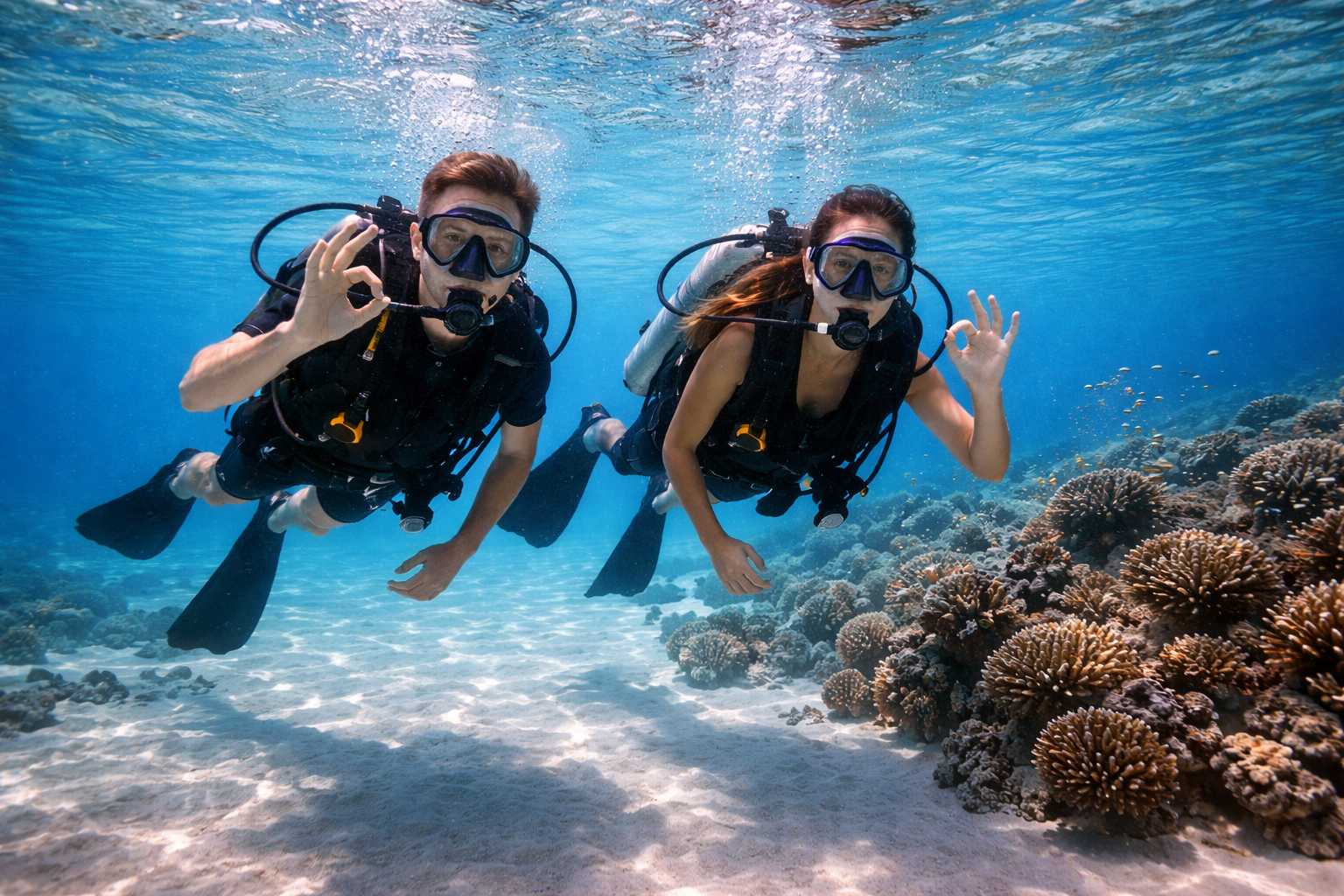
Where you start depends on whether you have a certification and how much time you have. All four options are available at most Maldives resort dive centres.
Not knowing what to expect is what makes people nervous. Here's exactly how a first Discover Scuba or checkout dive day runs at a typical Maldives resort.
Fill in a medical self-declaration form. Bring your certification card and logbook if you have them. If you're new, your instructor will explain the plan for the session and answer any questions.
⏱ 20–30 minutesYour instructor fits your mask, BCD, regulator, and fins. You learn the hand signals, how to clear your mask, and the most important skill: breathing slowly and continuously. There's no rushing this step — take your time.
⏱ 30–45 minutesBreathe underwater for the first time in the shallows. Practice equalising your ears, clearing your mask, and hovering neutrally. This is where nerves usually turn into smiles. Most people feel completely comfortable within 10 minutes.
⏱ 30–60 minutesYour dive group boards a traditional Maldivian dhoni. Your instructor briefs everyone on the site — what you'll see, the entry point, depth, and duration. For DSD dives, this is usually a sheltered reef or giri at 5–10 metres.
⏱ 10–20 minutes on the boatEntry from the boat, descend slowly with your instructor right beside you. The first few minutes are adjustment — breathing slowly, equalising, getting neutral. Then you relax, look around, and realise you're underwater in the Maldives. Turtles, reef fish, and coral everywhere. 35–45 minutes of something most people describe as life-changing.
⏱ 35–45 minutes underwaterBack on the boat, your instructor debriefs the dive — what you saw, how you did, and any suggestions for next time. Most beginners immediately want to book again. This is the moment many people decide to do the full PADI course.
⏱ 15 minutes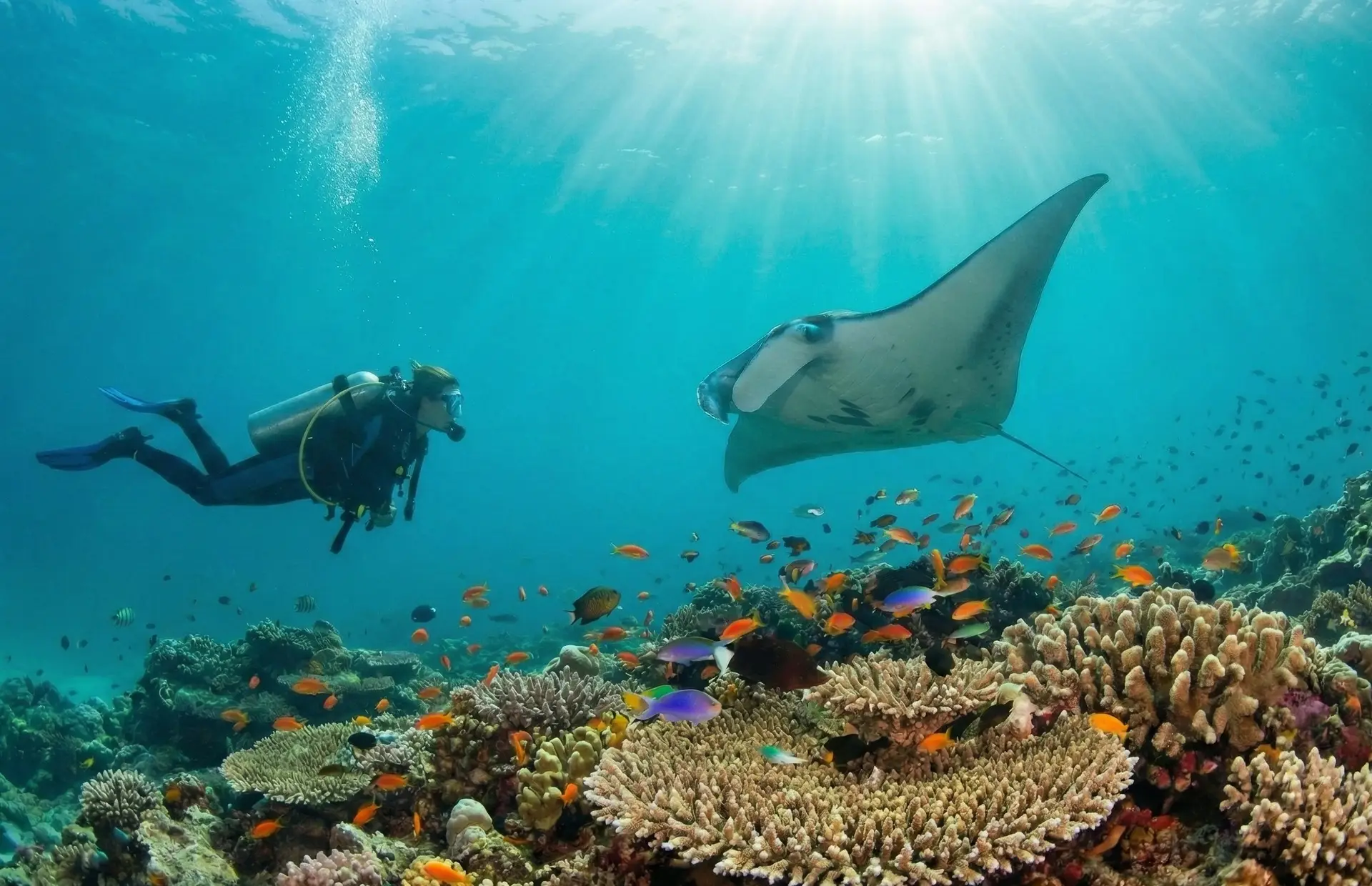
This is the part most guides skip. House reef and shallow reef dives are often the richest dives in the Maldives for marine life density. Here's what to expect on your first few dives.

Present on most house reefs throughout the Maldives. Often resting on coral heads or feeding on the reef flat. Gentle, curious, and completely unbothered by divers.
3–15m depth
One of the most common sights on Maldives house reefs. Small (1–1.5m), non-aggressive, and completely harmless. Seeing your first reef shark on a first dive is genuinely thrilling.
5–18m depth
Resting motionless on sandy reef floors, nurse sharks are one of the calmest encounters in the Maldives. Completely harmless and frequently seen on North Malé house reefs.
5–15m depth
Resting on sandy patches between coral formations, blue-spotted stingrays are stunning in the Maldives' clear water. Often found in the shallows at 5–12m — common on beginner reef dives.
5–12m depth
Clownfish in their anemone are found on virtually every house reef in the Maldives, often at just 3–8m depth. Schools of fusiliers, parrotfish, and butterflyfish surround you on every dive.
3–10m depth
Large, curious, and approachable — the Napoleon (humphead) wrasse is an iconic Maldives encounter. Often comes close to investigate divers. Completely harmless and always photogenic.
8–18m depth
Atoll choice matters more than most beginners realise. These six atolls offer the calmest conditions, the best PADI centres, and the most rewarding marine life for Open Water and DSD divers.
The best all-round choice for first-time Maldives divers. Calm house reefs, world-class PADI 5-Star dive centres at resorts like Vilamendhoo, and near year-round whale shark encounters accessible to Open Water divers. Start here.
Find a resort →Close to the airport — no seaplane required, saving $280–$500 per person. Excellent PADI centres, good house reefs, Manta Point accessible to Open Water divers (Dec–May), and easy boat access to multiple beginner sites.
Best dive resorts →The southernmost atoll has genuinely easy currents — the most beginner-friendly diving conditions in the country. Healthy coral (largely unaffected by bleaching), year-round manta rays, and the British Loyalty wreck for when you advance.
Explore resorts →For beginners visiting June–November, Baa offers a bucket-list snorkel at Hanifaru Bay (manta aggregations, snorkel only). There are also beginner-friendly reef dive sites throughout the atoll for OW-certified divers.
Manta ray guide →Home to Maaya Thila — one of the world's best dive sites. The shallower side (4–8m) is accessible to Open Water divers and packed with reef life. A great progression site once you have 10–15 dives under your belt.
Best dive sites →Close to Malé with speedboat access and a good range of sites at different levels. Protected lagoon reefs suit first dives. Vadhoo Caves is a swim-through site popular with beginners — turtles, unicornfish, and calm conditions.
Find a resort →Simple rules that make your first Maldives dives safer and more enjoyable.
These are the worries we hear most from first-time divers. Every single one of them is wrong.
The dive sites that get press are advanced — Fotteyo Kandu, Tiger Zoo, Hammerhead Point. But the vast majority of the country's 200+ sites are accessible to Open Water divers. South Ari, North Malé, and Addu Atoll all have excellent beginner conditions. Choose the right atoll and the Maldives is perfect for first dives.
Blacktip and whitetip reef sharks are the sharks most beginners encounter. They're non-aggressive, typically 1–1.5m long, and completely habituated to divers. Seeing a reef shark on a first dive is exciting, not scary. Reef sharks in the Maldives have an unblemished safety record with recreational divers.
Channel dives have strong currents — that's the point of them. But house reefs, lagoon sites, and giri dives (where beginners dive) are typically calm and current-free. Your dive centre won't send you to a current site until you're ready. Addu Atoll has some of the easiest currents in the entire Maldives.
PADI and SSI only require that you can swim 200 metres at your own pace (not a specific time) and tread water for 10 minutes. Most people are well within this. You're also wearing a BCD that keeps you afloat at the surface. Fitness helps with air consumption, but you don't need to be an athlete to dive.
Open Water divers to 18m have access to most of the best marine life in the Maldives — whale sharks, manta rays, reef sharks, turtles, and some thila sites like the shallow side of Maaya Thila. Advanced OW unlocks more sites, but it's absolutely not required to have exceptional first dives here.
Some of the most celebrated dive centres in the Maldives are at 4-star properties, not 5-star. Vilamendhoo in South Ari — widely considered home to one of the country's finest house reefs — is a mid-range resort. Good diving correlates to atoll location and dive centre quality, not room price.
Both work well. Here's the honest comparison so you can decide what suits you.
Complete your theory (eLearning) and confined water sessions at your local dive school at home. Arrive in the Maldives with just 4 open-water checkout dives to complete — in warm, clear, tropical water with reef fish all around you instead of a cold pool or harbour.
This saves 1–2 full diving days on your trip and costs $100–$150 less than the full course in the Maldives. You get the same PADI Open Water certification at the end.
If getting certified at home isn't possible, doing the full PADI Open Water course in the Maldives is completely fine — just plan your trip to include 3–4 days for it before your main diving begins.
The resort choice shapes your entire beginner experience. The diving quality doesn't correlate with price tag — what matters is the dive centre, the atoll, and the house reef. Here's what to look for.

Everything to sort before you arrive. None of this is complicated — but checking each box means you spend your first day diving, not sorting admin.

Open Water certified divers can dive with manta rays at cleaning stations — no advanced certification required. Manta Point in North Malé Atoll is the primary scuba site (December to May), where mantas hover motionless while wrasse clean them. The dive is gentle, with mild current and easy conditions.
Hanifaru Bay in Baa Atoll is snorkelling only — but accessible to complete beginners. This is one of the world's greatest wildlife spectacles: mass manta feeding aggregations of up to 200 rays between June and November. You don't need to be a certified diver to experience it.
Full manta ray encounter guide →Ready to go deeper? These guides cover the full picture — from dive sites to costs to choosing the right resort.
Answers to the questions beginner divers ask most.


Tell us your experience level, travel dates, and which marine life is on your wish list — and we'll match you to the right atoll, resort, and dive centre for your first Maldives dive experience.
Free advice · No booking fees · Based in the Maldives