

Home › Maldives Excursions › Maldives Manta Ray Excursion
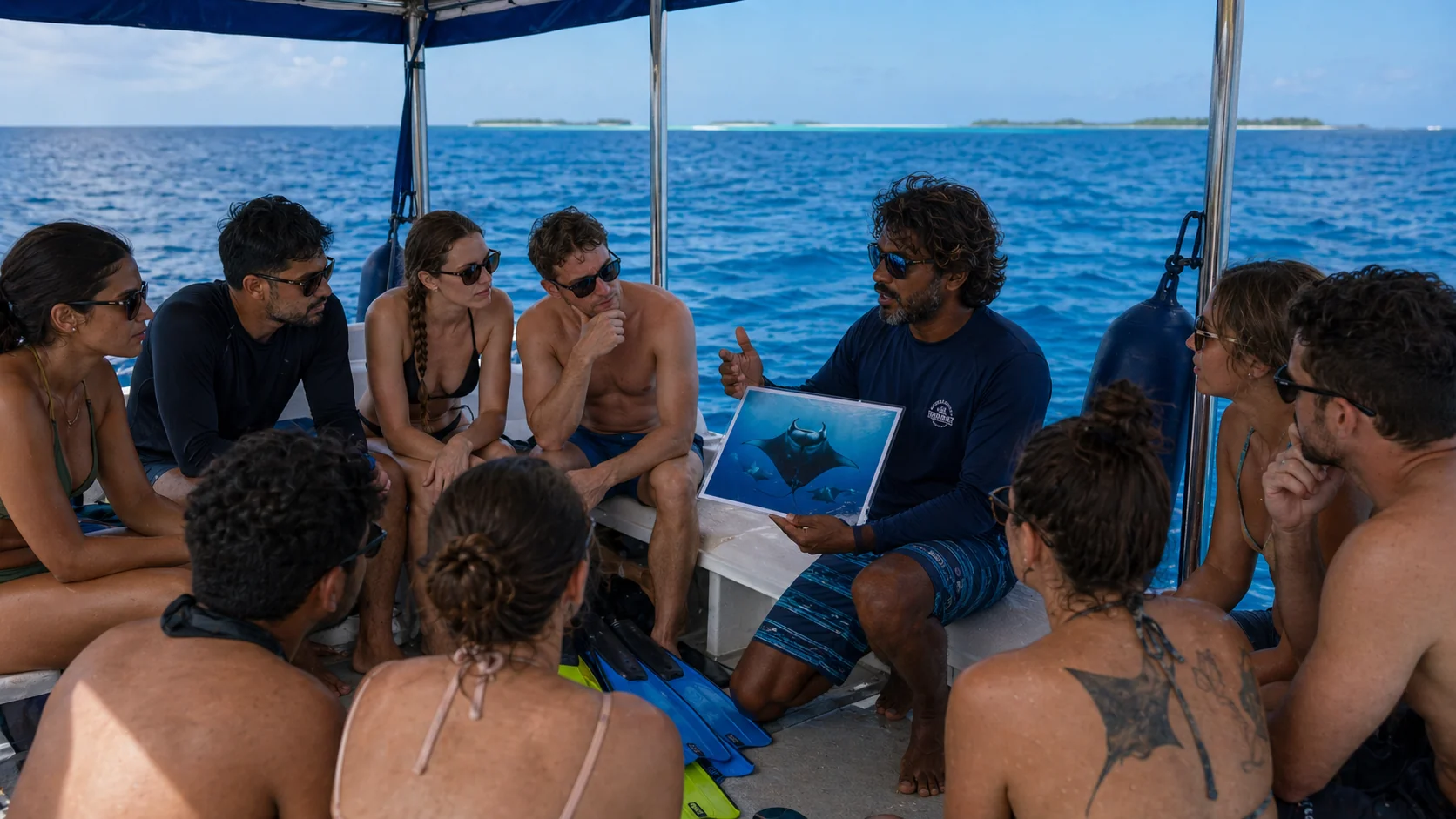
A Maldives manta ray excursion can be one of the country’s most memorable wildlife days, but it is one of the most seasonal pages in the whole silo. The best manta trip is the one that matches the right atoll and month, not the one with the boldest promise.
A Maldives manta ray excursion is usually a seasonal wildlife-search trip with reef snorkeling added as backup value, not a year-round guaranteed encounter from every island. Shared local-island manta routes usually sit around $60-$100 per person in the right season, private boats often start around $550-$1,100 total, and resort-run manta excursions usually land around $110-$240 per person.
The whole decision turns on atoll and month. A great manta route in the right season can feel unforgettable. The same product from the wrong island or the wrong time of year can feel expensive and thin. The Maldives is still a year-round manta destination overall, but different atolls work at different times.
A manta excursion is not a generic snorkeling day with a different name. It is a wildlife-search trip built around the seasonal movement and feeding behavior of manta rays. On a strong route, the crew is using local knowledge of current, wind, and known aggregation patterns. On a weak route, the word manta is just sales decoration.
That is why manta pages should always talk about season and atoll. If a page acts as if the same manta trip works equally well from every island and every month, it is not helping you plan the real day.
The Maldives sees two manta species: reef manta rays (Mobula alfredi), which are the main resident species travelers encounter, and the much rarer oceanic manta rays (Mobula birostris). Reef mantas often span around 3-4 meters, oceanic mantas can reach 5-7 meters, and both are harmless filter feeders that eat plankton rather than hunt people or fish.
Each manta has a unique belly-spot pattern, so researchers identify individuals by photographs rather than by tags. That research base is one reason the Maldives, and Hanifaru in particular, matter so much in the wider manta conversation.
In short
The best Maldives manta ray excursion is the one that lines up with the right season and the right atoll. Timing matters as much as operator choice.

Hanifaru Bay is the most famous manta area in the Maldives for a reason, but it is not the only place that matters. What matters most is whether your island base fits the seasonal route you want.
Hanifaru Bay sits inside the Baa Atoll UNESCO Biosphere Reserve, recognized in 2011, and is one of the most famous plankton-feeding aggregation sites on Earth. When southwest-monsoon currents push dense plankton into the bay, reef mantas arrive in extraordinary numbers, and gatherings of more than 100 animals have been recorded in the right conditions.
| Area or atoll | Why it matters | Best season or context | What to know |
|---|---|---|---|
| Hanifaru Bay, Baa Atoll | The most famous named manta area in the country | Usually June-November, often strongest August-October | Snorkeling only, ranger-managed, and heavily dependent on plankton conditions |
| Nelivaru Haa and wider Baa Atoll | Alternative Baa routes when Hanifaru access is full or conditions shift | Same southwest-monsoon manta season | Useful when your base is already in or near Baa |
| Lankan Manta Point, North Malé | One of the best-known cleaning-station sites outside Hanifaru | Often stronger in the December-April period | A good reminder that Maldives manta watching is year-round in different atolls |
| Boduhithi Thila / North Malé cleaning stations | Useful cleaning-station style route | Best in the northeast-monsoon pattern | Ask whether the day is truly built around manta timing |
| Madivaru Manta Point, Rasdhoo | A practical name for travelers staying around Rasdhoo | Route-dependent but useful in the right current pattern | Good local-island context if you are already based there |
| Veyofushi Manta Point, Lhaviyani | Alternative resort-access manta site | Seasonal and resort-route dependent | Works better for travelers already in that atoll than for people forcing the trip |
| Atoll-specific resort routes | Can be worthwhile if the resort sits near a real manta area | Only in the right season | Convenience does not replace marine logic |
Hanifaru Bay practical reality
Hanifaru is not a normal reef stop. Trips need permits, snorkeling visits are time-limited to about 45 minutes, daily access is capped, and scuba diving is not allowed in the bay. If the plankton conditions are weak or the visitor quota is already used, operators may substitute another reef or cancel the Hanifaru part of the day.
Most manta decisions are really about format and patience. Shared boats usually give the best entry price, while private boats and right-atoll resorts can make the day calmer and easier if mantas are a true priority.
Best when you are already in the right seasonal atoll and want the lowest per-person cost. Shared manta routes often work best when reef snorkeling is added as backup value.
The trade-off is less control if the timing changes on the day.
Best for serious marine-life travelers, photographers, or groups wanting quieter in-water management. A private boat helps with pacing and comfort, especially if conditions are delicate.
The value is in flexibility, not in promising more mantas.
Best when the resort already sits near a real seasonal manta route. Resort logistics can be excellent, but only if the atoll and timing actually support the day.
Always ask whether the final price includes tax and service.

These ranges help you compare route logic and format. A cheaper manta quote outside the right season is often worse value than a more expensive route in the right atoll at the right time.
| Trip style | Planning range | What you usually get | What changes the value |
|---|---|---|---|
| Shared local-island manta combo | $60-$100 pp | Manta-led route with reef snorkeling on many trips | Best when the season is genuinely active |
| Private manta charter | $550-$1,100 total | Flexible pacing, quieter group management, more control | Works best for serious marine-life travelers |
| Resort manta excursion | $110-$240 pp | Convenient departure and easier logistics | Worth it when the resort is in the right atoll context |
| Premium private resort route | $800-$1,800+ total | Private crew and full custom timing | Mostly for travelers building the day around manta priority |
Price note: Resort manta quotes may be shown before 17% Tourism Goods and Services Tax (TGST) and any service charge. Since 1 July 2025, TGST is 17%, so compare the final payable total, not only the base wildlife-day rate.
Key takeaway on value
The strongest manta value comes from booking the right atoll in the right season. If either one is wrong, the whole product weakens quickly.
| Typical timing | What usually happens |
|---|---|
| 7:00 a.m. | Boat departs from Dharavandhoo or another practical Baa base after the operator confirms permit status |
| 7:30 a.m. | Ranger or guide briefing on Hanifaru rules, water entry, and in-bay behavior |
| 8:00-9:00 a.m. | First snorkel window if permits are active and manta feeding conditions are good |
| 9:00-10:00 a.m. | Surface break, regroup, or move to a backup reef if the first window closes |
| 10:30 a.m. | Possible second short manta entry or another Baa marine stop depending on conditions |
| 12:00-1:00 p.m. | Lunch break or calmer island/sandbank stop depending on the operator route |
| 1:00-3:00 p.m. | Reef snorkeling or secondary wildlife stop on the return leg |
| 4:00 p.m. | Return to base |
Manta timing matters more than on most other excursions. June to November is peak Hanifaru Bay manta season, with August to October usually the strongest period when southwest-monsoon currents push the biggest plankton blooms into Baa Atoll.
| Season pattern | Best zones | Why it works | What to watch |
|---|---|---|---|
| Southwest monsoon, roughly May-November | Baa Atoll and Hanifaru-focused routes | Plankton-rich currents build the famous feeding aggregations | Can mean rougher water even when the manta day is stronger |
| Northeast monsoon, roughly December-April | North Malé and other cleaning-station routes | Current patterns shift the better manta logic away from Hanifaru | Travelers who search only for Hanifaru often miss that Maldives manta watching is still alive elsewhere |
Most good manta routes include reef value as well. That matters because no wildlife day should rely only on the hope of one single encounter.
| Possible sighting | Where it fits the day | How to think about it |
|---|---|---|
| Reef fish and coral life | Backup reef-snorkeling stop | Should still feel worthwhile on their own |
| Turtles | Some reef edges and calmer reef sites | A useful bonus, not the core reason to book a manta trip |
| Rays on sandy reef edges | Reef and lagoon transitions | Common enough to be a nice added sight rather than a surprise |
| General blue-water wildlife | Transfers between sites | Occasional rather than something to expect every trip |
A good manta excursion should keep the group calm and respectful in the water. Guests should not chase mantas, block their path, dive down at them, or touch them. The best encounters happen when the group floats predictably and lets the animal move on its own line.
This matters especially in Hanifaru, where rangers actively monitor bay behavior. No-touch rules are there to protect the manta’s protective mucus layer and to keep feeding behavior natural rather than chaotic.
Manta pages should always be read through the lens of month and atoll, not just activity label.
Hanifaru is a southwest-monsoon story. December-April travelers usually need a different manta plan rather than a weaker Hanifaru hope.
Ask why the route is relevant in your travel month, not just whether mantas exist somewhere in the country.
Hanifaru Bay is a snorkeling-only site. Scuba has been prohibited there for years, so do not book expecting a dive-style manta encounter.
Manta encounters work best when guests can float calmly and follow the guide without panic.
That is poor wildlife behavior and can break marine-park rules. A good encounter is calm, level, and respectful.
Luxury logistics do not fix the wrong atoll and wrong season.
Shared local-island manta combinations usually sit around $60-$100 per person in the right season. Private charters often start around $550-$1,100 total, while resort-run manta trips usually land around $110-$240 per person.
Baa Atoll and Hanifaru Bay are the most famous names, especially in the main season, but the right answer still depends on your month and island base. North Malé cleaning stations such as Lankan Manta Point can be stronger in the December-April period, while Baa and Hanifaru dominate the southwest-monsoon season.
June to November is peak Hanifaru Bay manta season, with August to October often the strongest period when southwest-monsoon currents push the biggest plankton blooms into Baa Atoll. December to April can still be very good for manta watching in the Maldives, but the focus shifts toward North Malé and other cleaning-station routes rather than Hanifaru.
No. Manta trips are seasonal wildlife searches, not fixed guaranteed encounters. Good operators often pair a manta route with a reef-snorkeling stop so the day still feels worthwhile if mantas are slower to find.
You do not need to be an athlete, but calm floating and guide awareness matter. Manta snorkeling works best for travelers who can stay relaxed in the water without panicking or chasing the animal.
Choose the option that already sits in the right seasonal atoll. Local islands usually win on value, while resorts can win on logistics and comfort if they are already near a real manta route.
Many manta trips run 4-8 hours depending on season, search distance, and whether reef snorkeling is added. The strongest value usually comes from practical routes, not the longest boat ride.
Some can, especially if they are calm in the water and the trip is well-guided, but most operators are happier with children aged 6 or 8 and above who can float calmly without panicking. Families with nervous swimmers should ask how closely the group is managed and whether there is a strong private option.
Many manta routes also include reef snorkeling where you may see reef fish, rays, turtles, and general coral life. That is one reason a manta-plus-reef day can still feel worthwhile even if the manta window is slower.
No. Good operators tell guests to keep a respectful distance, float calmly, and never block, chase, or dive down at the animal. Manta encounters work best when the group stays controlled in the water and respects marine-park rules.
They can be, especially for serious marine-life travelers or groups wanting quieter in-water management. The benefit is pacing and comfort, not a guaranteed sighting.
Usually only when the route still makes sense. Manta plus reef snorkeling is the cleanest combination because the reef stop gives the day backup value if conditions change.
Manta routes are usually compared with whale sharks, snorkeling days, seasonal Baa planning, and the wider excursion price guide.