

Three historic shipwrecks, the second-largest lagoon in the Maldives, a house reef accessible from shore, colourful painted homes, and a 60-minute speedboat from Malé. Gaafaru is one of the most genuinely undiscovered local islands in Kaafu Atoll.
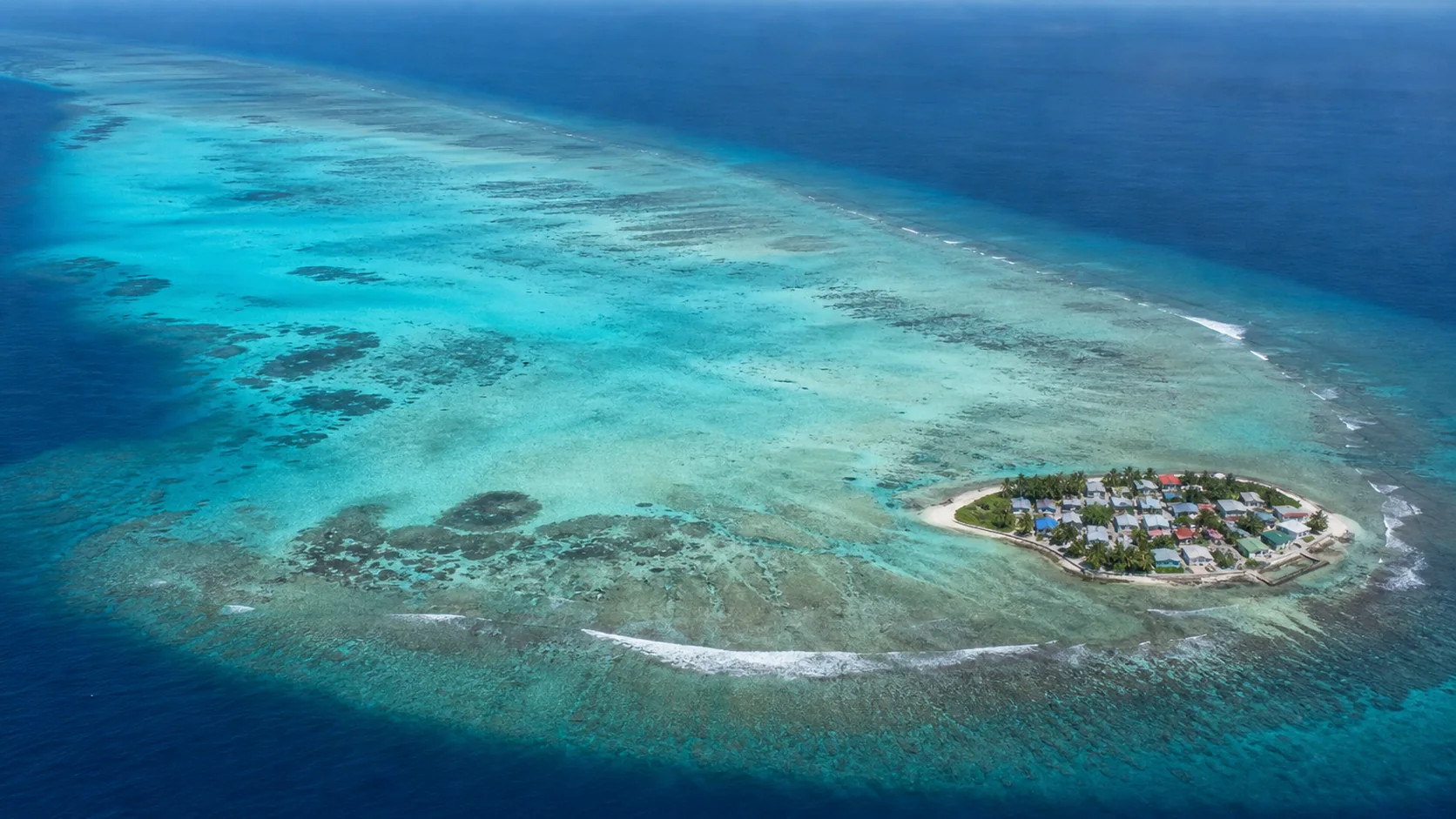
Gaafaru sits at the eastern tip of its own large elliptical reef; Gaafaru Falhu; whose 18 km diameter lagoon is the second largest in the Maldives and famous for its turtle population.
Gaafaru is a small inhabited island in its own right: it is the only island on an independent natural atoll called Gaafaru Atoll (also written Gahaafaru Atoll in older navigation records), though for administrative purposes it falls under Kaafu Atoll. That distinction matters for search results; when you see “Gaafaru Atoll,” “Gahaafaru Atoll,” or “Kaafu Gaafaru” used interchangeably in travel guides, they are all referring to the same destination.
The island sits 62 km north of Malé, on the northern edge of the Kaafu island group. A narrow but deep channel separates it from Kagi, the northernmost island of North Malé Atoll. That channel has historically been a busy shipping lane, which explains why three historic ships ran aground on the surrounding reef and why those wrecks are now Gaafaru’s most famous attraction.
The island itself is tiny; 1.2 km long and 600 m at its widest; and you can walk its entire circumference in under an hour. Despite its size, it packs in a great deal: a house reef accessible from shore, two beaches, homes painted in vivid shades of lilac, orange and blue, a traditional boatbuilding yard, a fishing harbour, and a strong community culture built around fishing and craftsmanship.
The Burulu Falhu (also written Gaafaru Falhu) is the name for the vast circular reef and lagoon system surrounding Gaafaru island. At 18 km in diameter it is the second largest lagoon in the Maldives, and its depth of around 30 m makes it a significant marine habitat. The lagoon is particularly famous for its turtle population, with hawksbill and green turtles regularly sighted both on the house reef and in the surrounding waters.
The reef that forms the outer boundary of this lagoon has proved dangerous to shipping for centuries; the same geological feature that traps ships is what makes the diving extraordinary. Healthy coral formation covers the reef walls at depths from shallow snorkelling territory through to 30 m drop-offs, and the minimal tourist traffic means the coral is in noticeably better condition than reefs at more heavily visited atolls.

Hawksbill turtles are commonly sighted on Gaafaru’s house reef, which is accessible from shore. The Burulu Falhu lagoon is one of the most important turtle habitats in Kaafu Atoll.
Gaafaru’s position on a historic Indian Ocean shipping lane meant that vessels coming through the Kaafu channel had to navigate carefully around the hidden reef. Three did not make it, and the result is one of the most concentrated wreck dive clusters on any single island in the Maldives. All three wrecks are now encrusted with coral and inhabited by diverse marine life.
The most famous wreck at Gaafaru. A 1,012-ton British steamship en route to India when it went down in 1879. The anchor, deck ribs and winch are visible at around 6 m on top of the reef, now engulfed in coral. The giant boilers and stern lie at 30 m at the base of the reef. Nurse sharks, moray eels, Napoleon wrasse, grouper and hawksbill turtles inhabit the site. Suitable for intermediate divers; the shallow section is accessible for snorkellers.
Named after its city of origin in Germany, the Erlangen was sailing from Colombo when it struck the Gaafaru reef. Wreckage is scattered from 5 m down to 40 m, with the main hull resting at 50 m on the sand. The upper sections carry significant coral growth and are home to rays, grouper, and crustaceans. The deeper sections require advanced open water certification and experience with deep diving.
A British survey vessel that went down in 1974. Less structurally intact than the SS Seagull but notable for its caves and overhangs at depth, which shelter nurse sharks, rays, and nudibranchs. The site drops to 50 m. Experienced divers find it rewarding; the shallower sections are accessible for intermediate level. Coral coverage on the wreck is extensive.

The SS Seagull (1879) is Gaafaru’s most famous wreck; anchor visible at 6 m, boilers and stern at 30 m, extensively covered in coral and inhabited by nurse sharks, Napoleon wrasse and moray eels.
You do not need to dive to experience Gaafaru’s marine life. The house reef is accessible directly from shore, with healthy coral formations extending 200–300 m from the beach at depths starting from very shallow before dropping off to 30 m. Sea turtles are commonly sighted on the house reef, and the coral health is strong due to minimal visitor numbers.
The upper sections of the SS Seagull wreck are shallow enough for snorkellers at around 6 m; you can see the anchor, deck ribs and winch without a tank. Two nearby sandbanks are also accessible by short boat trip for a combined sandbank, snorkelling, and swimming excursion. Most guesthouses arrange these as half-day trips.
Gaafaru has a strong identity as a fishing and boatbuilding island. The traditional Maldivian dhoni; the wooden boat used for fishing and transport; is still built and repaired here by hand. Walking past the boatyard in the morning is one of the more memorable things you can do on the island, and the craftsmen are generally happy for respectful observers.
The homes on Gaafaru are immediately striking: painted in vivid shades of lilac, orange, blue and pink, quite different from the whitewashed uniformity of more tourist-developed islands. The island is extremely clean by local island standards, which is noted by most visitors and a point of community pride.
The island is tiny enough that you will naturally run into local life just by walking around; fishermen at the harbour, children at the playground, women running small shops. Gaafaru has a school, health centre, pharmacy, youth club, and a futsal pitch. It functions as a complete community, not a tourism village. The atmosphere is genuinely friendly rather than commercially managed.
Lilac, orange and blue painted houses line sandy lanes; one of the most visually distinctive streetscapes on any Maldivian local island.
Dhoni construction and repair is still carried out by hand on the island. One of the few local islands where traditional boatbuilding is still visibly active.
Fishing is the primary livelihood. Locals sometimes barbecue the day’s catch outside their homes in the evening; an informal local tradition worth asking your guesthouse about.
Two sandbanks within short boat distance make for easy half-day excursions combining swimming, snorkelling and a private picnic in open water.

Gaafaru’s homes are famously painted in vivid shades of lilac, orange and blue; one of the most photogenic streetscapes on any Maldivian local island.
South Beach is the designated tourist beach where swimwear is permitted. It is a natural, undeveloped stretch of sand; no sun loungers, no beach bars. Bring your own mat or towel. The adjacent reef offers snorkelling from shore, though a boat trip to the house reef gives better access to the turtle zones.
The main beach on the island, used by residents. Modest dress (shoulders and knees covered) is required here as on all public island areas. Suitable for walking and photography.
| Option | Duration | Cost (indicative) | Notes |
|---|---|---|---|
| Shared speedboat | ~60–75 min | ~USD 35 per person | Recommended. Departs from Malé around 3:30 pm daily except Fridays. Confirm current schedule and operator with your guesthouse before booking. |
| Private speedboat | ~60–75 min | ~USD 100–200+ per trip | Flexible departure time. Worth splitting between 2–4 people. Prices rise in rough weather. |
| MTCC public ferry | ~3+ hours | ~USD 5 per person | Sun, Tue, Thu from Malé at 11 am. Return Mon, Wed, Sat from Gaafaru at 9 am. Cheapest option. Not recommended if you are prone to seasickness. |
| Factor | Gaafaru | Maafushi | Guraidhoo | Dhiffushi | Thulusdhoo |
|---|---|---|---|---|---|
| Distance from Malé | 62 km, ~70 min | 26 km, ~45 min | 32 km, ~45 min | ~35 km, ~45 min | ~35 km, ~45 min |
| Tourist development | Low, genuinely local | High, tourist-facing | Medium | Low–medium | Medium (surf-focused) |
| Wreck diving | Three historic wrecks | None | None | None | None |
| Turtle sightings | Frequent on house reef | Possible by boat | Possible by boat | Possible | Possible |
| Surfing | No | No | No | No | Yes (Cokes wave) |
| Guesthouses | A few, growing | 30+ | Several | A few | Several |
| Alcohol | No | No | No | No | No |
| Best for | Wrecks, turtles, culture | Beginners, variety | Budget, channel diving | Quiet, short stay | Surfing, budget |
Gaafaru is quieter than Maafushi and less surf-focused than Thulusdhoo. It has a more open-ocean feel than Dhiffushi and stronger wreck and turtle credentials than any of the comparison islands. Choose Gaafaru when the sea, the reef, the wrecks, and the fishing culture are the primary draw rather than tourist infrastructure or surf access.
HolidayVibe is a Ministry of Tourism licensed travel agency in Malé. We arrange guesthouse bookings, speedboat transfers, wreck dive excursions and snorkelling trips for Gaafaru. WhatsApp us for a confirmed quote.
Two nights is the minimum to justify the speedboat transfer and see the main activities. Three to four nights is the most comfortable length for most visitors, covering the wrecks (or snorkelling), a sandbank trip, the island walk, and at least one fishing or dolphin excursion. Longer stays suit dedicated divers who want multiple days on the wrecks and reef in different conditions.
Gaafaru suits couples who want a quiet guesthouse stay with sea excursions and local island life, without resort-level pricing. If you want both the local island experience and a resort finish, a split stay works well: a few nights on Gaafaru followed by a resort in North Malé Atoll (30–60 minutes away by speedboat). HolidayVibe can arrange both in a single booking with a coordinated transfer between them.
For families, Gaafaru works if the children are comfortable with boat trips and simple guesthouse facilities. The island is safe and friendly to walk. There is no swimming pool on the island; the beach and reef are the main water options for children. Confirm meal flexibility with your guesthouse before booking if travelling with young children.
| Topic | Detail |
|---|---|
| Currency | USD and MVR accepted; no ATM on the island. Some guesthouses offer money-changing. Carry cash. |
| Dress code | Cover shoulders and knees everywhere except South Beach (bikini beach). This applies to all genders. |
| Alcohol | Not available on the island. Gaafaru is a dry local island. |
| Healthcare | Basic health centre on the island. For anything serious, transfer to Malé. |
| Connectivity | 4G mobile data via Dhiraagu and Ooredoo. Most guesthouses have Wi-Fi. |
| Photography | Always ask permission before photographing people. |
| Shopping | Small general stores; a couple of local souvenir shops selling handmade items. |
| Green Tax | USD 6 per person per night at guesthouses |
| TGST | 17% from 1 July 2025 on all taxable tourist services |
| Best diving season | January–May for weakest currents and best visibility at wreck sites |

South Beach on Gaafaru is the designated tourist beach where swimwear is permitted. The adjacent reef offers good snorkelling, with turtle sightings common in the shallower sections.
Gaafaru is a small inhabited island 62 km north of Malé. It is the only island on its own natural atoll (called Gaafaru Atoll or Gaafaru Falhu), though administratively it falls under Kaafu Atoll. When you see “Gaafaru Atoll” or “Kaafu Gaafaru” in search results, they both refer to the same island destination. It sits north of North Malé Atoll, separated from the northernmost island of that atoll by a narrow deep channel.
Gaafaru island and Gaafaru Atoll are essentially the same destination. Gaafaru is the only inhabited island on a natural reef structure called Gaafaru Atoll (or Gaafaru Falhu, also written Gahaafaru Atoll in older navigation sources). For administrative purposes, the Maldives government groups it under Kaafu Atoll. Travel searches for “gaafaru atoll,” “gahaafaru atoll” and “gaafaru island maldives” are all looking for the same place.
The standard route is a shared or private speedboat from Malé, taking approximately 60–75 minutes. Shared speedboats cost around USD 35 per person and typically depart around 3:30 pm daily except Fridays. A public MTCC ferry also operates on Sundays, Tuesdays and Thursdays (departing at 11 am) and costs around USD 5 per person but takes over 3 hours. There is no airport on Gaafaru and no seaplane or domestic flight option. Always confirm current schedules with your guesthouse before travelling.
Gaafaru is most famous for three diveable historic shipwrecks (SS Seagull 1879, Erlangen, and Lady Christine 1974), its turtle population in the Burulu Falhu lagoon (the second largest in the Maldives), accessible house reef snorkelling from shore, and its status as one of the most genuinely undeveloped local islands within a reasonable speedboat distance of Malé. It is also known for its colourful painted homes and traditional boatbuilding culture.
Yes. Gaafaru has three diveable shipwrecks. The SS Seagull (1879) is the most famous, with its anchor visible at 6 m and boilers at 30 m. The Erlangen has wreckage scattered from 5 to 40 m, with the main hull at 50 m. Lady Christine (1974) has caves and overhangs dropping to 50 m. All three sit on the Gaafaru Falhu reef, which historically claimed ships navigating the northern Kaafu shipping channel. The shallow upper section of the SS Seagull is accessible for snorkellers.
Yes. Hawksbill and green turtles are commonly sighted on Gaafaru’s house reef, which is accessible from shore. The Burulu Falhu lagoon is specifically noted for its turtle population and is one of the more important turtle habitats in Kaafu Atoll. Turtle sightings are never guaranteed on any individual snorkel or dive, but Gaafaru is one of the more reliably productive local islands for turtle encounters in the central Maldives.
Yes. South Beach is the designated tourist beach on Gaafaru where swimwear is permitted. The island’s main beach (Gaafaru Beach) requires modest dress as it is a public area used by residents. Outside designated tourist beach areas, shoulders and knees should be covered throughout the island.
Yes. Gaafaru has a small number of guesthouses, with the number growing as the island gains more attention from budget and dive-focused travellers. HolidayVibe arranges guesthouse bookings on Gaafaru alongside speedboat transfers and excursions. Browse Gaafaru guesthouses here.
No. There is currently no ATM on Gaafaru island. Carry sufficient cash in USD or Maldivian Rufiyaa before you travel. Some guesthouses offer money-changing services, but the rate will be better at Velana International Airport or in Malé before departure. Some local businesses accept cards, but cash remains the most reliable option.
January to May is the best period for diving the wrecks and snorkelling the reef, with the weakest currents and best underwater visibility. The northeast monsoon (roughly November to April) brings calmer seas and more reliable speedboat conditions. The southwest monsoon (May to October) can bring rougher seas and more variable visibility, though the island is accessible year-round. June in particular can have strong currents that affect wreck diving access.
HolidayVibe Maldives is a Ministry of Tourism licensed agency in Malé. We arrange guesthouses, speedboat transfers, wreck dive excursions, snorkelling trips and sandbank day trips for Gaafaru. No booking fees. WhatsApp us for a quote.